
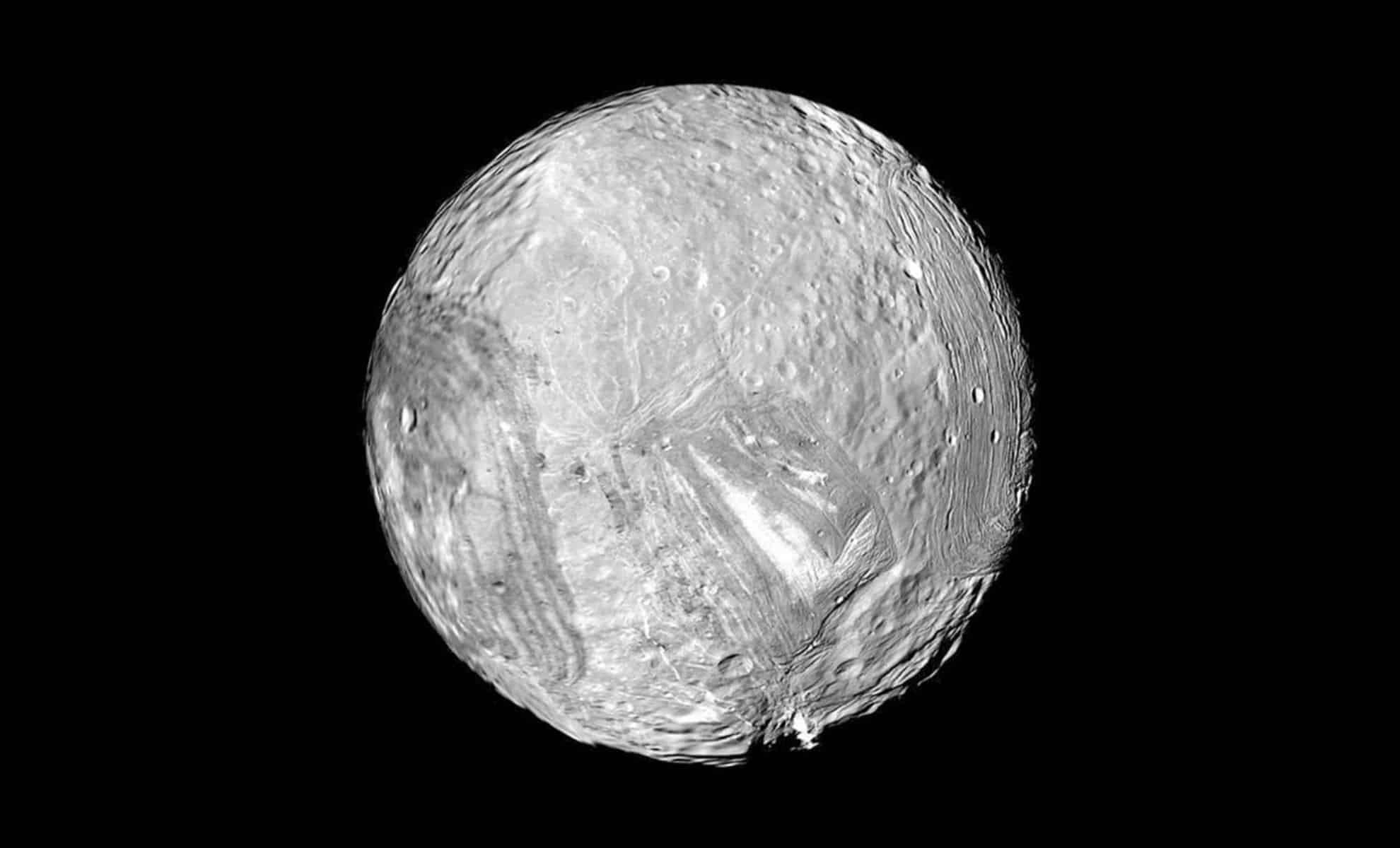
New research suggests that Miranda, a tiny moon orbiting Uranus, may conceal a vast ocean underneath its frozen exterior, potentially adding it to the growing list of celestial bodies with subsurface oceans.
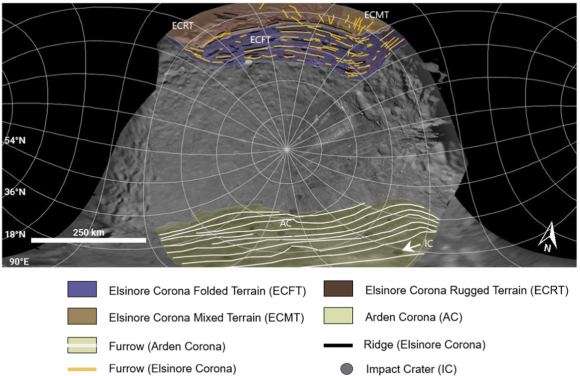
Scientists Caleb Strom from the University of North Dakota and Tom Nordheim of the Johns Hopkins Applied Physics Laboratory (APL) revisited the data obtained during the Voyager 2 spacecraft’s 1986 encounter, employing advanced modeling techniques to study Miranda’s striking surface characteristics, including its towering ridges and distinctive “coronae.” Their analysis indicates the possibility of a hidden ocean beneath the moon’s ice, potentially extending to depths of up to 62 miles (100 kilometers), which might have been preserved by historical tidal heating.
Revealing Signs of Geological Activity on Miranda
Previously thought to be a geologically inactive and frozen world due to its small size and great distance from the Sun, Miranda has now been revealed to possess evidence of tectonic activity that suggests internal dynamics. This analysis highlights the moon’s unusual topography, featuring ridges alongside trapezoidal coronae—large, unique geological structures unlike any other known in the solar system. As Tom Nordheim remarks, “To find evidence of an ocean inside a small object like Miranda is incredibly surprising.”

The team suggests that gravitational interactions with nearby moons, including Ariel and Umbriel, produced tidal forces generating internal heat through friction. These tidal effects, active during resonant orbital patterns, likely played a crucial role in shaping Miranda’s surface and maintaining its subsurface ocean. Although tidal heating is well documented on larger moons like Europa and Enceladus, it was unexpected for a moon as diminutive as Miranda. This discovery implies that Miranda may have undergone intermittent heating episodes sufficient to keep liquid water beneath its crust.
Miranda Joins the Family of Ocean Worlds
Miranda’s suspected internal ocean places it among an expanding group of ocean worlds, encompassing moons such as Europa, Enceladus, and possibly Mimas. Despite their cold outer solar system locales, these moons maintain oceans beneath frozen surfaces primarily due to tidal heating. Uncovering an ocean on Miranda broadens understanding of the diversity and distribution of subsurface oceans far from their parent stars.
Caleb Strom notes that this work could reshape perceptions of small icy moons: “If a moon as small as Miranda can sustain an ocean, it opens new possibilities for the range of environments that allow water to persist in these distant corners of the solar system.” This insight invites fresh inquiry into how these ocean-bearing worlds form, evolve, and potentially offer habitats for life—even on small, remote bodies.
The Path Ahead: Confirming Ocean Presence and Exploring Habitability
Although the findings are promising, Nordheim cautions that “Definitive proof of an ocean requires returning with new instruments and direct observations.” The current conclusions are drawn from Voyager 2 data and theoretical models, so future missions to Uranus, such as the proposed Uranus Orbiter and Probe mission recommended by the National Academies’ Decadal Survey, could verify Miranda’s ocean and further explore its characteristics.
Such missions would aim to detect subsurface liquid layers, assess ice shell thickness, and identify ongoing geophysical activity. Studying Miranda alongside other Uranian moons could help determine whether habitable conditions exist far from solar warmth, providing vital clues about potential life-supporting environments in the outer solar system.
Extending the Search for Life in the Outer Solar System
The discovery of a probable subsurface ocean on Miranda supports the notion that distant icy moons might offer suitable niches for life. These ocean worlds are among the best astrobiological prospects beyond Earth, and recognizing that even small moons can harbor liquid water challenges previous assumptions.
Confirming such oceans will motivate further research on Uranus’s moons, unlocking insights into their origins, evolution, and the range of conditions that can support life in the harsh environments of the outer solar system.
- Categories:
- Astronomy ,
- News ,
- Nasa







0 comments
Sign in to Comment