
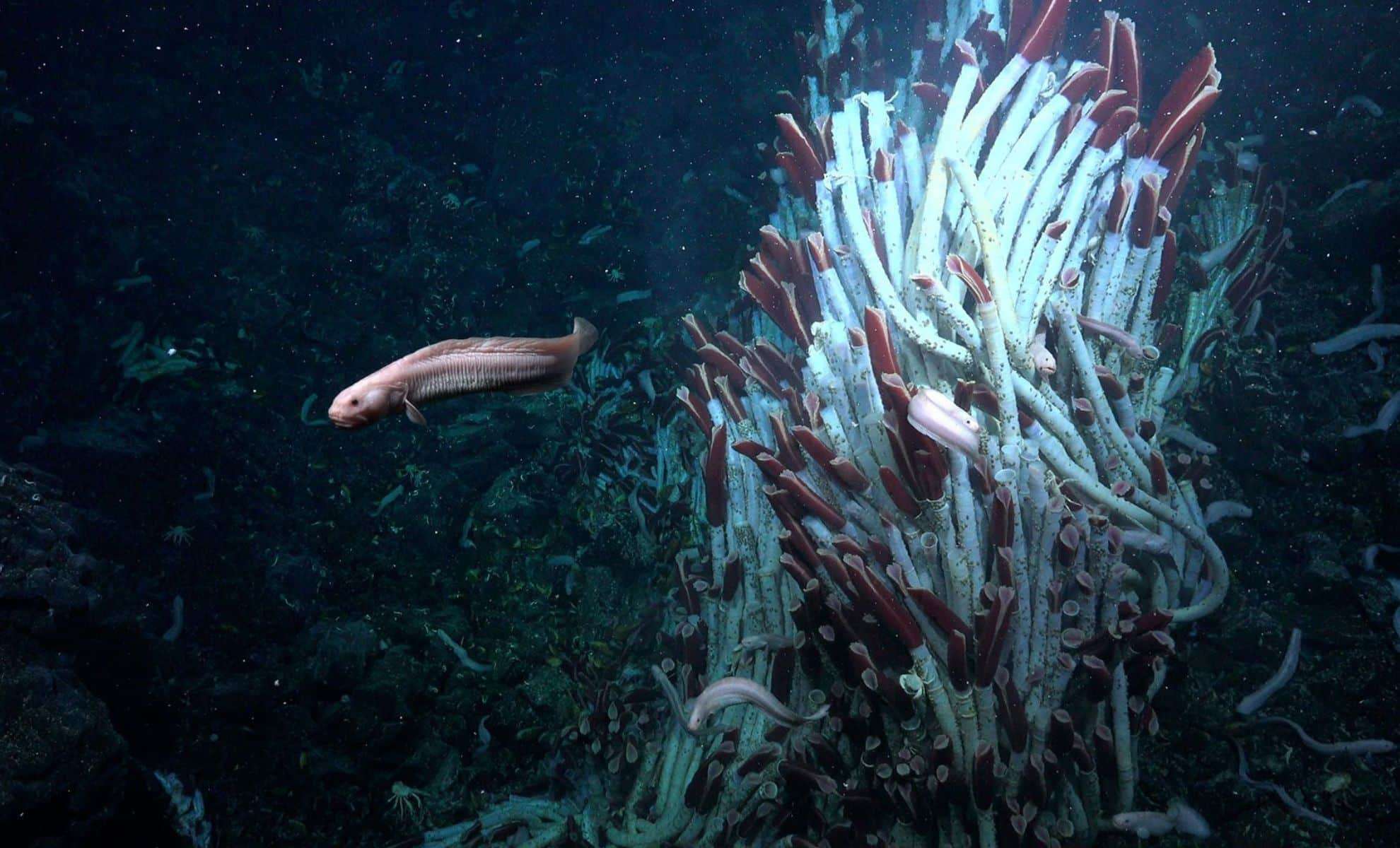
A groundbreaking deep-sea mission has identified a previously hidden ecosystem lying beneath the ocean's crust, where diverse animal communities, including massive tube worms, flourish in the intense conditions beneath hydrothermal vents. This finding by researchers exploring the East Pacific Rise demonstrates that life thrives not only at the ocean surface and seafloor but also inside subsurface volcanic caves, redefining marine ecosystem boundaries.
Exploring the Concealed World Under Hydrothermal Vents
During a 30-day voyage aboard the Schmidt Ocean Institute’s vessel “Falkor (too)”, the scientific team investigated the volcanic East Pacific Rise, a boundary where tectonic plates diverge to form deep hydrothermal vent systems. These vents sustain habitats without sunlight, relying on chemosynthetic bacteria to transform vent-emitted chemicals into energy. Although vent ecosystems have been studied extensively, the researchers discovered an extraordinary occurrence: not only do organisms thrive at the vent surfaces, but they also inhabit hidden volcanic cavities below the seafloor.
Utilizing the advanced remotely operated vehicle (ROV) SuBastian, the team drilled into the seafloor and carefully turned over pieces of volcanic crust. Beneath these rocks, they uncovered an elaborate network of warm fluid-filled chambers bustling with life, such as giant tube worms reaching lengths up to 1.6 feet (0.5 meters). Marine ecologist Dr. Monika Bright, who coauthored the study, described the experience as “spectacular,” adding, “there were animals, 50 centimeters long, lying in there—alive.”

These subsurface ecosystems exist at temperatures around 75 degrees Fahrenheit (24 degrees Celsius), significantly warmer than the surrounding cold ocean water. This remarkable discovery expands the known edges of life on Earth, indicating that the above- and below-seafloor communities are tightly linked, with organisms traversing fissures in the ocean crust to access different habitats.
Linking Seafloor and Subsurface Life Forms
The scientists found that the vent fluids, transporting heat and minerals from beneath the Earth’s crust, create conditions suitable for life above and below the seafloor. These fluids fuel chemosynthetic bacteria, which in turn sustain various species such as snails, mussels, and giant tube worms. Unlike typical ecosystems that depend on sunlight, these deep-sea systems harness chemical energy through a process called chemosynthesis.
Researchers propose that larvae of tube worms and other creatures follow warm vent fluids through cracks beneath the seafloor to colonize new areas. Dr. Sabine Gollner, a study coauthor, explained, “We hypothesized that tubeworm larvae can travel in cracks below the ground with the warm vent fluid to colonize the surface vents from below.” This insight suggests these subsurface habitats form part of a dynamic biological system exchanging life between the seafloor and deeper volcanic rock.
These findings overturn older beliefs that life beneath the ocean floor was confined to microbes and viruses, showing that larger, more complex organisms inhabit these volcanic caves—offering new perspectives on life’s resilience in extreme settings.
Implications for Exploration and Conservation of Deep-Sea Habitats
While this discovery opens exciting opportunities to study subsurface ocean biospheres, it also raises caution about potential consequences from deep-sea exploration and commercial mining operations. The scientists emphasize safeguarding these delicate ecosystems from disruption. Dr. Monika Bright stressed, “We need to protect what is living below the surface, as it is an important component of the ecosystem.”
The research, featured in Nature Communications, points to the likelihood that similar life-rich habitats exist under other hydrothermal vent systems globally. Future investigations aim to map the reach of these subsurface caves in both horizontal and vertical dimensions.
With only a small percentage of the ocean floor explored, this discovery highlights how much remains unknown about marine environments. Marine biologist Alex Rogers, not involved in the study, remarked that this breakthrough “adds to our understanding of vent ecosystems, how populations of vent organisms are maintained, and just how much life exists at these systems.”







0 comments
Sign in to Comment