

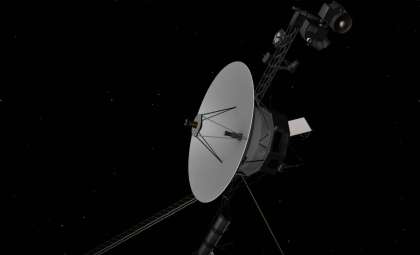
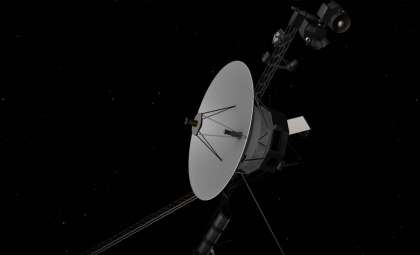
NASA has successfully reestablished communication with Voyager 1 after the spacecraft unexpectedly switched to its backup radio transmitter for the first time since 1981.
Now over 15 billion miles away from Earth, journeying through interstellar space, Voyager 1 triggered its fault protection mode, causing the primary X-band transmitter to power down and activating the secondary S-band transmitter, which had been inactive for more than 40 years.
NASA’s engineers at the Jet Propulsion Laboratory (JPL) faced a daunting challenge in reconnecting with Voyager 1, as the backup transmitter emits a much weaker signal that is difficult to detect across the immense distance.

Tracing the Signal Issue and Launching Recovery Efforts
On October 16, JPL operators sent a routine command to Voyager 1 to adjust a heater component designed to stabilize onboard systems. Unexpectedly, this command triggered fault protection mode, lowering data transmission and ultimately deactivating the main transmitter. By October 19, all contact was lost, leaving engineers unsure of the spacecraft’s condition. Further investigation revealed that Voyager 1’s onboard automation had switched to the long-unused low-power S-band transmitter.
Linda Spilker, Voyager’s deputy project scientist at JPL, detailed the recovery effort: “Tracking down a signal with a transmitter unused for decades was unprecedented. We weren’t certain the S-band system would even respond.” Leveraging NASA’s Deep Space Network (DSN), a worldwide array of antennas, the team embarked on a meticulous search and eventually detected the faint S-band signal, an achievement that boosted team morale.
Operating on the Backup Transmitter While Assessing Risks
Following the successful signal acquisition, JPL decided to keep Voyager 1 communicating via the S-band transmitter temporarily to avoid further hazards. Because the original trigger of the fault protection remains a mystery, switching back to the X-band transmitter poses a risk. NASA confirmed, “We will not attempt to return to the primary transmitter until we are confident it is safe.”
The transmission rate through the backup S-band is significantly slower than the primary system, reducing the quantity and detail of scientific data returned. Nonetheless, the JPL Voyager team views this interim solution as essential to maintaining the operation and continuing the spacecraft’s valuable interstellar research.
The Enduring Legacy of Voyager 1’s Interstellar Exploration
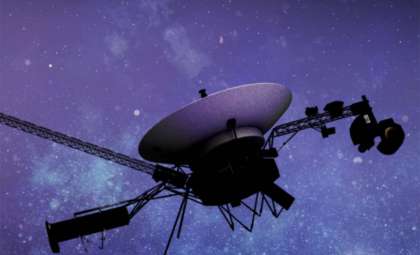
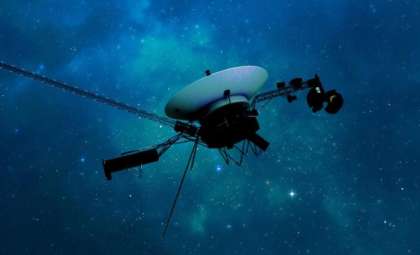
Launched in 1977 alongside its companion Voyager 2, Voyager 1 stands as the only human-made object to have entered interstellar space, providing crucial data about cosmic radiation, magnetic fields, and particles beyond our solar system’s boundary. Surpassing original mission expectations, Voyager 1 continues to offer unparalleled insights into distant cosmic environments.
The spacecraft’s sustained functionality reflects its resilient engineering and the dedication of the NASA team. As Spilker emphasized, “These probes were designed for a few years of operation, and now, nearly five decades later, we are still receiving priceless data.” Their ability to adapt to aging hardware and limited power highlights the ingenuity behind Voyager’s continued success.
Ongoing Obstacles for Sustaining Voyager 1
As Voyager 1 ventures deeper into interstellar space, maintaining contact becomes increasingly difficult due to dwindling power supplies, aging hardware, and the enormous distance exceeding 15 billion miles. NASA has already deactivated some non-critical instruments to conserve energy and expects to continue such measures to prolong the mission’s duration.
This recent event illustrates the technical creativity needed to sustain the Voyager mission. The JPL team’s quick adaptation to rely on the backup S-band transmitter highlights the durability of the Voyager program and NASA’s problem-solving expertise. Spilker remarked, “Every data packet Voyager 1 transmits represents a historical window into a previously unexplored region of space.”








0 comments
Sign in to Comment