
Researchers from Microsoft, in collaboration with academic institutions, have published a comprehensive study in the journal arXiv, providing an in-depth assessment of how generative AI technologies are transforming the job market. Rather than relying on broad predictions, the team examined real-world usage of AI assistants—particularly Bing Copilot, Microsoft’s AI-driven search platform—to identify how specific professions engage with or resist automation.
The outcome is a detailed ranking of 40 occupations with the highest susceptibility to generative AI tools alongside 40 roles that remain largely unaffected for the time being.
AI Targets Job Functions, Not Entire Occupations
The report introduces the concept of an “AI applicability score”, which quantifies how frequently users of Bing Copilot request assistance with particular job-related activities. This approach shifts the focus from job titles to the actual tasks people aim to automate. This distinction is crucial: automation impacts tasks unevenly within jobs.

Professions with higher AI exposure cluster primarily in knowledge-intensive sectors. Included are mathematicians, software developers, language translators, technical documentation specialists, legal aides, and financial accountants. These roles share a dependence on structured information, data research, and written content creation—domains where advanced language models like GPT-4 and Bing Copilot excel.
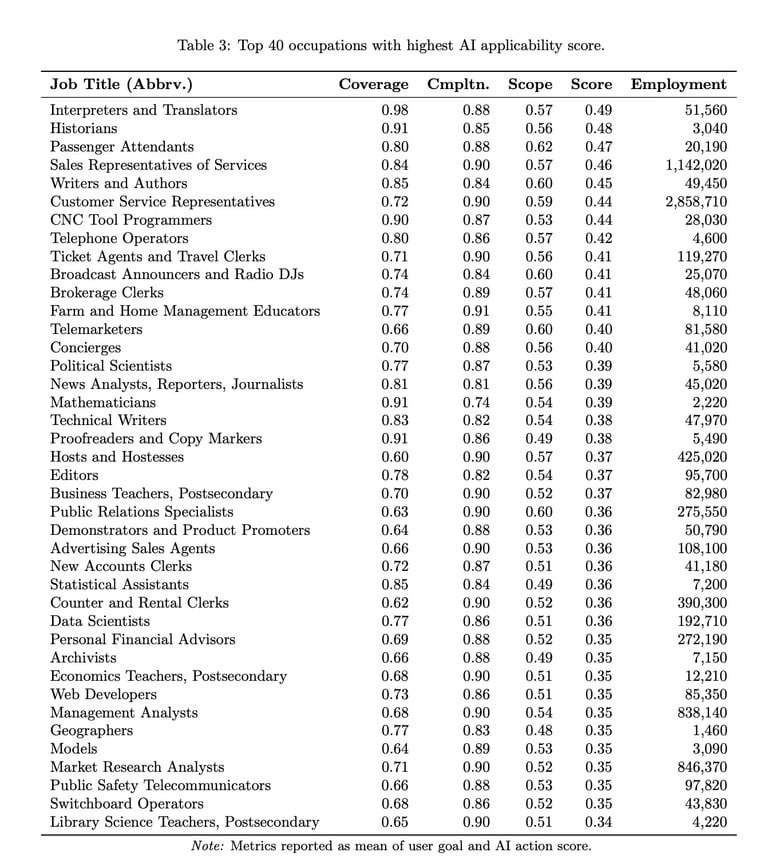
The study highlights AI’s role primarily as an assistant: editing emails, summarizing reports, debugging programming code, or crafting detailed explanations. Its purpose is to enhance human performance rather than fully replace workers—at least according to design.
Nevertheless, current industry trends show a different reality. Since 2023, Microsoft and other major technology firms have reduced staff in fields such as customer support, content moderation, and editorial roles—all identified as high AI applicability jobs. The authors acknowledge the complexities in forecasting AI’s economic ripple effects, describing them as "hard to predict and often counterintuitive."
40 Occupations Least Influenced by AI for the Time Being
On the flip side, the research points to 40 professions with minimal exposure to current AI systems. Most of these are hands-on roles demanding physical presence in dynamic, unpredictable settings. Examples include dishwashers, motorboat operators, stone carvers, gas station attendants, and embalmers.
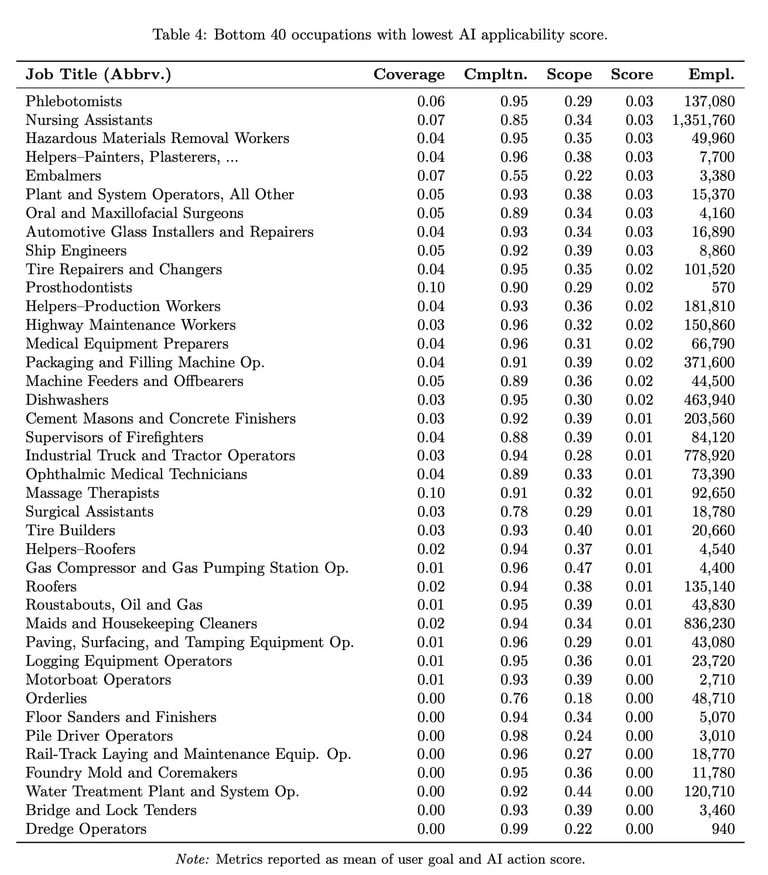
These professions remain less affected not due to inherent technological immunity but because current AI systems lack the capacity to operate in real-world physical environments. Whereas language models excel at processing and generating information, they cannot manage elements like grease, noise, temperature, motion, or delicate manual dexterity.
Automation in these fields demands significant breakthroughs in robotics, computer vision, and spatial reasoning. Progress in these domains is ongoing but remains far behind advancements in language-based AI. The authors caution that "absence of exposure today doesn't guarantee resistance tomorrow."
Variations in AI Vulnerability Among Desk Jobs
Even within office-based work, some roles are more susceptible to AI than others. The study finds that routine, repetitive cognitive tasks are particularly vulnerable. These include activities such as form-filling, report generation, data organizing, and standardizing communications—tasks that don’t require extensive subject matter expertise or emotional intelligence.
Conversely, positions necessitating advanced decision-making, empathic interaction, or innovative problem-solving—such as senior executives, therapists, or mediators—remain less impacted for now.
Crucially, the analysis points out that AI exposure does not automatically equate to job displacement. Often, it leads to "task reconfiguration," where employees delegate routine components to AI and concentrate on higher-value responsibilities. However, this positive transition depends heavily on organizational commitment to retraining staff, which is not guaranteed.
Shifting Perspectives: AI as a Workforce Ally Instead of a Threat
This Microsoft report reframes discussions on AI's workplace impact by supplying empirical data about how generative AI is currently utilized. It steers clear of sensational forecasts, emphasizing instead a spectrum of impact—some professions are already evolving, others adjusting gradually, and many hardly touched yet.
The paper also underscores that AI’s influence is dynamic. As AI models become more sophisticated and integrate with robotic systems, sensor technologies, and multimodal data, the distinction between cognitive and physical labor is expected to become less clear.
At present, screen-based jobs are the most vulnerable to change. Over time, however, all professions will need to consider how generative AI could redefine their workflows, as the line between augmentation and substitution continues to fade.
- Categories:
- News













0 comments
Sign in to Comment