

The Perseverance rover from NASA has recently photographed a uniquely patterned rock on Mars, sparking curiosity among researchers about the planet’s geological past.
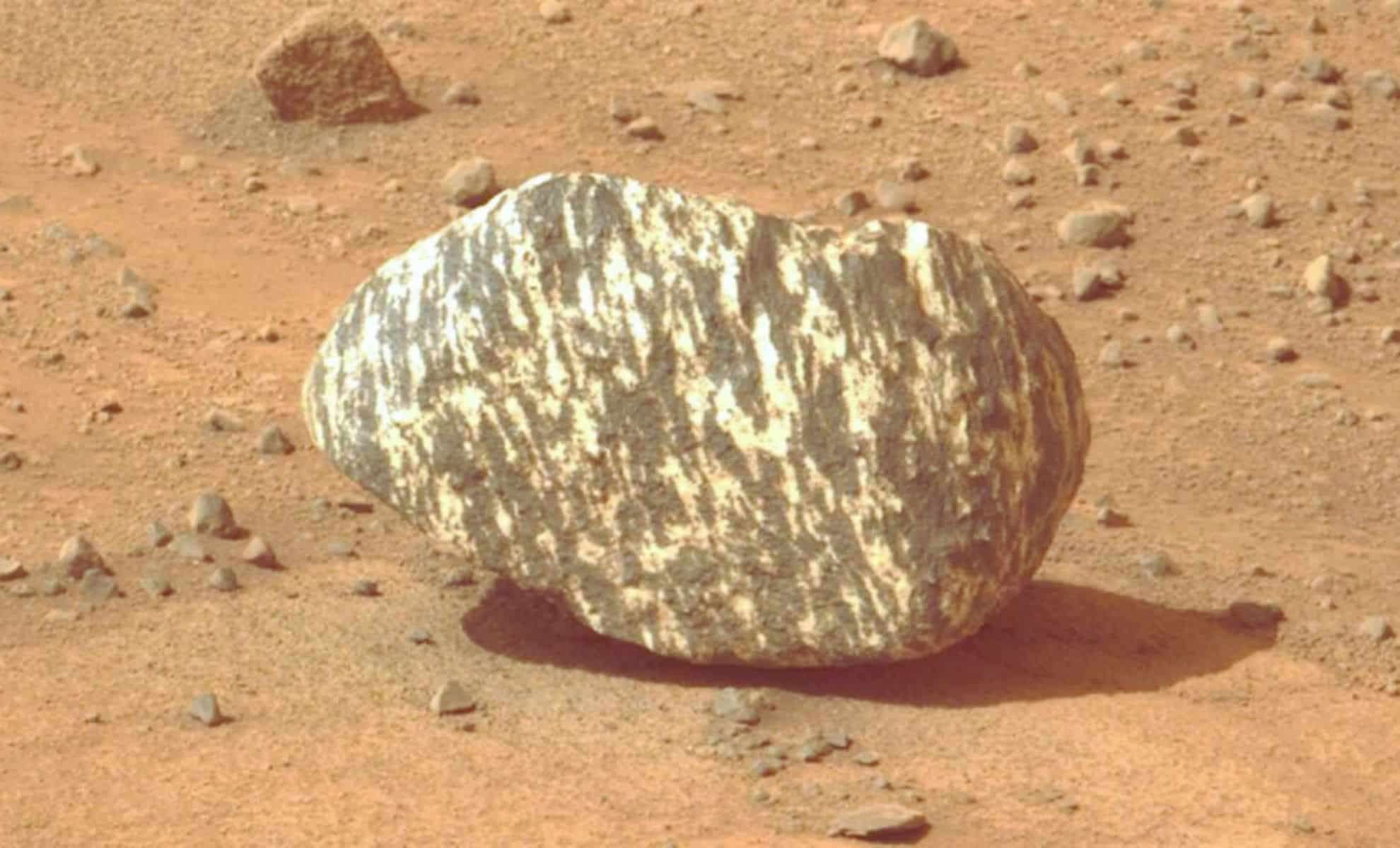
This striking black-and-white striped stone, named ‘Freya Castle’, was identified in September 2024 while the rover was navigating Jezero crater, according to Live Science, referencing official NASA updates.
Distinctive Features of the Martian Striped Rock
Known informally as Freya Castle, this rock stands out due to its vivid alternating stripes, earning the nickname ‘zebra rock’. Unlike the usual reddish Martian terrain stones, it exhibits clear contrasting bands of dark and light shades, hinting at a complicated origin.
Its size is roughly 8 inches (20 centimeters) wide, and it visually differs from neighboring bedrock. Preliminary evaluations by NASA indicate that this pattern may be the outcome of igneous or metamorphic activity, suggesting intense geological processes such as magma cooling slowly or pressure-driven changes deep underground.
Insights From Jezero Crater
Freya Castle was found during Perseverance’s Crater Rim Campaign, the fifth science mission aimed at exploring the upper parts of Jezero crater, a site thought to have once contained a lake.
Although the rover had moved beyond the area when the images were reviewed, this unusual rock has renewed interest in this region. Researchers are now eager to discover more examples upslope, which could allow for on-site examination of similar materials.

Should additional deposits be located, it would imply that the zebra rock is not an isolated find but part of a widely spread geological feature that dates back billions of years.
Possibility of Rock Displacement From Upper Regions
NASA’s observations suggest that Freya Castle might have traveled downward from higher terrain, potentially as a result of seismic disturbances or gradual erosion.
Its solitary location and unique mineral composition support the idea that it originated from a different geological unit. Understanding these movements could offer valuable clues about the erosion and tectonic forces that have shaped Jezero crater’s landscape, contributing to our broader comprehension of Mars’ geological and climatic history.
Continuing Discoveries from Perseverance’s Exploration
The zebra rock adds to a list of remarkable features identified by Perseverance, which has also recorded leopard-like spotted rocks, pale boulders, and sedimentary layers potentially containing ancient microbial fossils. These findings support the rover’s mission to uncover signs of past life and record Mars’ environmental evolution.
As the rover ascends the crater rim, NASA aims to locate more rock varieties akin to Freya Castle that might reveal preserved biosignatures or mineral evidence of historic water activity on Mars. Perseverance remains fully operational while investigating one of the Red Planet’s most promising geological zones.
Researchers are hopeful that the higher areas of Jezero crater will provide a more detailed understanding of Mars’ dynamic, possibly habitable history. With discoveries like this intriguing zebra rock, the quest to determine whether Mars once harbored microbial life continues to gain momentum.
- Categories:
- Space










0 comments
Sign in to Comment