
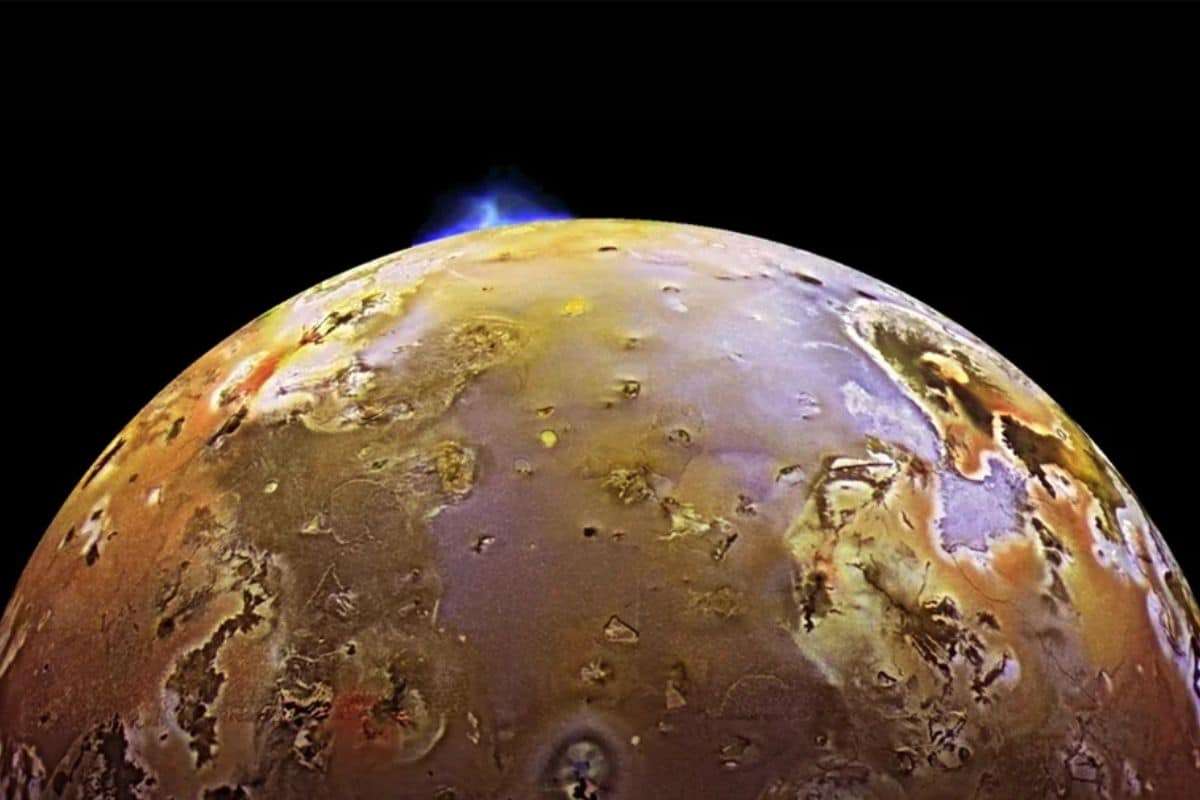
The Juno spacecraft, operated by NASA, has recorded what experts are calling the most powerful volcanic eruption ever documented on Io, Jupiter’s famously volcanic satellite. During a recent close approach, Juno detected a huge thermal hotspot near Io’s southern pole, with an eruption intensity surpassing any volcanic event found on Earth.
Juno’s Mission Expands Beyond Jupiter’s Atmosphere
Initially launched to explore Jupiter’s atmosphere, magnetosphere, and inner layers, Juno has greatly outperformed its original objectives since entering orbit in 2016. Its extended mission now includes close investigations of three of Jupiter’s largest moons – Ganymede, Europa, and Io – enabling detailed studies of these fascinating celestial bodies.
Io stands out as the innermost of the four Galilean moons and hosts more than 400 active volcanoes, making it the most volcanically dynamic object within our Solar System.

Yet even for a moon known for extraordinary eruptions, the newly detected hotspot captured by Juno’s infrared instrument (JIRAM) surprised researchers with its unprecedented scale and power.
Volcanic Activity Larger Than Earth’s Largest Lake
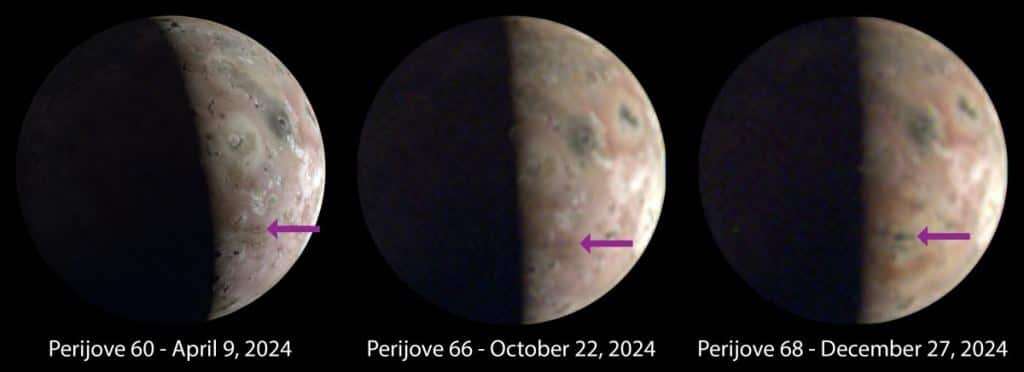
During a flyby on December 27, 2024, Juno’s JIRAM sensor identified a volcanic hotspot in Io’s southern hemisphere that exceeds the size of Lake Superior, Earth’s largest freshwater lake. This eruption unleashed energy exceeding 80 trillion watts, establishing it as the most intense volcanic event ever documented on Io.
Alessandro Mura, a Juno co-investigator from Italy’s National Institute for Astrophysics, described the finding as “a massive hot spot – in Io’s southern hemisphere so strong that it saturated our detector.”
Scientists suggest this immense eruption stems from an extensive magma reservoir beneath the surface, likely linked to several volcanic chambers.
Driving Forces Behind Io’s Powerful Volcanism
Unlike Earth, where plate tectonics dominate volcanic activity, Io’s eruptions are governed by tidal heating. Io’s orbit around Jupiter is elliptical, causing the moon to be repeatedly stretched and compressed by Jupiter’s gravitational pull. This constant flexing generates enormous friction inside Io’s interior, melting rock and fueling persistent volcanic activity.
The gravitational interactions with neighboring moons, Europa and Ganymede, amplify this effect, intensifying Io’s internal heat. This results in landscapes marked by molten lava lakes, eruptive plumes, and evolving surface features.
Revealing a New Chapter in Io’s Volcanic Landscape
This giant volcanic hotspot dwarfs Loki Patera, a famous volcanic lava lake on Io spanning approximately 126 miles (202 km) across and studied since the 1970s. The newly discovered site covers an estimated 40,000 square miles (100,000 sq km), making it the largest active volcanic region recorded on Io.
Previous observations of Io’s eruptions came from Earth-based telescopes and spacecraft, but Juno’s close-range infrared imaging offers unprecedented detail on how these eruptions actively transform the moon’s surface in real time.
Looking Ahead: Juno’s Future Encounters with Io
Juno is scheduled for another flyby of Io on March 3, 2025, which will help researchers monitor changes on the moon’s surface over time. Given the eruption’s magnitude, scientists anticipate lasting layers of volcanic ash, lava deposits, and sulfur-rich materials spreading across Io.
Studying Io’s volcanism sheds light on how tidal heating can drive geological activity on other worlds. This process may be vital in understanding the geology of exoplanets orbiting gas giants and icy moons like Europa or Enceladus, which may harbor hidden subsurface oceans.
As Juno continues to orbit Jupiter, the mission aims to unravel more about Io’s volcanic history, magma flows below its crust, and interactions with Jupiter’s magnetosphere. Each close pass reveals new surprises, solidifying Io’s role as one of the most extreme and constantly evolving destinations in the Solar System.
With this record-breaking volcanic hotspot, Io once again highlights the astonishing dynamics of planetary science and reminds us of the many mysteries the Solar System still holds.
- Categories:
- Space







0 comments
Sign in to Comment