

Suspended high above Antarctica's vast ice expanse, a NASA balloon has intercepted radio signals that defy current astrophysical comprehension. These unusual emissions, originating deep within the frozen continent, challenge established scientific frameworks. First spotted nearly ten years ago, the curious signal has reappeared with enhanced data, sparking renewed investigation as detailed in a recent Physical Review Letters publication.
Listening From Above: Balloon-Borne Detectors Seeking Cosmic Neutrinos
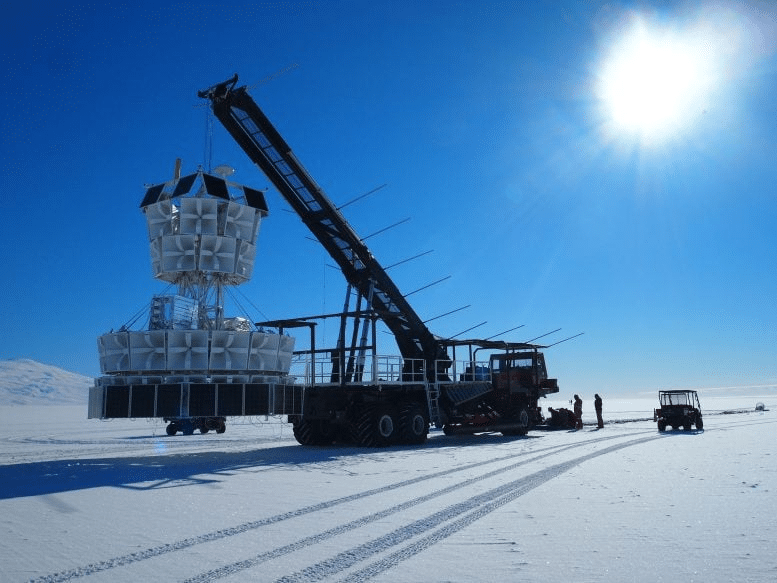
For several years, researchers have deployed radio antenna arrays attached to high-altitude balloons above Antarctica, aiming to catch fleeting cosmic messages. This setup is part of the Antarctic Impulsive Transient Antenna (ANITA) initiative, focused on identifying rare neutrinos—nearly massless particles notorious for passing through matter almost undisturbed.
“The radio waves that we detected nearly a decade ago were at really steep angles, like 30 degrees below the surface of the ice,” said Stephanie Wissel, associate professor of physics, astronomy, and astrophysics who worked on the ANITA team. “While the origin of these events is still unclear, our new study indicates that such events have not been seen by an experiment with a long exposure like the Pierre Auger Observatory. So, it does not indicate that there is new physics, but rather more information to add to the story.”
Add Cosmo Herald as a Preferred Source

The recent study, published in Physical Review Letters, revisits these phenomena with updated analytical methods and comparative datasets. Evidence now suggests that the strange radio signals likely aren’t caused by neutrinos but could instead stem from novel radio wave behaviors or previously unknown natural activities within the Antarctic ice.
Neutrinos: The Universe’s Stealthy Cosmic Couriers
Neutrinos stand among the most elusive particles in the cosmos. Each second, countless numbers pass through every person unnoticed, scarcely interacting with matter.
“You have a billion neutrinos passing through your thumbnail at any moment, but neutrinos don’t really interact,” Wissel explained. “So, this is the double-edged sword problem. If we detect them, it means they have traveled all this way without interacting with anything else. We could be detecting a neutrino coming from the edge of the observable universe.”
Scientists view neutrinos as messengers from energetic cosmic events. Capturing these particles allows astrophysicists to study phenomena like supernova explosions, black hole mergers, and potentially new physics beyond current models. However, because neutrinos evade detection so easily, experiments require enormous detectors and extended observation periods.
That's why significant efforts are invested in radio-based neutrino observatories, which use Antarctic ice as a medium to amplify faint signals from neutrino interactions.
“We use radio detectors to try to build really, really large neutrino telescopes so that we can go after a pretty low expected event rate,” Wissel said.
Her research in Antarctica and South America pushes detection to new limits, striving to catch these ghost-like cosmic particles.
NASA’s Balloons: Turning Earth's Upper Atmosphere into a Cosmic Observatory
Lofted roughly 40 kilometers over the ice, the NASA balloon payload carries multiple antennas pointed downward, effectively crafting an unprecedented observational platform in the stratosphere.
“We have these radio antennas on a balloon that flies 40 kilometers above the ice in Antarctica,” Wissel said. “We point our antennas down at the ice and look for neutrinos that interact in the ice, producing radio emissions that we can then sense on our detectors.”
These missions last for several weeks, during which massive amounts of data are recorded and combed for brief radio bursts signaling potential neutrino impacts. Despite thorough examination, some detected signals remain enigmatic. “It’s an interesting problem because we still don’t actually have an explanation for what those anomalies are, but what we do know is that they’re most likely not representing neutrinos,” Wissel noted.
The Antarctic Ice Enigma: Unraveling Unexplained Radio Signals
“My guess is that some interesting radio propagation effect occurs near ice and also near the horizon that I don’t fully understand,” Wissel admitted. “But we certainly explored several of those, and we haven’t been able to find any of those yet either.”
Her remarks highlight how Antarctica remains a frontier for discovery, revealing surprises beyond current scientific models. The upcoming mission, PUEO, is set to offer enhanced sensitivity, potentially unlocking these mysteries. “So, right now, it’s one of these long-standing mysteries, and I’m excited that when we fly PUEO, we’ll have better sensitivity,” Wissel said. “In principle, we should be able to better understand these anomalies which will go a long way to understanding our backgrounds and ultimately detecting neutrinos in the future.”
- Categories:
- Science













0 comments
Sign in to Comment