
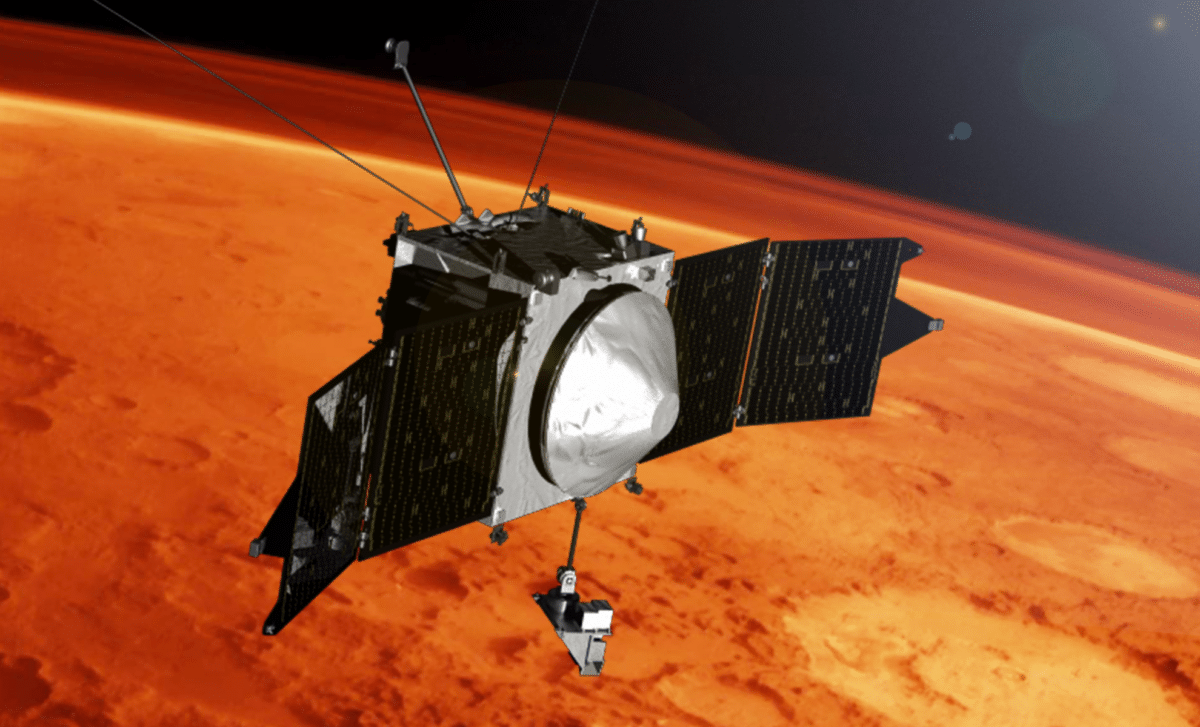
NASA’s MAVEN (Mars Atmosphere and Volatile Evolution) mission has served as a vital asset in understanding Mars for more than ten years. Recently, the spacecraft entered an unexpected communication blackout lasting over a month, placing its current status in doubt.
As recovery efforts intensify, NASA is navigating the complexities of reengaging with MAVEN following its silence beginning in December 2025. Now that the solar conjunction phase has concluded, renewed communication attempts are underway, though mission experts remain cautious about the prospects.
MAVEN’s Communication Gap Extends Beyond a Month
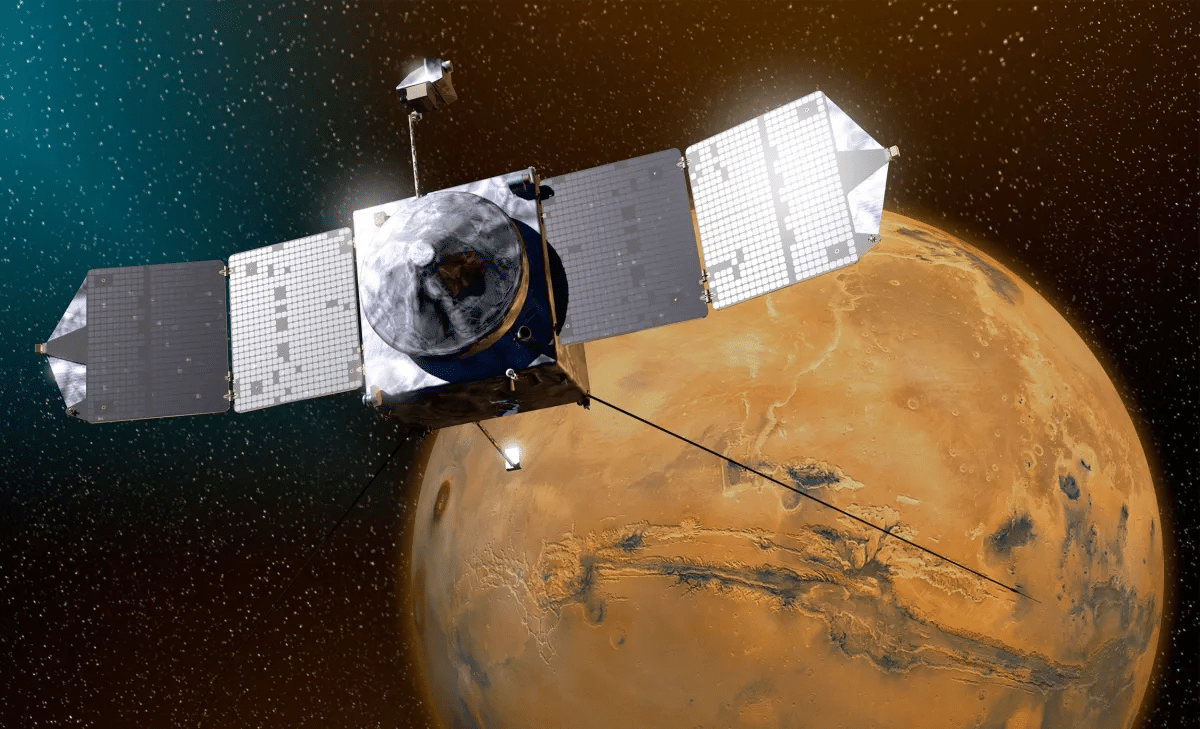
MAVEN, orbiting Mars since 2014, has delivered essential atmospheric data and functioned as a communication hub for rovers such as Curiosity and Perseverance. Contact was lost suddenly on December 6, 2025, after the spacecraft passed behind Mars—a predictable event causing a communication blackout. However, unlike previous occasions, NASA’s Deep Space Network was unable to reestablish signals once MAVEN reappeared, casting uncertainty over the mission's status.

“NASA will not have contact with any Mars missions until Friday, Jan. 16,” the agency said in a Dec. 23 statement.
While the root cause remains undetermined, one theory suggests that MAVEN may have entered an irregular spin state following its orbit behind Mars. This unexpected rotation could have altered the spacecraft's trajectory, complicating efforts to regain control. Numerous attempts to reestablish contact have so far been unsuccessful, prompting concern from NASA's team.
Solar Conjunction: A Barrier in Communication Recovery
The solar conjunction, an event occurring approximately every two years where the sun positions directly between Earth and Mars, adds an additional challenge. During this interval, charged solar particles disrupt radio transmissions, forcing NASA to suspend communication with Mars missions temporarily.
This communication blackout prevents corrupted transmissions that might endanger spacecraft safety.
“We will start looking again, but at this point it’s looking very unlikely that we are going to be able to recover the spacecraft,” said Louise Prockter, the director of NASA’s planetary science division, on January 13, according to Space News.
Prockter’s remarks reveal increasing doubts regarding MAVEN’s revival. Although the conclusion of solar conjunction offered hope for renewed contact, the prolonged silence has diminished expectations that MAVEN will resume normal function.
Hardware Limitations Hamper Restart Possibilities
An added hurdle is MAVEN’s aging onboard systems. The spacecraft has faced technical setbacks, including issues with its inertial measurement units (IMUs) crucial for navigation. In 2022, these problems sent MAVEN into “safe mode” for about three months, compelling reliance on a backup system that experiences faster degradation. In response, engineers expedited the development of an alternative navigation mode using star positions, reducing dependence on the compromised IMUs.
Despite these innovations, the spacecraft’s aging hardware remains a limiting factor. Past failures caused MAVEN to miss important solar flare events and disrupted its relay role for other Mars missions. Though MAVEN retains sufficient fuel to continue orbiting through at least 2030, its operational capacity may be constrained, further complicating efforts to restore full service.
Consequences of MAVEN’s Silence for Mars Science
The loss of MAVEN’s continuous operation significantly impacts Mars exploration. As a key communication link for rover missions like Curiosity and Perseverance, its outage has forced NASA to depend more heavily on other orbiters such as Mars Reconnaissance Orbiter and Mars Odyssey. This reallocation increases demand on these remaining assets to support surface science.
MAVEN’s scientific legacy is profound, having enhanced understanding of Mars’ atmospheric evolution, including the processes behind its atmosphere's thinning and transformation into a frigid, arid world. Data from MAVEN on weather patterns, dust storms, and auroras have illuminated the planet’s climate and habitability prospects. Without MAVEN, critical knowledge gaps in Martian atmospheric studies may widen.
- Categories:
- Space





0 comments
Sign in to Comment