

NASA’s OSIRIS-APEX spacecraft, tasked with investigating the asteroid Apophis, has avoided cancellation but faces an uncertain outlook. Following budget cut threats that nearly halted progress, the mission was granted a crucial $20 million funding boost in the latest budget agreement. However, this funding only covers a limited timeframe, leaving the mission’s continuation in question. As OSIRIS-APEX nears its highly anticipated 2029 encounter with this near-Earth asteroid, significant obstacles and financial instability lie ahead.
OSIRIS-APEX Confronts an Uncertain Path Forward
Initially destined to explore the Apophis asteroid, OSIRIS-APEX has experienced a rocky journey, with its future hanging by a thread until recently. Earlier this year, the Trump administration proposed cutting 19 NASA missions, including OSIRIS-APEX, as part of budget reductions. Fortunately, a last-minute $20 million allocation has kept the mission alive for the upcoming fiscal year, according to Ars Technica. This patchwork funding reflects ongoing funding battles within NASA, as numerous missions face precarious futures amid political uncertainty in Washington, D.C.
“We were called for cancellation as part of the president’s budget request, and we were reinstated and given a plan to move ahead in FY26 (Fiscal Year 2026) just two weeks ago,” said Dani DellaGiustina, principal investigator for OSIRIS-APEX at the University of Arizona. “Our spacecraft appears happy and healthy.”
Add Cosmo Herald as a Preferred Source

Despite this temporary approval, continual reliance on annual budget approvals leaves the OSIRIS-APEX team in ongoing uncertainty about the mission’s continuation beyond next year.
Countdown to Apophis: A Close Approach to Earth
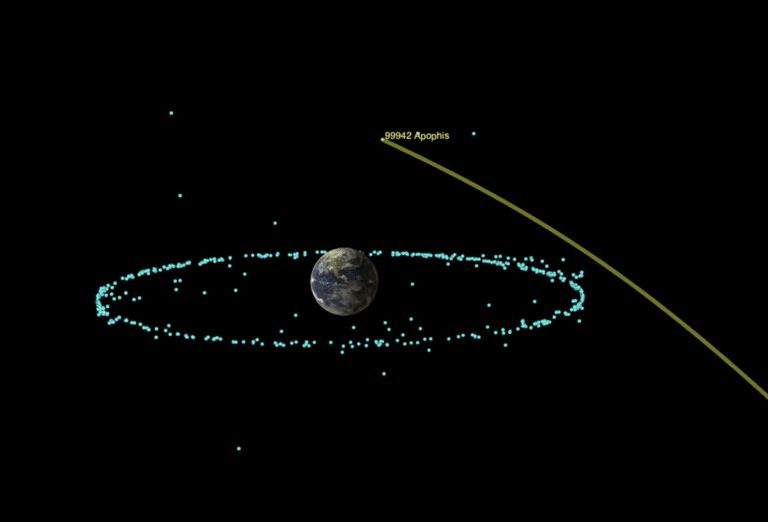
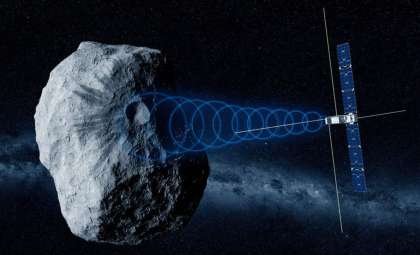
Nicknamed the “God of Chaos” asteroid, Apophis is set for a remarkable flyby of Earth in 2029. Measuring over a quarter-mile wide, this asteroid once sparked concerns about a potential collision, but updated tracking data now confirms it will pass safely. Still, its trajectory will bring it closer than geostationary satellites orbiting our planet, making it observable without instruments and presenting a rare chance for in-depth study. OSIRIS-APEX is poised to analyze Apophis during this critical encounter, providing insights into the dynamics of near-Earth objects during close approaches.
“We are not anticipating we will have to cut any science at Apophis,” DellaGiustina said. “But the cuts do affect things like recalibrating the science instruments on the spacecraft, which got dirty and dusty from the mission’s brief landing to capture samples from asteroid Bennu in 2020.”
Postponing essential maintenance might hinder the quality of scientific observations when the spacecraft surveys Apophis. Nonetheless, DellaGiustina remains hopeful:
“We’re happy to be reinstated, so it’s about as good as can be expected, I think, for this particular point in time.”
OSIRIS-APEX’s Vital Role: Unlocking Asteroid Mysteries
The mission’s significance extends well beyond Apophis’s trajectory. By studying this asteroid’s close encounter with Earth, scientists hope to observe surface, rotational, and orbital shifts caused by gravitational interactions. These insights could enhance our knowledge of small body behavior in space and inform planetary defense strategies. Dani DellaGiustina’s team is particularly interested in how such encounters might trigger seismic events or surface changes like landslides on the asteroid.
Additionally, OSIRIS-APEX aims to investigate Apophis’s composition and its historical journey through the solar system. Filling these knowledge gaps could prove essential as humanity advances its capabilities to monitor and potentially mitigate threats from near-Earth objects.
- Categories:
- News








0 comments
Sign in to Comment