
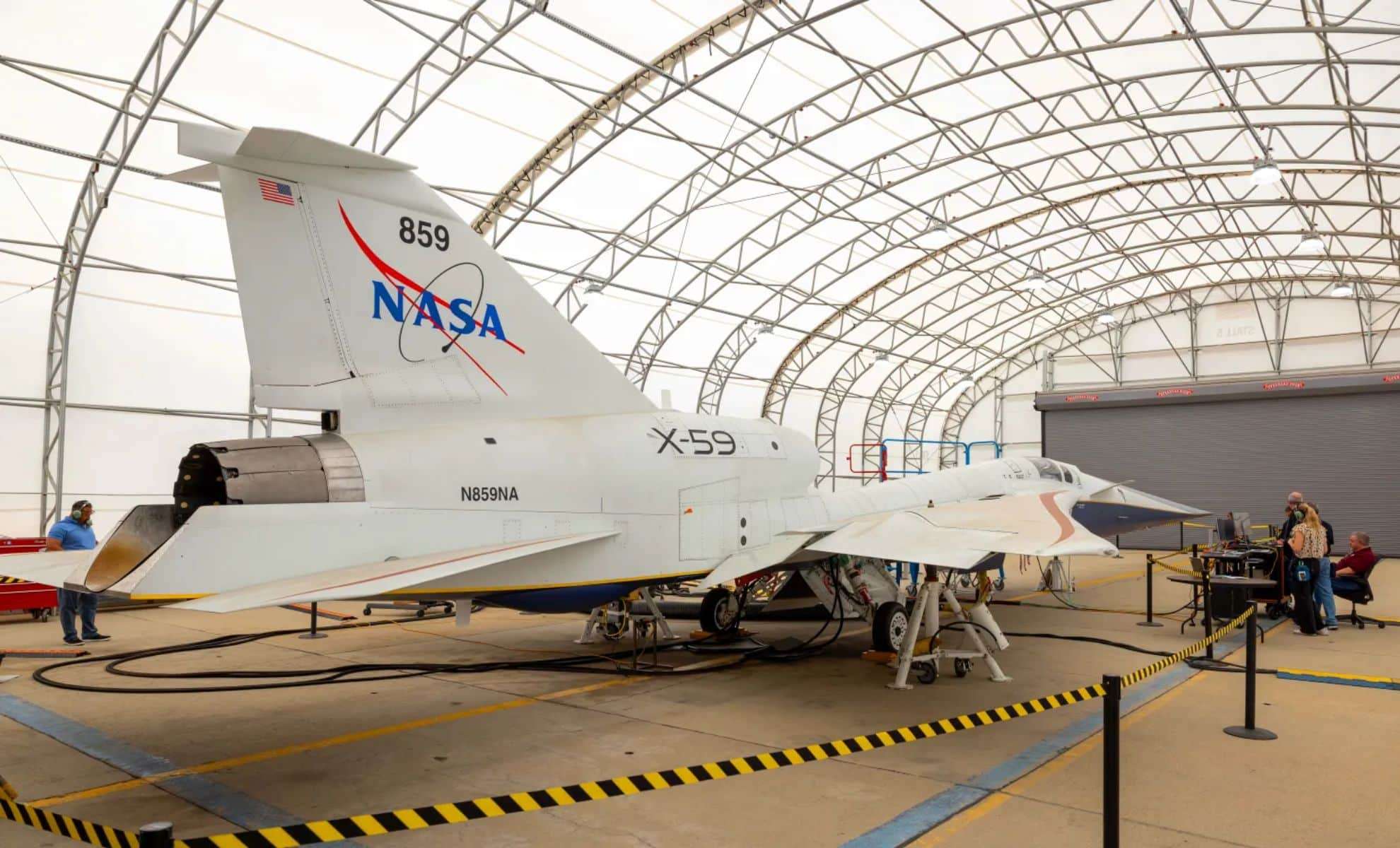
NASA’s cutting-edge X-59 Quiet Supersonic Technology aircraft has recently completed a series of sophisticated ground-based tests that imitate real flight scenarios while remaining stationary. These evaluations took place at Lockheed Martin’s Skunk Works in Palmdale, California, as part of NASA's Low-Boom Flight Demonstrator initiative. Updates and results from these tests have been shared by NASA.
Ground-Based Flight Simulation: The Aluminum Bird Approach
During the so-called “aluminum bird” testing phase, the X-59 was subjected to demanding assessments that activated the aircraft’s onboard flight computers and subsystems to behave as though it were airborne. While the engine remained off, control surfaces reacted dynamically to simulated commands, including varying altitude, speed, and temperature conditions.
NASA’s Armstrong Flight Research Center avionics lead Yohan Lin described the process: “the objective was to have the airplane’s systems operate as if in flight.”

Engineers intentionally introduced faults to test the system’s ability to manage failures and ensure pilot control and recovery mechanisms functioned properly. Lin noted, “We anticipated uncovering some issues that required software tweaks, which is precisely what we found. These tests were invaluable.”
Traditionally known as “iron bird” testing, these evaluations are typically performed on stationary structures hosting the subsystems. However, because the X-59 is a singular prototype, conducting these tests directly on the aircraft itself lowered expenses and delivered more precise data on system integration.

Silent Supersonic Flight: The Technology Inside the X-59
The aircraft features advanced innovations designed to soften the sonic booms common to supersonic jets. Lockheed Martin’s Skunk Works crafted the X-59 with a distinctive elongated, slender fuselage and forward canards that reshape shock waves produced as it crosses the sound barrier.
The X-59 boasts a length of 100 feet (30.4 meters) and a wingspan of 29.5 feet (9 meters). Its cockpit combines components from a T-38 “Falon” trainer jet, and its landing gear originates from the F-16 “Falcon.” Powered by a General Electric F-414 engine, the aircraft cruises at Mach 1.42 (940 mph or 1,510 km/h) and can peak at Mach 1.5 (990 mph or 1,590 km/h) at approximately 55,000 feet (16,800 meters) altitude.
The primary goal is to achieve supersonic speeds without generating disruptive sonic booms, producing instead a faint noise or none at all to those on the ground.
Advancing Supersonic Travel Over Populated Areas
Completing ground-based system tests is a crucial milestone that sets the stage for upcoming flight trials, which will confirm the X-59’s low-noise sonic capabilities. Successful simulation results ensure that the plane’s avionics and flight controls are well-prepared for real flight conditions.
As flight testing proceeds, NASA will collect and analyze data to share with regulators like the Federal Aviation Administration (FAA), with the goal of revising noise restrictions that currently limit supersonic flights over land.
Should the X-59 fulfill its promise, it could transform commercial air travel by permitting supersonic speeds without disturbing communities below. NASA actively chronicles the progress of the X-59’s ongoing development through detailed reports and public communication.
- Categories:
- Space












0 comments
Sign in to Comment