
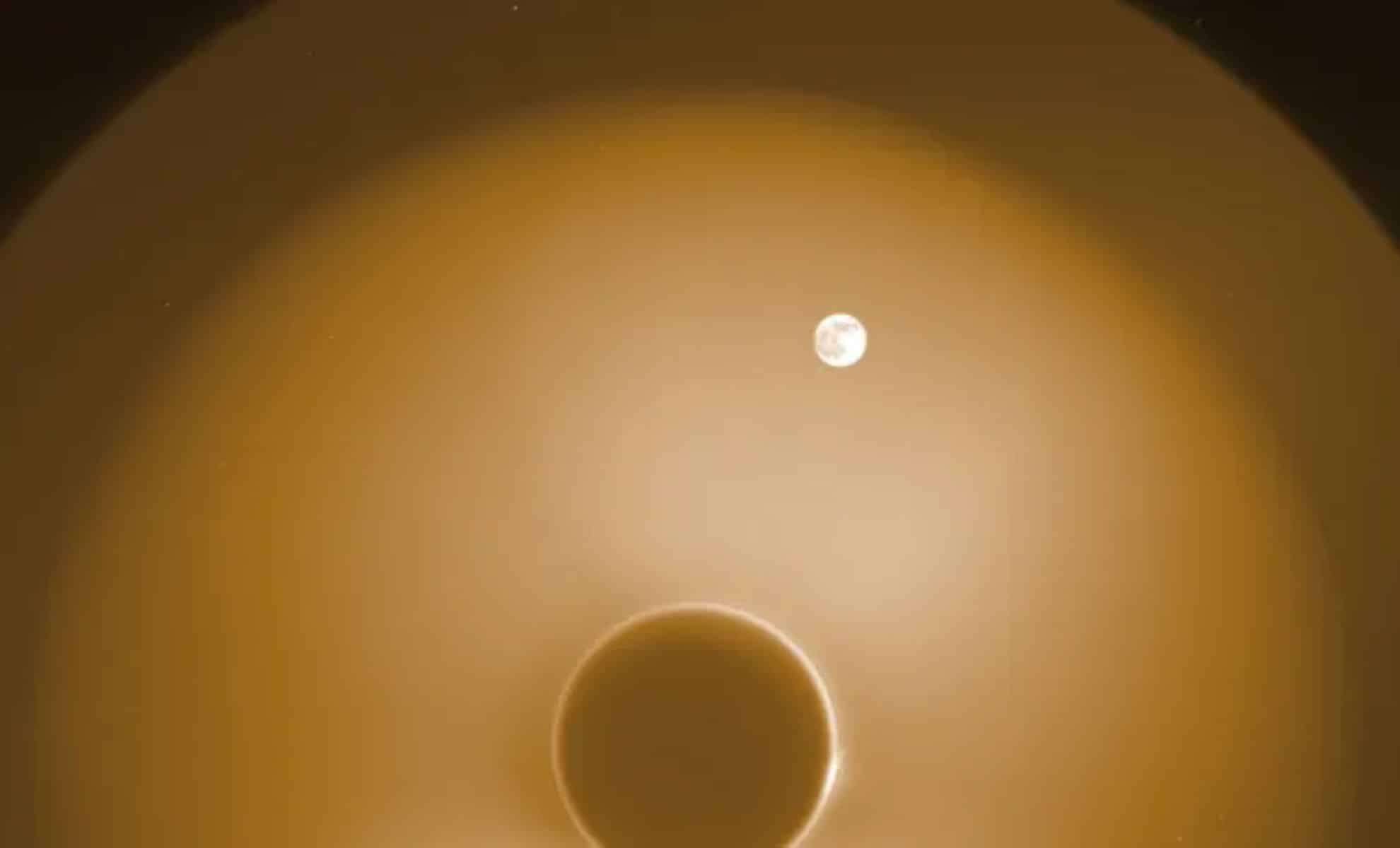
NASA’s PUNCH mission recently produced a captivating image that appears to show the sun partially obscured alongside a mysterious second moon. This unusual visual was captured during the spacecraft’s initial testing phase and stems from its specialized instruments and vantage point, rather than representing an actual celestial object, as explained in a recent report from the Southwest Research Institute.
The Image Capture Process and Mission Goals
The striking photo was obtained by the Narrow Field Imager onboard the PUNCH satellite array, which consists of four small spacecraft designed to analyze the solar wind. The dark silhouette in the image results from an occulter—a device that blocks the sun’s overwhelming brightness to reveal subtle details in the solar corona. The luminous halo around the sun is light reflecting off this occulter, while what seems to be a second moon is actually the Earth’s moon illuminated indirectly by sunlight bouncing off Earth’s surface. These elements combine to create the eerie “double moon” appearance.
The core mission of PUNCH is to study the solar wind—a stream of charged particles traveling at supersonic speeds from the sun. This wind influences space weather, which can impact satellites, communication systems, and power infrastructure on Earth. By imaging the sun’s outer atmosphere and the region between Earth and the sun, PUNCH helps scientists gain insights into how solar emissions affect our near-Earth space environment.

Linking Heliophysics Efforts Through Collaborative Missions
Craig DeForest, PUNCH’s lead investigator, highlighted how the mission works in tandem with NASA’s Parker Solar Probe (PSP). “PSP and PUNCH together merge distinct areas of heliophysics research into a comprehensive picture,” he noted. While PSP makes in situ measurements within the solar corona, PUNCH’s imaging capabilities extend observations further out near Earth’s orbit. This combination offers a more complete understanding of how solar processes evolve across space.
Such collaboration is vital to advancing space weather studies by combining direct particle data with high-resolution imagery. The findings will enhance the ability to predict geomagnetic storms, safeguarding Earth-based technologies. Furthermore, PUNCH’s commitment to open-access data promotes global scientific collaboration.
- Categories:
- News





0 comments
Sign in to Comment