
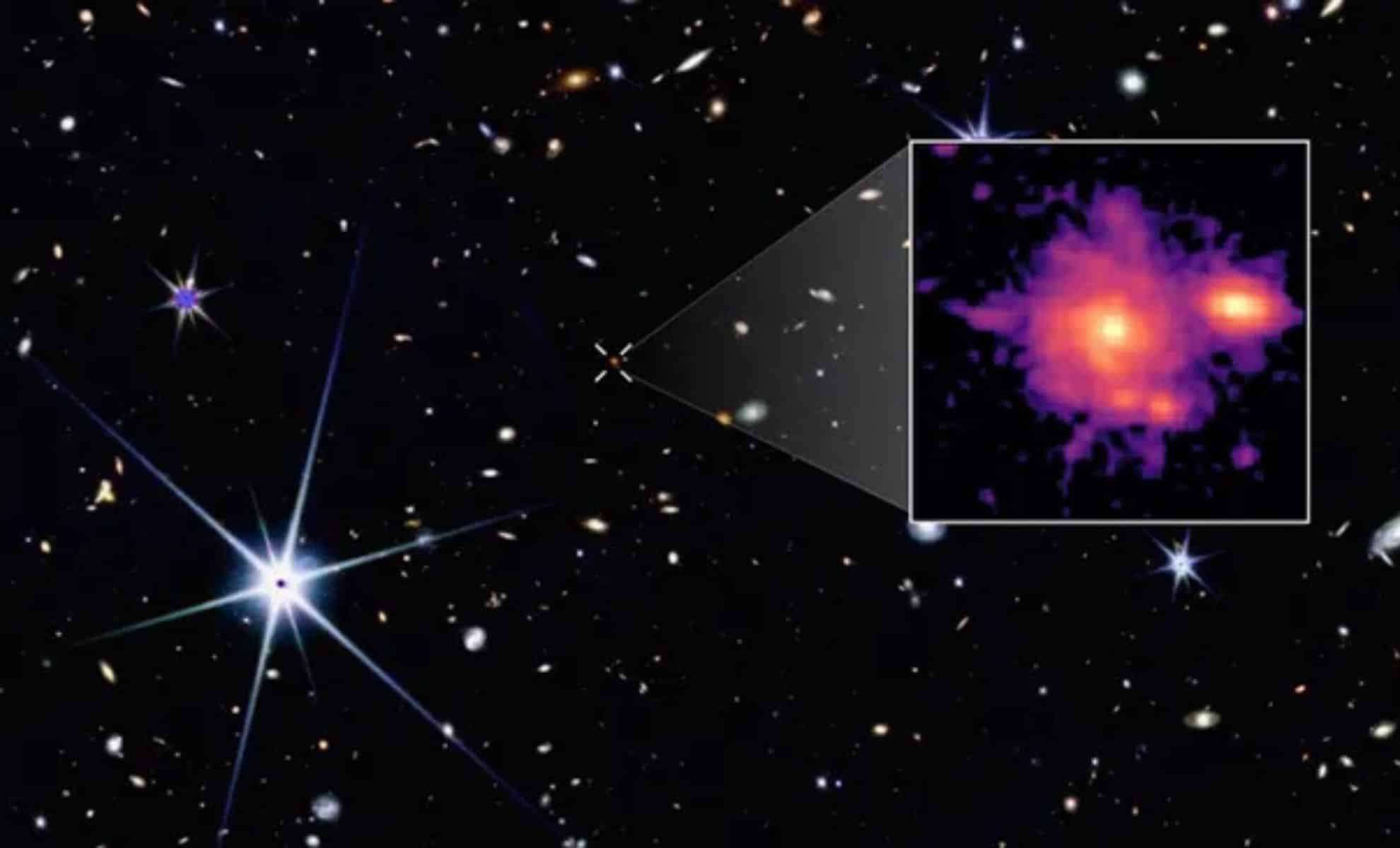
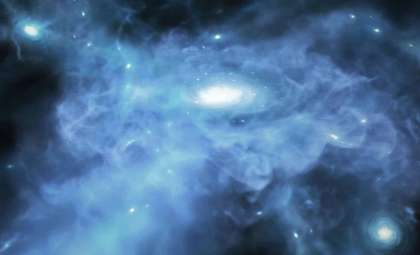
Astronomers utilizing the James Webb Space Telescope (JWST) have identified an extraordinary spiral galaxy remarkably akin to our Milky Way, earning it the nickname “long-lost twin.” Named Zhúlóng, this galaxy formed roughly 1 billion years after the Big Bang, making it the most remote spiral galaxy recorded to date. Published in the journal Astronomy & Astrophysics, this breakthrough challenges existing theories on the rapid development of galaxies like our own in the early universe.
Zhúlóng exhibits classic features of a mature spiral galaxy, such as a compact central bulge composed of older stars and expansive spiral arms. These characteristics were previously thought impossible in such an early epoch, confronting the belief that large galaxies evolve over billions of years through gradual star formation and merging.
A Mature Galaxy Emerging Early in Cosmic History
Not only is Zhúlóng’s age remarkable, but its advanced form is equally impressive. Spanning about 60,000 light-years, it’s slightly smaller than the Milky Way’s 100,000-light-year size. With a stellar mass of approximately 100 billion solar masses, this galaxy firmly qualifies as a close relative of our own. The discovery of such an evolved galaxy so soon after the universe’s inception surprised researchers.

“This finding illustrates how JWST is revolutionizing our understanding of the infant universe,” stated Pascal Oesch, associate professor at the University of Geneva and co-author of the study. Zhúlóng was detected unexpectedly during JWST’s PANORAMIC survey, which employs the telescope’s “pure parallel” observing mode to explore multiple deep-space areas simultaneously.
Rewriting Galaxy Formation Timelines
The perplexing aspect for scientists is how Zhúlóng attained such a developed structure within a relatively short timeframe. According to the Lambda-CDM paradigm, which is the prevailing cosmological framework, galaxies of this scale typically require billions of years to form via hierarchical merging—the successive combination of smaller galactic building blocks. By comparison, the Milky Way is estimated to have taken over 8 to 10 billion years to achieve its spiral configuration.
However, Zhúlóng’s progression to a similar state in under a billion years challenges key notions about the rapidity and mechanisms of galaxy assembly in the universe’s formative epochs. It adds to a growing roster of early galaxies and supermassive black holes observed by JWST that appear to have matured surprisingly fast.
This prompts critical questions: Could current models be lacking vital processes, or do we need new insights into how dark matter, gas movements, and star formation operated shortly after the Big Bang? The discovery has prompted theorists to reassess galaxy formation theories and explore alternative explanations, including enhanced gas cooling or potential changes to gravitational theories.
Future Exploration of Zhúlóng
Next steps involve detailed follow-up studies of Zhúlóng to better understand its properties. One key focus will be measuring the galaxy’s metallicity—the proportion of elements heavier than hydrogen and helium—offering clues about the number of previous stellar generations. A high metal content would suggest an unexpectedly advanced chemical evolution for such an early cosmic time.
Upcoming observations using JWST’s spectroscopic tools alongside the Atacama Large Millimeter/submillimeter Array (ALMA) will explore the dynamics of gas within the galaxy’s disk, ongoing star formation activity, and investigate whether a supermassive black hole lies at its core.
These analyses could reveal if Zhúlóng is an exceptional case or an indicator that galactic formation models require significant revision. Meanwhile, this discovery exemplifies how the James Webb Space Telescope is not only revealing ancient cosmic history but also reshaping our foundational understanding of the universe.
- Categories:
- News





0 comments
Sign in to Comment