
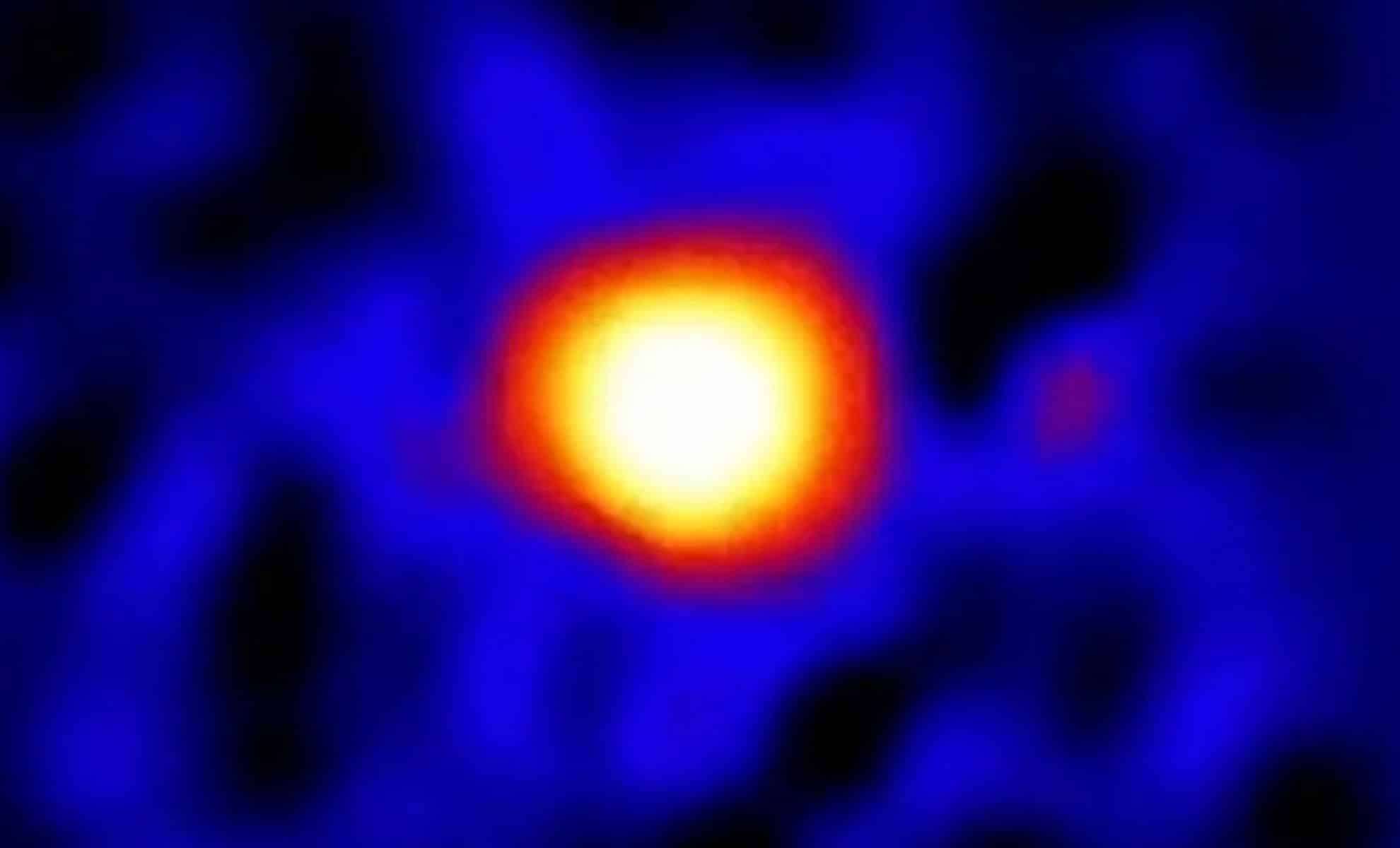
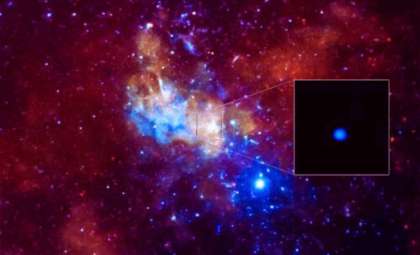
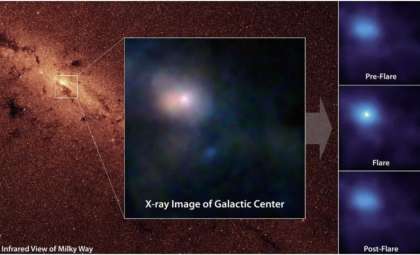
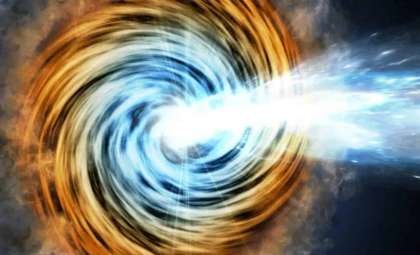
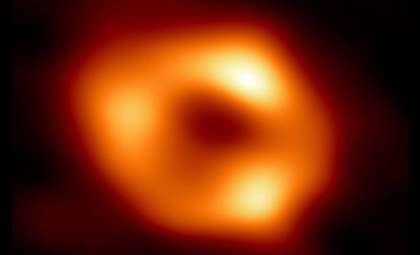
The James Webb Space Telescope has provided groundbreaking observations of the Milky Way’s core, detecting sporadic, powerful flares emanating from the supermassive black hole, Sagittarius A*. These findings deliver an unprecedented, close-up view of the energetic phenomena shaping our galaxy’s nucleus. Once thought to be relatively stable, Sagittarius A* is now seen as emitting frequent bursts of energy in an irregular, rapid succession, illustrating a far more turbulent environment than previously known.
Employing Webb’s advanced Near-Infrared Camera (NIRCam), astronomers monitored the accretion disk of Sagittarius A* for 48 hours over a year. Contrary to expectations of regular flare patterns, the black hole displayed random flashes varying in intensity and length. Some bursts were exceptionally bright, while others were subtle flickers, revealing a continuous, high level of activity that exceeds prior scientific predictions.
The Unexpected Variability of Sagittarius A*
In a study released on February 18, 2025, in The Astrophysical Journal Letters, principal investigator Farhad Yusef-Zadeh from Northwestern University described these findings as constantly surprising. “Our data revealed a dynamic, bubbling brightness that shifts unpredictably,” he said, characterizing the black hole’s behavior as “entirely random.” The team found no recurring sequence in the energetic eruptions, making each flare observation a unique event. This pattern of sudden bright bursts followed by quieter intervals is unlike anything documented in earlier black hole research.

“The process is comparable to how the Sun’s magnetic activity builds up and releases energy as solar flares,” Yusef-Zadeh noted. “While the physical surroundings around a black hole are far more violent and extreme, the bubbling magnetic dynamics show similarities. The Sun’s surface also teems with activity.” This analogy underscores the shared magnetic processes, although Sagittarius A* operates on a vastly greater scale.
Decoding Magnetic Reconnection Near the Black Hole
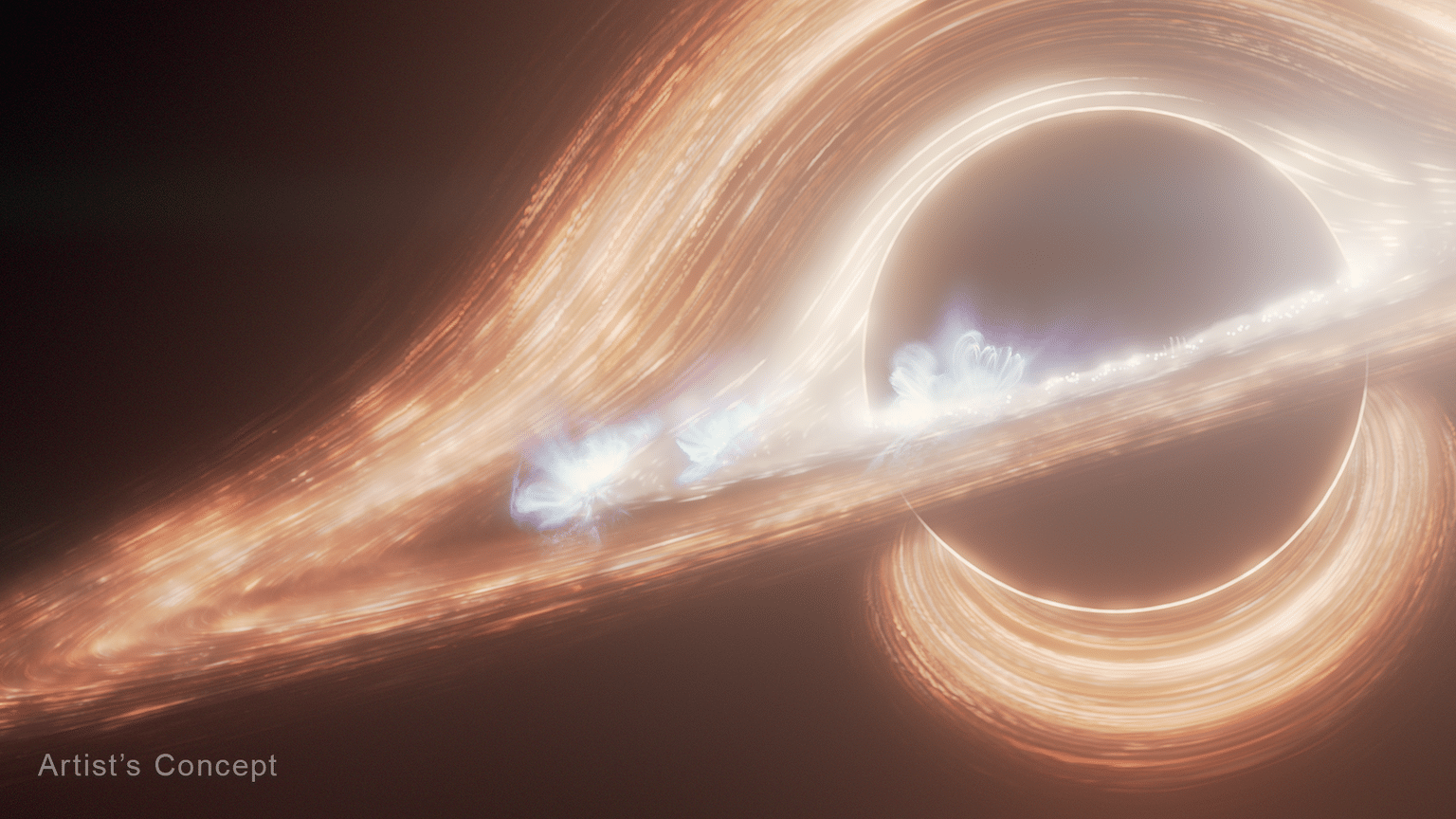
The energetic flare events spotted by Webb are attributed to magnetic reconnection, a process where magnetic field lines break and reconnect, releasing vast amounts of energy through particle acceleration. Lead scientist Yusef-Zadeh likened this to static electricity phenomena. “Magnetic reconnection acts like a spark of static electricity, essentially an electric reconnection,” he explained. These reconnection events are immensely powerful and likely generate the largest, most luminous flares observed from Sagittarius A*.
Magnetic reconnection near the black hole propels particles to nearly light speed, emitting intense radiation bursts that Webb’s NIRCam captured with exceptional detail. These new observations offer critical insights into black hole physics and help astronomers better understand how supermassive black holes influence their cosmic neighborhoods and grow over epochs.
Detecting a Novel Delay Among Flare Wavelengths
A remarkable observation was a delay between flare brightness changes at different wavelengths. For the first time, researchers noticed that shorter wavelengths brightened slightly before longer wavelengths did. “This is an unprecedented detection of a timing difference at these wavelengths,” stated Yusef-Zadeh. “Simultaneous measurements with NIRCam showed the longer wavelength lagged by a brief interval—ranging from a few seconds up to 40 seconds.” This subtle time difference provides valuable clues about the energy flow around Sagittarius A*.
The lag suggests that particles producing shorter wavelength emissions lose their energy faster as they move outward compared to those emitting longer wavelengths. Understanding this effect could prove crucial in unraveling the interplay between the magnetic fields and energy transfer mechanisms at work near the supermassive black hole.
- Categories:
- News


0 comments
Sign in to Comment