
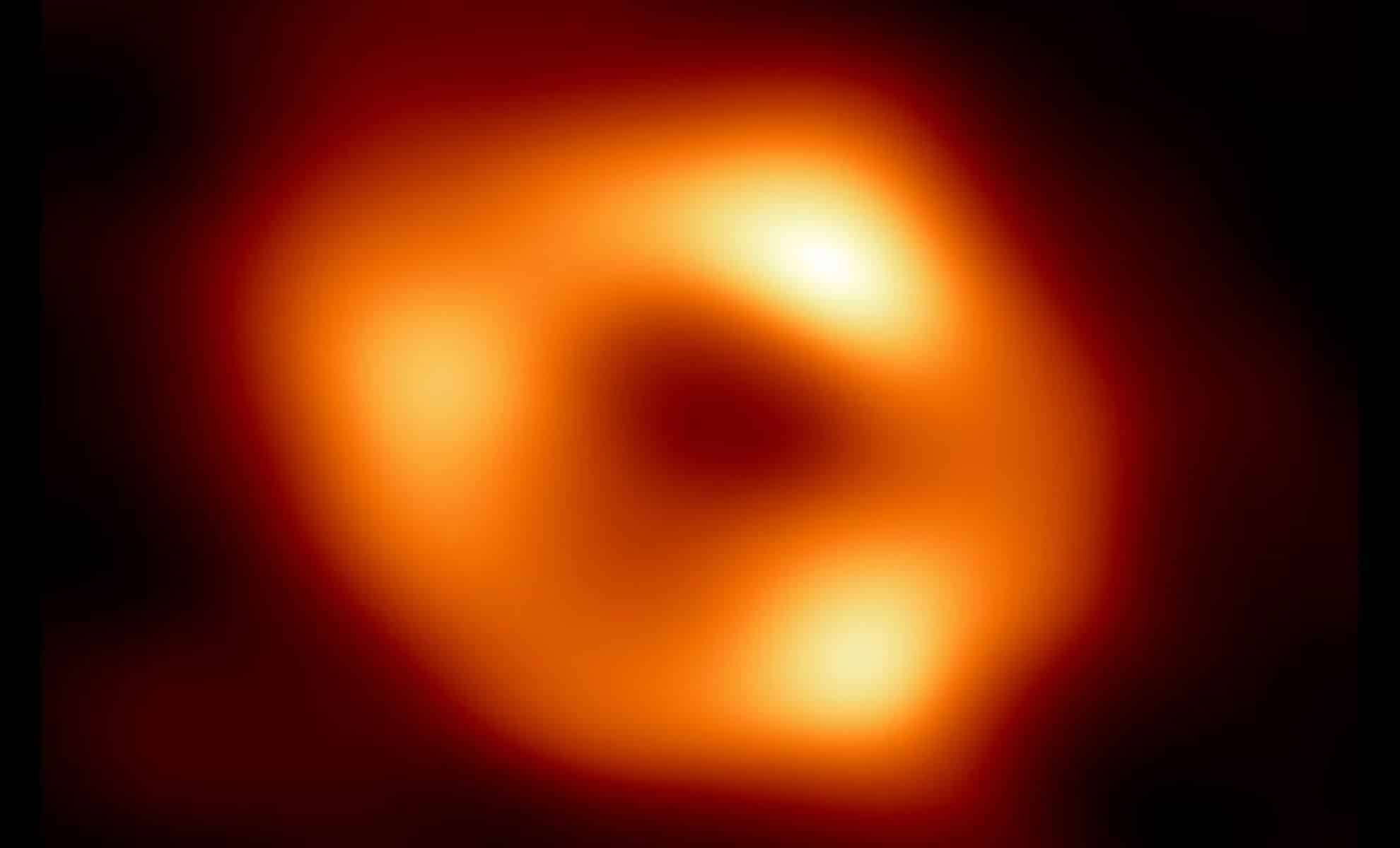
A recent investigation raises questions about the fidelity of the inaugural image of Sagittarius A*, the supermassive black hole anchoring our galaxy, taken by the Event Horizon Telescope (EHT) in 2022.
The widely recognized “radiant ring” image, which provided humanity with the first visual of the Milky Way’s central black hole, might not perfectly depict Sagittarius A*’s actual structure. Scientists from Japan’s National Astronomical Observatory suggest that certain image reconstruction methods could have masked critical features, leading to a reconsideration of this landmark image.
Revisiting the True Configuration of Sagittarius A*
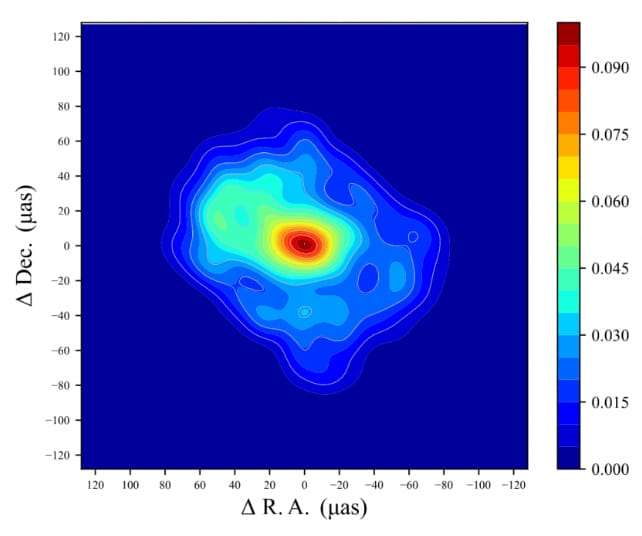
Led by Assistant Professor Miyoshi Makoto, the team reanalyzed the original EHT datasets employing different analytical techniques. Their results propose that the accretion disk—the swirling gas and dust orbiting the black hole—might be less symmetrical than previously thought. Instead of a perfect circle, the disk shows signs of being elongated from east to west, with the eastern side exhibiting greater brightness than the western part. Makoto attributes this uneven illumination to relativistic beaming, where emission traveling toward Earth appears enhanced, while emission moving away becomes fainter, producing an asymmetric visual effect.

This challenges the conventional interpretation of a uniform “ring” and implies that the EHT image might have presented a smoothed version due to observational artifacts. Capturing black holes is inherently difficult because of their fast-moving, turbulent surroundings, and the required data reconstruction may have inadvertently simplified the actual morphology.
The Challenges Behind Black Hole Imaging
Creating an image of Sagittarius A* involved a worldwide array of telescopes acting as a colossal Earth-sized observatory via very long baseline interferometry (VLBI). This technique merges signals from far-flung telescopes to produce images of remarkable clarity, yet it relies on data interpolation, which can introduce distortions. According to this new study, such interpolation may have imposed a false symmetry, producing the impression of a perfect ring around Sagittarius A* despite its true asymmetrical nature.
Makoto emphasized that “no telescope can capture an astronomical image perfectly,” noting that while VLBI delivers extraordinary detail, it also depends on assumptions that could oversimplify the complex realities of black hole environments. The effort is further complicated by the accretion disk’s extreme rotation, reaching speeds close to 60% of light's velocity. Rapid variability in this chaotic region compounds the difficulty of generating an exact image, especially if those rapid changes aren’t fully integrated into the reconstruction process.
Future Directions in Black Hole Observation
The research underscores the importance of advancing imaging methodologies to better represent black holes’ true appearances, particularly the intricately dynamic surroundings of Sagittarius A*. Upcoming EHT campaigns, enhanced with improved instrumentation and refined data processing, hold promise for capturing more accurate and detailed views. This progress is vital as the EHT aims to study additional supermassive black holes both in our galaxy and beyond.
Continued evolution in black hole imaging technologies is expected to provide sharper and more insightful depictions of these mysterious cosmic giants and their tumultuous accretion disks. This study highlights the necessity of revisiting existing data sets using novel analytical methods to ensure that celebrated scientific milestones continue to reflect the most precise understanding available.
- Categories:
- Astronomy ,
- News










0 comments
Sign in to Comment