
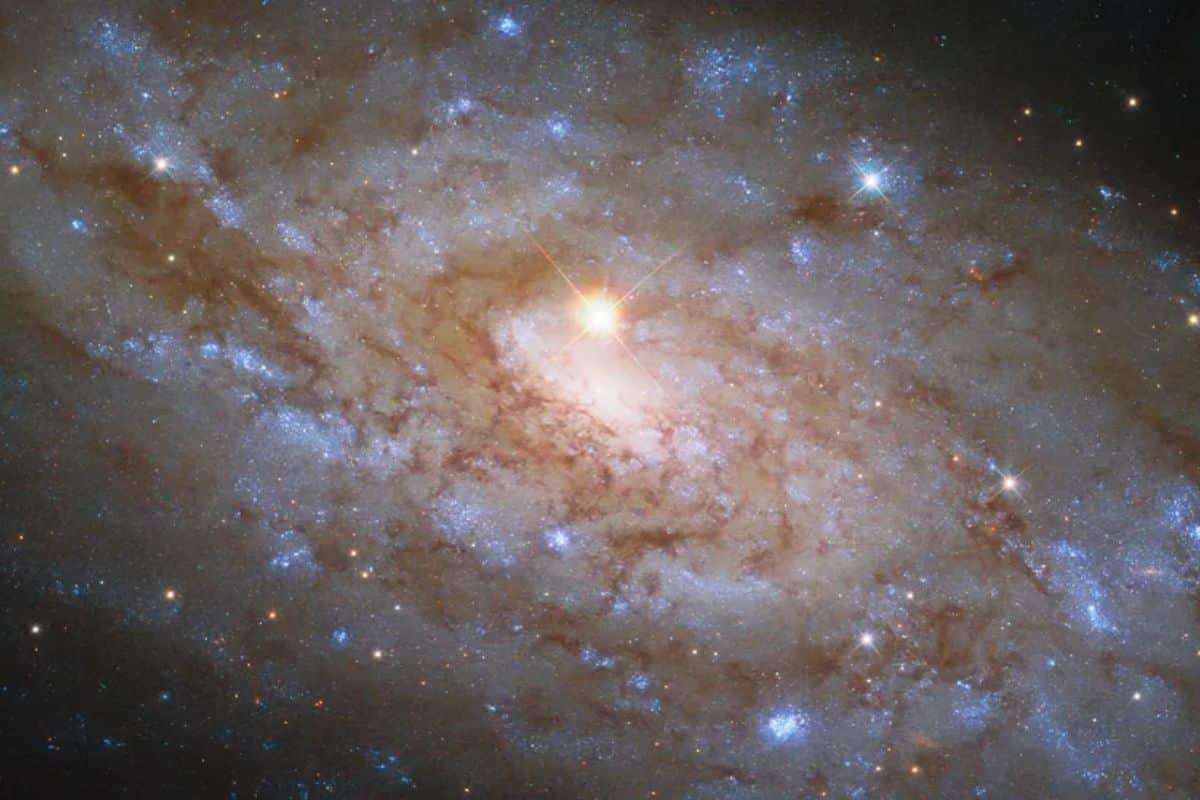
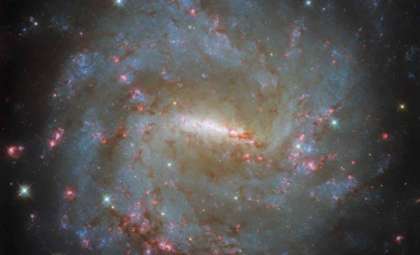
The Hubble Space Telescope has recently delivered a breathtaking image of the spiral galaxy NGC 5530, which lies roughly 40 million light-years from Earth. Yet, this captivating picture includes an unexpected visitor: a bright star from within our own Milky Way, located a mere 10,000 light-years away, which appears to intrude on the galaxy’s scene.
An Unforeseen Alignment
This release from ESA notes that a bright point of light near the center of NGC 5530 might be mistaken for the galaxy’s luminous core.
However, as explained by the European Space Agency (ESA), “While some galaxies have extraordinarily bright centers where they host a feasting supermassive black hole, the bright source near the center of NGC 5530 is not an active black hole but instead a star.”
This star is located within the Milky Way, only about 10,000 light-years from us. The illusion results from a coincidental alignment along Hubble’s line of sight, making the star seem like it belongs at the core of the flocculent spiral galaxy NGC 5530.
The star shows a characteristic cross-shaped light pattern known as diffraction spikes, caused by light bending around Hubble’s internal supports.

NGC 5530: A Galaxy with Fragmented Spiral Arms
Unlike grand design spiral galaxies such as our own Milky Way, NGC 5530 falls into the category of flocculent spirals, which feature irregular, patchy spiral arms rather than smooth, clearly defined ones.
These arms form from localized star formation events, triggered by interactions among gas, dust, and stellar winds. Such bursts produce clusters of young stars, resulting in the clumpy appearance rather than continuous spirals, as ESA elaborates.
Encircling NGC 5530’s bright center, intricate layers of dark, reddish dust suggest the presence of dense molecular clouds—star nurseries that fuel ongoing star birth. Elsewhere, blue regions mark areas of active star formation, where collapsing gas clouds are generating new stars.
A Remarkable Cosmic Coincidence
This Hubble photograph highlights the vast scale of the cosmos and the fascinating instances where celestial bodies appear aligned, though separated by immense distances. ESA scientists point out that “This chance alignment gives the appearance that the star is at the dense heart of NGC 5530.”
A Star Unexpectedly Stealing the Spotlight
As Hubble continues to deliver spectacular views of remote galaxies, rare events like this stellar “photobomb” underscore the complexity of interpreting astronomical images.
For researchers, such serendipitous captures provide deeper understanding of both the celestial subjects and the advanced methods used to observe them across vast cosmic distances.
- Categories:
- Astronomy






0 comments
Sign in to Comment