
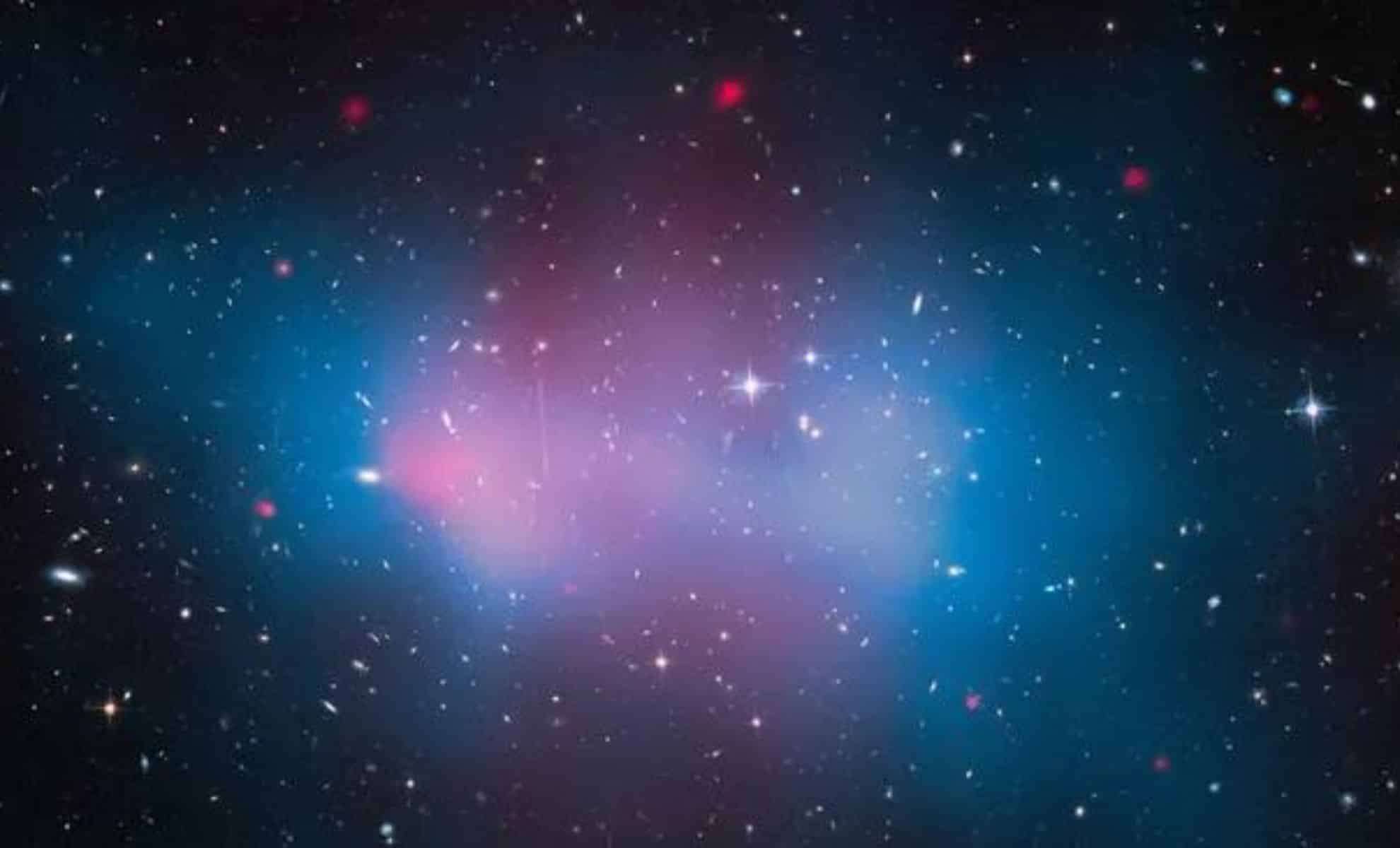
Emerging research hints that dark matter, the elusive component constituting most of the universe's mass, may engage in interactions within itself.
This fresh perspective challenges prevailing theories within the Standard Model of particle physics and the popular Lambda Cold Dark Matter (Lambda CDM) framework.
The colossal galaxy cluster known as "El Gordo" has played a pivotal role in this innovative research. Confirming these results could dramatically reshape how scientists understand dark matter and its intrinsic characteristics, profoundly influencing cosmological studies.

Decoding the Mystery of El Gordo
El Gordo, or ACT-CL J0102-4915, is an extraordinarily massive galaxy cluster roughly 7 billion light-years distant. Its name, which translates to "the Fat One" in Spanish, stems from two smaller galaxy clusters colliding at velocities reaching several million miles per hour.
With a mass equivalent to three million billion times that of the Sun, El Gordo ranks among the heaviest known galaxy clusters. Researchers from Italy's Scuola Internazionale Superiore di Studi Avanzati (SISSA) have utilized this cluster as a cosmic testbed to investigate dark matter's behavior. The cluster's exceptional traits and extreme environment offer a prime opportunity for probing theories about dark matter dynamics.

Questioning Established Models
According to the Standard Model and Lambda CDM cosmology, dark matter interacts only via gravity, with no self-interactions or direct interactions with ordinary matter. Yet, observations from El Gordo reveal phenomena that conflict with these assumptions.
These models describe how gas in merging galaxy clusters behaves differently than dark matter, dissipating energy and lagging behind. Riccardo Valdarnini, leading the study, remarked, “According to the currently accepted standard cosmological model, the present baryonic matter density of the universe can account for only 10% of its total matter content.
The remaining 90% is in the form of dark matter.” The mismatch between observed cluster behaviors and traditional models underscores the necessity of exploring alternate dark matter theories.
The Concept of Self-Interacting Dark Matter
The Self-Interacting Dark Matter (SIDM) hypothesis suggests that dark matter particles may collide and exchange energy amongst themselves. This model offers a promising explanation for the unusual traits observed in El Gordo.
Valdarnini’s group ran hydrodynamical simulations replicating conditions in El Gordo, finding that the spatial arrangement of mass components within the cluster aligns with predictions from the SIDM framework. “The most significant result of this simulation study is that the relative separations observed between the different mass centroids of the ‘El Gordo’ cluster are naturally explained if the dark matter is self-interacting,” Valdarnini explained.
These results imply dark matter might not be entirely collisionless, but instead could engage in complex interactions influencing its distribution in massive galaxy clusters.
Detailed Observations and Computational Models
El Gordo is composed of two merging sub-clusters named the northwestern (NW) and southeastern (SE) components. X-ray observations reveal a singular peak in the SE sub-cluster’s X-ray emissions, accompanied by two faint, stretched tails beyond this peak.
Importantly, the X-ray peak leads the SE dark matter peak, while the Brightest Cluster Galaxy (BCG) is offset from the SE mass center. In the NW sub-cluster, the densest galaxy concentration does not coincide with its mass peak either.
These irregularities point toward dark matter possessing collisional traits. The hydrodynamical simulations conducted by Valdarnini’s team fine-tuned various parameters to emulate these features, supporting the plausibility of the SIDM model in explaining El Gordo’s observed characteristics.
Broader Significance for Cosmology
Insights from El Gordo challenge the Lambda CDM model’s assumption that dark matter is cold and non-collisional.
If dark matter does indeed exhibit self-interactions, it could revolutionize our understanding of cosmic structure formation and evolution. Valdarnini concluded, “This suggests that present SIDM models should be considered as only a low-order approximation and that the underlying physical processes that describe the interaction of dark matter in major cluster mergers are more complex than can be adequately represented by the commonly assumed approach based on the scattering of dark matter particles.”
These findings pave the way for advanced models that more accurately reflect the true behavior of dark matter and its cosmic role.
- Categories:
- Astronomy ,
- News ,
- Space












0 comments
Sign in to Comment