
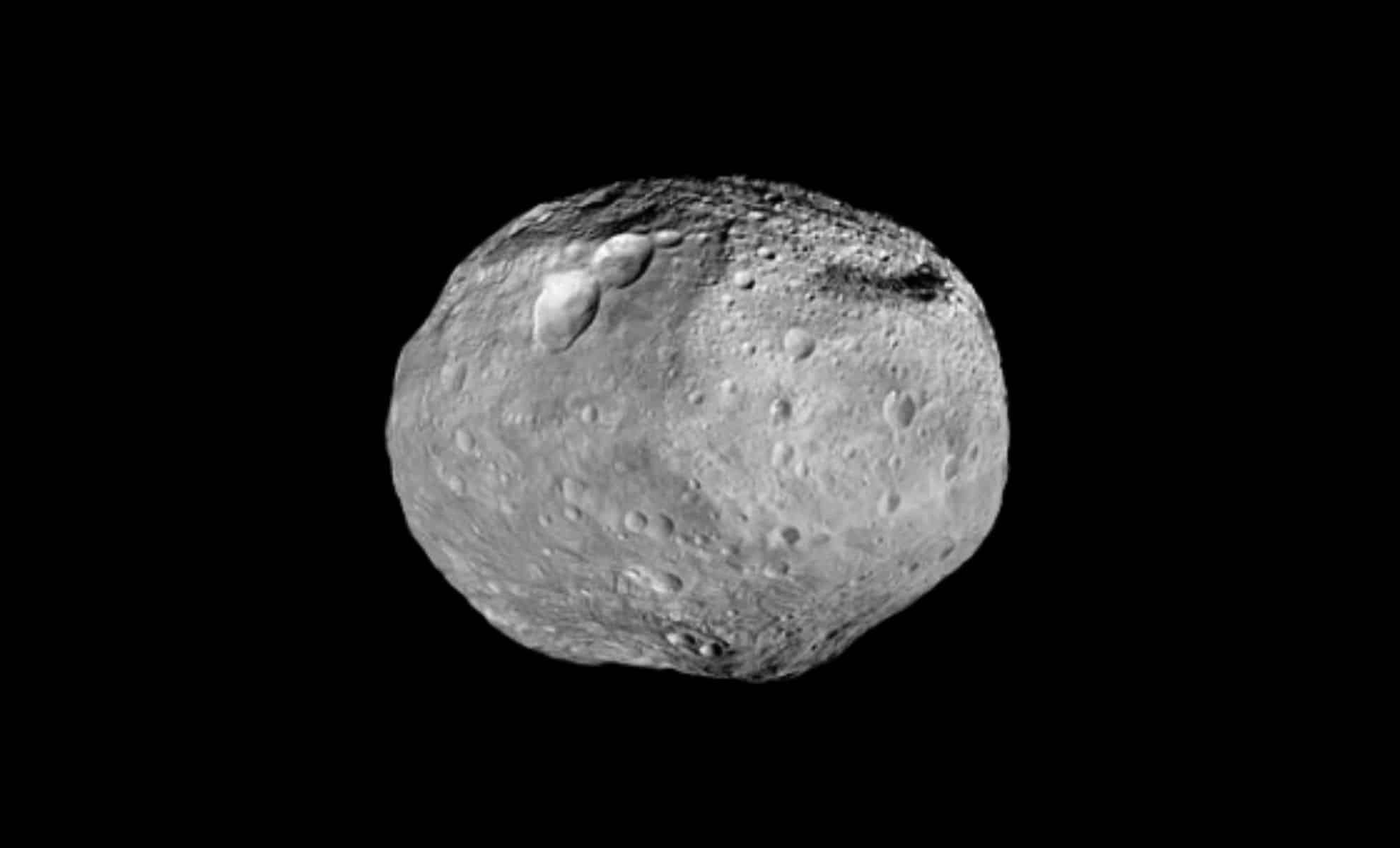
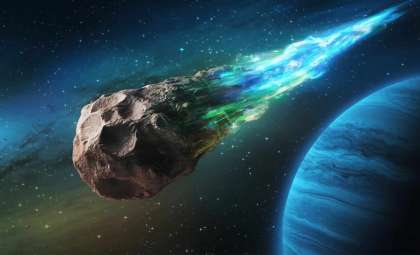
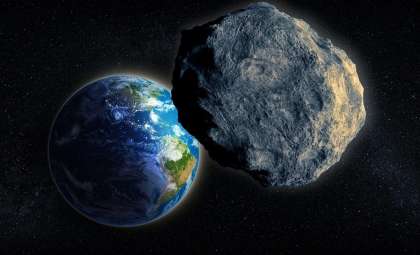
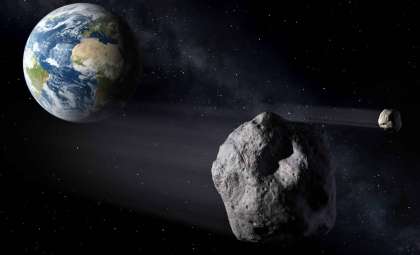
For years, researchers have grappled with the puzzling nature of asteroid Vesta, a massive space object about 500 kilometers across that straddles the boundary between an asteroid and a planet.
Unlike typical asteroids, Vesta exhibits a level of complexity that challenges straightforward classification, yet it doesn’t quite possess all the traits that define a planet.
A recent investigation led by NASA’s Jet Propulsion Laboratory (JPL) has dramatically shifted the scientific perspective on this mysterious body.

Reevaluating Vesta’s Inner Composition
Earlier interpretations, primarily based on data from NASA’s Dawn mission, depicted Vesta as having a layered interior typical of planetary bodies: a crust, a mantle, and a dense metallic core.
The asteroid’s basaltic surface suggested it was once molten, leading scientists to conclude it had undergone full planetary differentiation.
However, with nearly ten years of improved calibration techniques applied to Dawn’s gravity and imagery datasets, researchers attained exceptional consistency between visual observations and radio tracking data from NASA’s Deep Space Network.
This new analysis suggests Vesta does not contain a concentrated central mass. Instead, its internal structure appears strikingly homogeneous, a discovery that profoundly changes our understanding of its formation.
Seth Jacobson, a planetary scientist at Michigan State University and a co-author of the study, explained, “The absence of a distinct core was unexpected. It challenges our previous notions of Vesta.”
Reinterpreting Vesta’s Geological Past
The key to this insight lies in examining Vesta’s moment of inertia, which reveals how its mass is arranged during rotation.
Typically, bodies with dense cores spin faster as their mass draws inward—much like a figure skater pulls in their arms to spin quicker.
In contrast, Vesta's slower spin rate implies its mass is more evenly distributed rather than concentrated centrally.
This finding contradicts earlier beliefs that the asteroid had a big iron-nickel core, indicating a different evolutionary path.
Ryan Park, the study’s lead author, proposes that this arrangement could be the result of a halted differentiation process.
It’s possible Vesta started developing internal layers as it heated and melted, but the process was cut short—potentially by insufficient heat or disruptive impacts.
Park added, “Our results reveal a far more intricate history for Vesta, shaped by interrupted planetary formation and significant late collisions.”
There's so much going on in the May sky! Spot the bright asteroid Vesta (maybe even without binoculars!), catch Saturn during its once-in-15 years equinox, don't miss the Full Moon – and that's just the beginning! 🌟
Get the full list of May events here: https://t.co/PKBKgRBNqM pic.twitter.com/7vVDz12Cqj
— Star Walk (@StarWalk) April 29, 2025
Emerging Hypotheses on Vesta’s Origin
One theory suggests Vesta’s internal layering began but never fully completed, making it a geological time capsule that preserves an early stage of planetary development.
Alternatively, a bold new hypothesis gaining momentum proposes that Vesta might actually be a surviving portion of a once larger planet destroyed during the turbulent early days of the solar system.
Jacobson, who once viewed this idea as speculative, now considers it plausible given the fresh evidence.
In this context, Vesta could represent a fragment of primordial crust from a planetary body that either never fully matured or was shattered by collisions with other nascent planetary objects known as embryos.
“This concept evolved from an offhand suggestion to a hypothesis worthy of serious consideration due to the reinterpreted Dawn mission data,” Jacobson remarked.
Numerous meteorites discovered on Earth share Vesta’s spectral signature, and these specimens lack signs of incomplete differentiation, reinforcing the connection. “We are quite confident these meteorites originated from Vesta,” Jacobson said.
Happy #AsteroidDay! Meet Vesta, the first asteroid visited by a spacecraft ☄️ 🛰️ pic.twitter.com/gqypMFYYA3
— Science Channel (@ScienceChannel) June 30, 2017
Vesta’s Broader Role in Planetary Science
Regardless of which explanation proves correct, both amplify Vesta’s importance as a key object in studying planetary science.
Upcoming investigations will likely concentrate on revisiting the isotope ratios of meteorites linked to Vesta and enhancing dynamical simulations to assess how well a fragment from a disrupted planet could occupy Vesta’s current trajectory.
The impact of the Dawn spacecraft persists, with its newly refined data continuing to shed light on Vesta’s mysterious past—and maybe even that of the long-vanished planet it might have once been part of.
As Jacobson summarized, “These samples may be remnants of an ancient planet frozen before reaching full development. The identity of that world remains unknown.”
- Categories:
- Space






0 comments
Sign in to Comment