
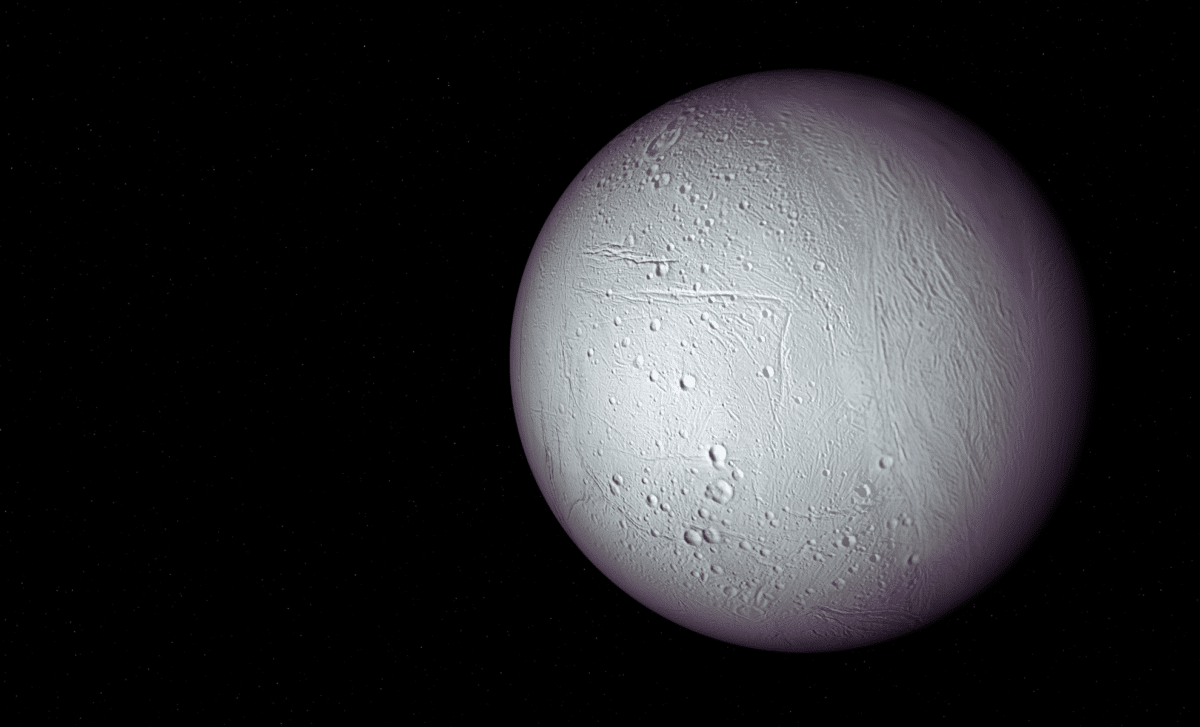
Enceladus, one of Saturn's icy moons, has captivated researchers for years due to its dynamic geysers and concealed ocean beneath a thick ice crust. Recent research has unveiled compelling evidence of heat escaping from both poles of this celestial body, strengthening the argument that Enceladus could possess the energy needed to support life. Featured in Science Advances, this investigation provides a novel understanding of the sustainability of Enceladus’ subsurface ocean over long periods.
Discovery of Heat Emission at Both Poles Changes the Understanding
Until now, scientists mainly associated thermal activity with Enceladus’ south pole because of its visible geysers. However, the latest research using data from NASA’s Cassini spacecraft indicates that both the moon's north and south poles emit heat. This revelation points to a more widespread distribution of internal heat, suggesting that Enceladus' geothermal processes extend across its entire surface rather than being confined to a single hotspot.
According to Dr. Georgina Miles, the study’s principal investigator,

“Enceladus is a key target in the search for life outside the Earth, and understanding the long-term availability of its energy is key to determining whether it can support life.”
Such findings reinforce the possibility that Enceladus is more than a frozen orb. Heat detected at both poles could mean that its subsurface ocean has maintained liquid water for extensive epochs, potentially billions of years. This thermal continuity suggests that the environmental conditions beneath the icy crust might be conducive to life’s emergence and development.
Energy Flow’s Importance for Habitability
The potential for life on Enceladus hinges on persistent and balanced energy input. Life requires a steady energy supply, and for Enceladus’ ocean to remain liquid, the heat it gains must offset losses. This energy is primarily supplied by tidal heating, caused by the gravitational interplay with Saturn. As Enceladus orbits, the planet’s strong gravity flexes the moon's interior, generating frictional heat that keeps the ocean from freezing.
The work published in Science Advances confirms that the global heat output from Enceladus aligns with models predicting heat generation through tidal forces, underscoring the adequacy of this heat to sustain its ocean across geological timescales.
“Understanding how much heat Enceladus is losing on a global level is crucial to knowing whether it can support life,” said Dr. Carly Howett, the corresponding author of the paper.
These results imply a steady supply of energy, allowing Enceladus’ ocean to persist in a life-supporting, liquid state over immense time spans.
Tidal Heating Sustains the Subsurface Ocean
Tidal heating is essential for stopping Enceladus' ocean from freezing solid. Saturn’s gravitational forces cyclically deform the moon, creating friction within its icy shell. This process, known as “tidal flexing,” produces enough thermal energy to preserve liquid water beneath the surface despite extremely cold space conditions.
What stands out in the recent findings is how well the observed heat emission from both poles matches theoretical tidal heating models. According to Cassini’s thermal data, the level of emitted heat corresponds with predictions regarding how much tidal energy converts to heat internally. This confirms that Enceladus’ internal heating mechanism is both efficient and enduring, potentially allowing the ocean to remain stable for millions or even billions of years—providing an environment possibly suitable for life.
New Data on Ice Shell Thickness Enhances Exploration Plans
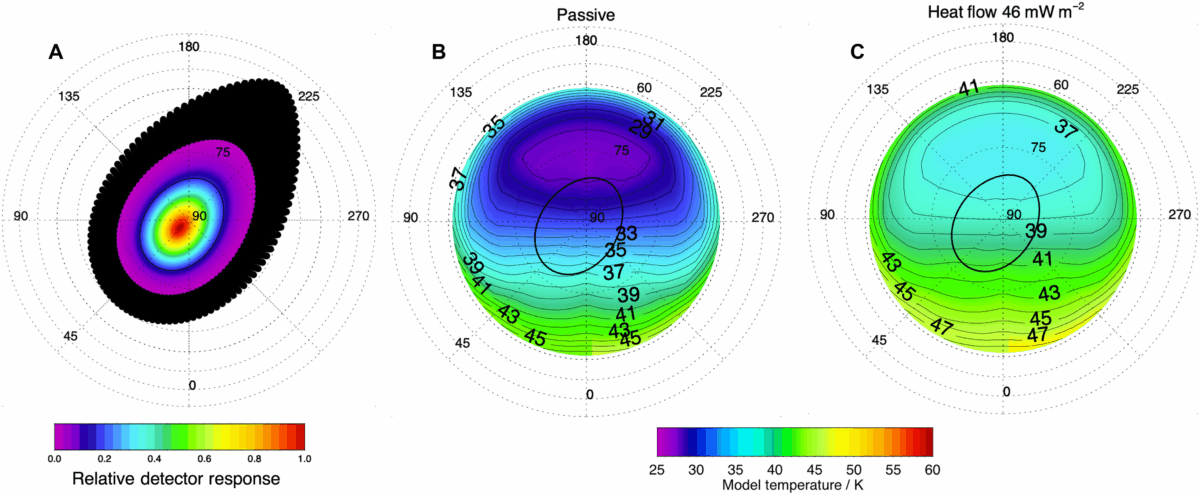
An exciting outcome of the research is the updated measurement of Enceladus’ ice shell thickness, critical for upcoming exploration missions. Using Cassini’s thermal readings, scientists estimate the ice to be roughly 20–23 kilometers thick near the north pole and around 25–28 kilometers thick on average globally. These thickness estimates are key for designing future probes intended to penetrate or explore beneath this frozen layer.
Despite the substantial thickness, the ice is not impervious. The detected thermal flux indicates sufficient heat escapes through it, potentially enabling missions to access the hidden ocean below.
“Eking out the subtle surface temperature variations caused by Enceladus’ conductive heat flow from its daily and seasonal temperature changes was a challenge, and was only made possible by Cassini’s extended missions,” Dr. Miles adds.
Overall, this research not only deepens our understanding of the moon’s internal heat dynamics but also sets the stage for future investigations aimed at probing Enceladus’ intriguing ocean world.
- Categories:
- News













0 comments
Sign in to Comment