
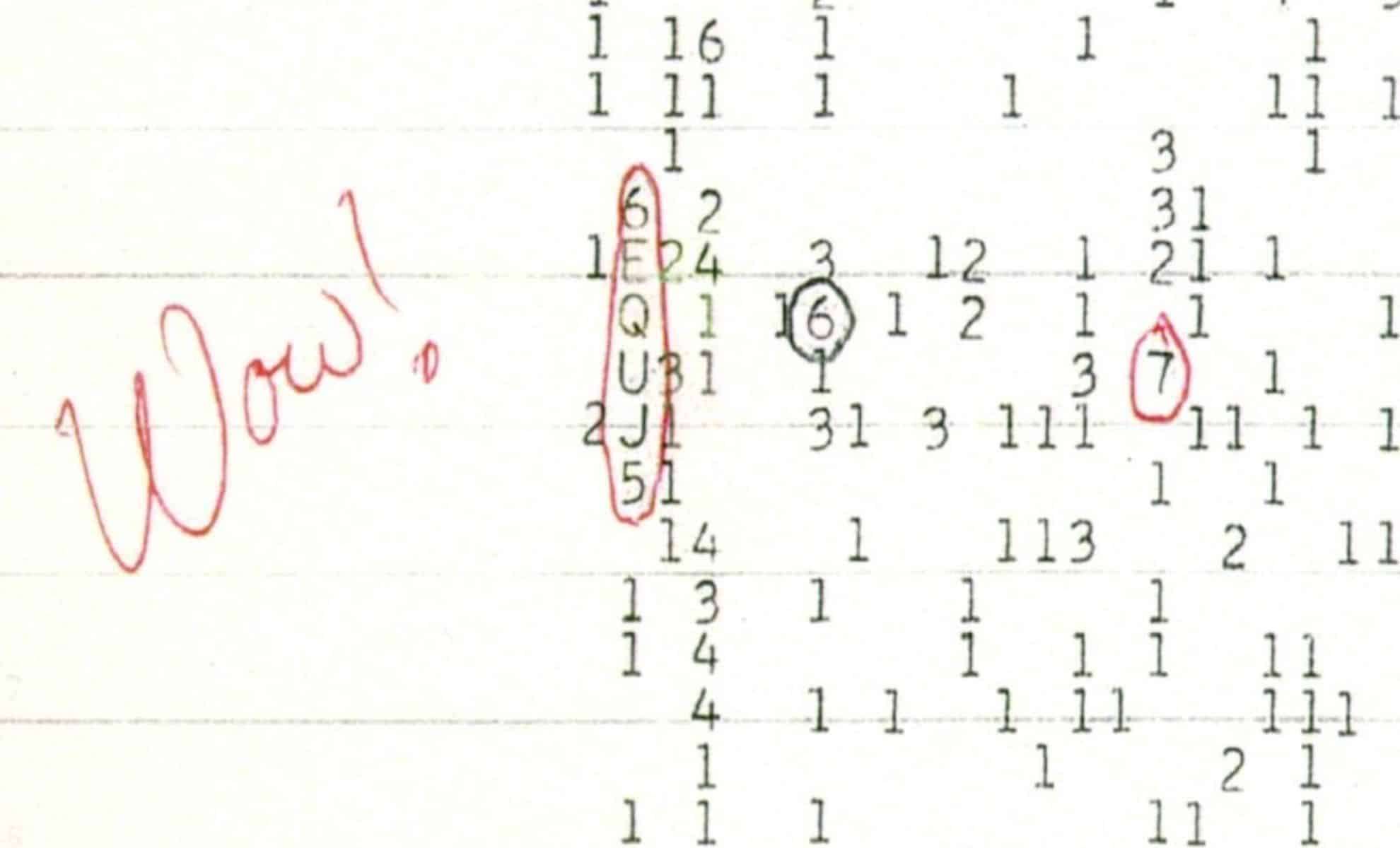
For almost 50 years, the Wow! Signal has puzzled astronomers worldwide. Detected in 1977 by Ohio State University’s Big Ear Radio Telescope, this brief 72-second burst of radio waves sparked intense curiosity over its potential links to alien civilizations. Recently, a comprehensive analysis published on arXiv revisits this enigmatic signal using overlooked data. Spearheaded by the Arecibo Wow! (AWOW) project, researchers provide new insights into its origin and characteristics.
A Signal That Changed Astronomy, Revisited Decades Later
On August 15, 1977, astronomer Jerry R. Ehman noticed a distinctive, narrow radio emission during routine examination of SETI data. Struck by the signal’s strength, he circled the code “6EQUJ5” and annotated “Wow!” in the margins—prompting the iconic name. This signal quickly became a symbol of hope for detecting extraterrestrial intelligence and captivated both scientists and enthusiasts.
Initially thought to be artificial, the lack of a repeated signal and ongoing debate led to alternate natural explanations. However, no conclusive answers emerged until the recent study. Led by Abel Méndez and his team at the Planetary Habitability Laboratory, the analysis incorporated a wealth of previously unexamined observational data from the Wow! event.

Stronger Signal, Sharper Frequency, and Greater Velocity
Applying advanced signal processing methods, the team recalibrated the Wow! Signal’s properties with unprecedented accuracy. Their findings revealed a peak strength of 250 Janskys, quadrupling earlier estimates. Additionally, the detected frequency was adjusted to 1420.726 MHz, a small yet critical shift.
Remaining within the widely studied hydrogen line—a favored frequency for interstellar messaging—the revised frequency indicates the source was traveling faster than previous calculations suggested, likely residing within our galaxy. Méndez told Gizmodo, “While the numerical changes seem minor, in radio astronomy they’re significant.”
Natural Origins Gain Credibility
The fresh data supports Méndez’s earlier hypothesis that the Wow! Signal could stem from a cold hydrogen cloud activated by a short-lived radiation event, such as those produced by a magnetar. These intensely magnetized neutron stars can emit brief but intense bursts that stimulate hydrogen atoms to emit detectable radio waves.
Alternatively, the team considers the role of a natural maser—microwave amplification occurring under certain cosmic conditions. Either scenario could create a narrow spectral signature like the Wow! Signal without invoking alien technology. As EarthSky highlighted, while the new evidence doesn’t solve the mystery, it offers important direction.
Refined Location Fuels Future Exploration
By pinpointing the signal’s probable source to two areas within the Sagittarius constellation, the researchers have provided the astronomical community with a sharper search window. The coordinates have been narrowed to right ascensions 19h 25m 02s ± 3s and 19h 27m 55s ± 3s, along with a declination of -26° 57′ ± 20′ (J2000). Méndez described this as the most precise mapping yet, potentially enabling more targeted studies going forward.
Though the Wow! Signal may not have been a direct communication from extraterrestrial intelligence, ongoing investigation aims to unlock its secrets. The team plans to publish further findings over the coming two years, reanalyzing archival observations in pursuit of one of astronomy’s most enduring puzzles.
- Categories:
- News












0 comments
Sign in to Comment