
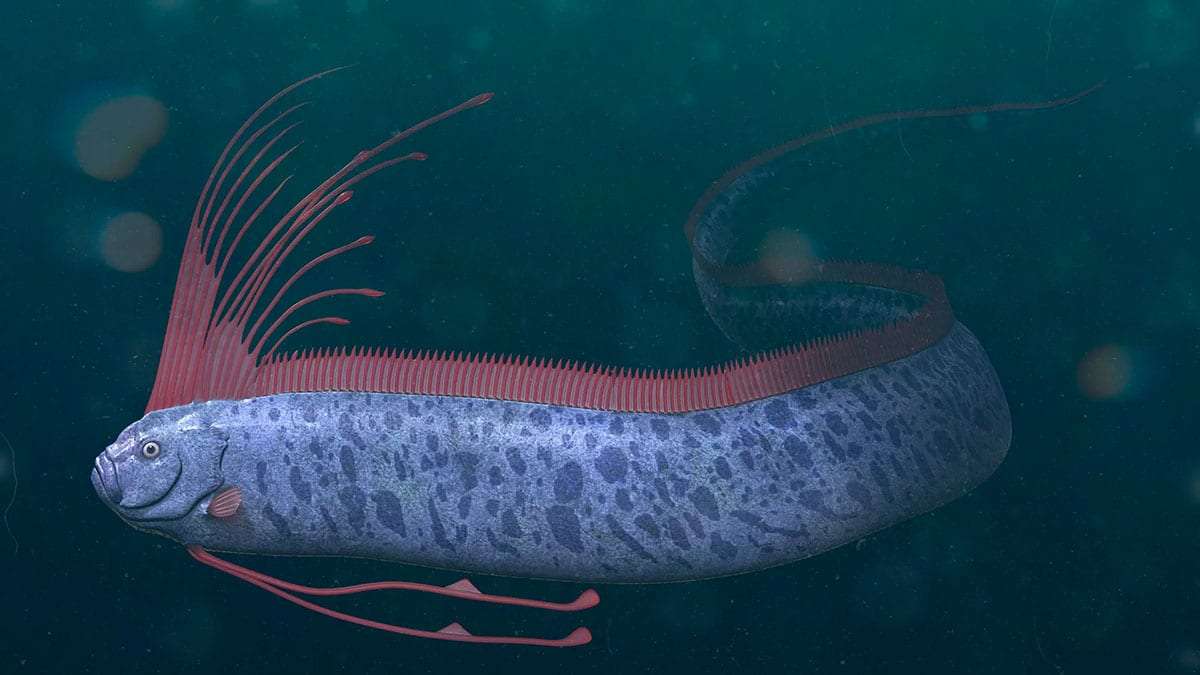
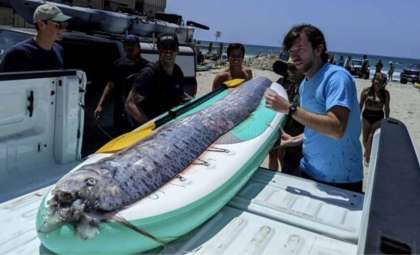
The oarfish, or Regalecus glesne, inhabits the deep ocean and seldom comes near the surface. Its long, ribbon-like body and bright red dorsal fin have led to its nickname, “King of Herrings.” The recent discovery took place at La Jolla Cove, a well-known dive location close to San Diego.
Rooted in ancient tales and Japanese folklore, oarfish sightings near shorelines are traditionally seen as indicators of imminent earthquakes or natural disasters. In Japan, they are referred to as “ryugu no tsukai,” meaning “the messenger from the sea god’s palace.”
This new encounter has reignited interest in the supposed link between oarfish surfacing and seismic events. Notably, a magnitude 4.4 earthquake affected Los Angeles just two days after the fish was spotted, intensifying curiosity about these mysterious sea creatures.

Experts weigh in on the “Omen Fish” theory
Despite the intriguing timing, researchers remain cautious about confirming any direct connection between oarfish appearances and earthquakes. Animal biology expert Rachel Grant from Anglia Ruskin University in Cambridge provides one hypothesis:
“There is a theoretical possibility that dying oarfish might signify upcoming seismic disturbances. Earthquakes can produce pressure shifts in the earth’s crust, generating electrostatic charges and releasing charged ions into ocean waters.”
Still, it is important to emphasize that no definitive scientific proof currently exists to validate claims linking oarfish sightings with earthquake forecasting. The Ecuadorian Geophysical Institute has stressed the absence of credible evidence supporting this notion.
Distinctive traits of the oarfish
Understanding more about these elusive giants includes noting their features:
- They can reach lengths up to 36 feet, making them the longest known bony fish on Earth
- A red crown of spines adorns their heads
- Their diet mainly consists of krill, plankton, and small crustaceans
- They typically dwell at depths ranging between 200 and 1,000 meters
California's earthquake record and the threat of the “Big One”
The oarfish's appearance has renewed anxiety about California’s susceptibility to massive tremors, specifically the feared “Big One.” This potential mega-quake could be unleashed by seismic activity along the San Andreas Fault, which extends through much of the state.
Significant previous earthquakes in California include:
DateLocationMagnitudeConsequencesJuly 5, 2019Ridgecrest7.1The strongest quake in two decadesJune 28, 1992Landers7.3One death and over 350 injuriesApril 25, 1992Cape Mendocino7.295 injured and extensive damage
While these events caused significant harm, seismologists warn that the anticipated “Big One” could deliver disaster on an even larger scale. The San Andreas Fault is capable of triggering earthquakes measuring 8.0 or higher, potentially inflicting widespread damage across California.
Bridging myth and modern science
As research continues on the oarfish and its possible ties to seismic activity, the recent San Diego finding highlights the nuanced relationship between ancient stories and scientific investigation. Though the “Doomsday Fish” myth lacks firm scientific backing, it reflects humanity’s deep-seated urge to find meaning in natural events.
This oarfish was taken to a National Oceanic and Atmospheric Administration (NOAA) lab for further examination, where scientists aim to determine the cause of death and collect valuable data on this rare species.
For Californians vigilant about earthquake readiness, the oarfish sighting represents a captivating blend of legend and fact. While it’s improbable that these deep-sea dwellers can forecast earthquakes, their rare appearances continue to spark wonder about the hidden forces beneath Earth’s surface.
Whether or not the “Doomsday Fish” truly signals disaster, its presence underscores the vital role of ongoing scientific exploration and our enduring fascination with nature’s mysteries. The oarfish remains a symbol of oceanic secrets and the many captivating phenomena yet to be uncovered in the depths.
- Categories:
- Science ,
- Climate change ,
- Evolution















0 comments
Sign in to Comment