

In a pioneering study, scientists have managed to convert light into a supersolid, a rare state of matter that uniquely combines characteristics of both solids and fluids. Published in Nature, this achievement by a collaborative team of physicists and nanotechnology experts marks a significant breakthrough for quantum physics, photonics, and material science.
The Nature of Supersolids
A supersolid is an intriguing phase of matter that simultaneously holds a rigid crystalline arrangement like a solid and can exhibit frictionless flow, a hallmark of superfluid behavior.
Until now, supersolids have only been realized in ultracold atomic systems near temperatures approaching absolute zero. Generating a supersolid using photons challenges traditional understanding of matter's states and energy dynamics.

Creating a Solid State of Light
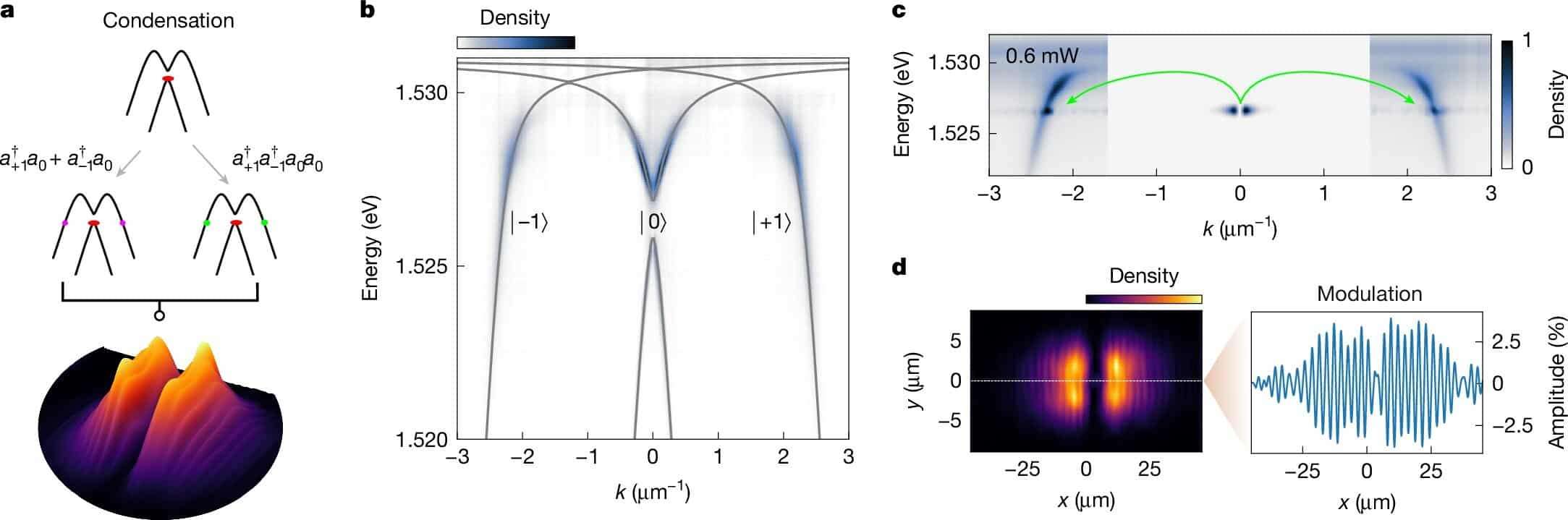
Led by Dimitris Trypogeorgos and Daniele Sanvitto from Italy’s National Research Council (CNR), the project involved directing a laser beam at a specifically designed gallium arsenide substrate featuring nanoscale ridges.
This interaction resulted in the formation of polaritons, quasiparticles blending light and matter that displayed supersolid characteristics.
The experimental setup induced polaritons to arrange themselves into a regular lattice while still flowing without friction. As Trypogeorgos remarked,
“We actually made light into a solid. That’s pretty awesome.”
The Impact of Photon-Based Supersolids
This marks the inaugural creation of a light-based supersolid, which could revolutionize control over photonic materials and quantum architectures.
Compared to earlier methods reliant on near-zero temperature atomic gases, light-driven supersolids may offer increased stability and tunability, presenting a promising platform for quantum computing and optical innovation.
Quantum information processing stands to gain from this discovery by leveraging supersolid photonic systems that could provide robust qubit environments, enhancing quantum coherence.
Furthermore, engineering supersolid states of light could catalyze advancements in high-performance optical circuits, enabling faster and more efficient photonic components. This also opens new research pathways into exotic matter phases and deepens insight into intense light-matter coupling in quantum regimes.
The Road Ahead
The researchers aim to perfect their technique to exercise finer control over photonic supersolids and investigate their use in cutting-edge quantum technologies.
Future efforts will prioritize stabilizing and manipulating these light-based phases, potentially transforming numerous sectors spanning fundamental physics, photon-based devices, and quantum computation.
This extraordinary development redefines light’s capabilities and sets a foundation for extraordinary progress in quantum material science and technology.
Harnessing light that acts as both a fluid and a solid could revolutionize scientific approaches to quantum materials and their real-world applications.











0 comments
Sign in to Comment