
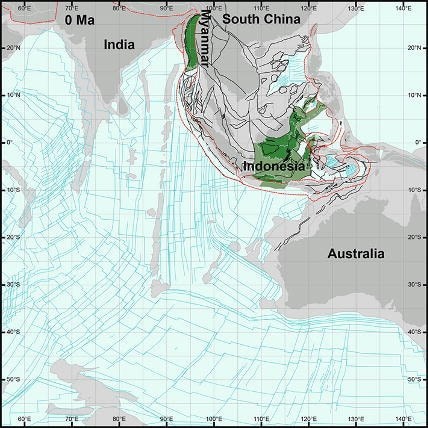
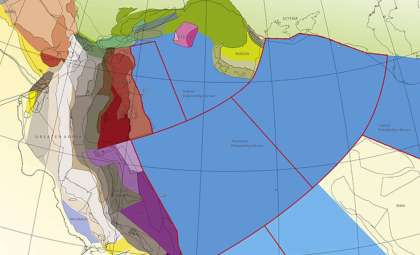
About 155 million years ago, a landmass named Argoland separated from the ancient continent that became Australia, only to seemingly disappear from geological records. Now, after extensive research, scientists reveal that Argoland wasn’t lost but rather broken into fragments scattered across the ocean floor beneath Southeast Asia.
A recent investigation led by Utrecht University researchers overturns earlier notions of continental movement and fragmentation. Unlike typical large continents drifting intact, Argoland split into numerous continental strands, lying concealed beneath islands such as those in eastern Indonesia and parts of Myanmar.
Geologists were long confounded by Argoland’s vanishing act. Typically, continental breakups leave behind unmistakable clues — rock formations, fossil evidence, or mountain chains — tracing the paths of the drifting landmasses. However, Argoland’s past left little trace, prompting speculation about whether it had submerged, melted deep into the mantle, or was simply misinterpreted.

Fragmentation, Not Vanishing, Explains Argoland’s Fate
Unlike other Gondwana remnants that split off cleanly, Argoland cracked into numerous smaller pieces early in its breakup. These segments traveled independently, making their paths hard to trace. Lead researcher Eldert Advokaat told Live Science that previous efforts to connect scattered geological pieces simply didn’t add up. “Nothing fit,” he said.
This fragmentation set Argoland apart from typical continental breaks seen between Africa and South America. The Utrecht team proposed that Argoland originally consisted of multiple microcontinents, a theory that helped unlock the mystery.
The press release states most shards drifted toward eastern Indonesia, while others settled near Myanmar. Because these pieces spread widely, they were hard to piece together until researchers described Argoland as a “ribbon continent”.
Introducing the “Argopelago” Concept
To characterize the broken nature of Argoland, the scientists introduced the term “Argopelago.” This concept views the continent not as a single entity but as a “widely dispersed and fragmented collection” of continental fragments separated by oceanic crust yet geologically connected.
Geologist and co-author Douwe van Hinsbergen highlighted that these geological reconstructions extend beyond pure academic value.
“Those reconstructions are vital for our understanding of processes like the evolution of biodiversity and climate, or for finding raw materials.”
The results appeared in the peer-reviewed journal Gondwana Research. The researchers stressed that abandoning the idea of continents acting as rigid blocks was essential in revealing Argoland’s complex structure.
Unlocking Biological Mysteries: The Wallace Line Connection
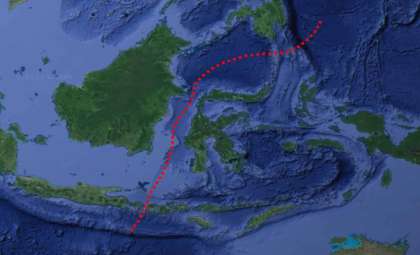
Beyond geology, uncovering Argoland might shed light on enigmatic ecological boundaries such as the Wallace Line. This invisible divide cuts through Indonesia, separating ecosystems where placental mammals (like elephants and tigers) thrive to the west and marsupials along with cockatoos populate the east.
The sharp disparity has confounded scientists for years. The new findings suggest Argoland’s breakup may have carried distinct animal populations that later interacted only partially with Southeast Asia’s fauna when the continental pieces collided with the region.
Advokaat noted that the drifting and eventual emplacement of Argoland likely reinforced the Wallace Line’s ecological separation. This insight could be pivotal in tracing how species migrated or were barred from crossing ancient island chains.
- Categories:
- News

0 comments
Sign in to Comment