

After years of diligent investigation, the SETI@home initiative is nearing the conclusion of its extensive hunt for signs of extraterrestrial communications. Scientists at the University of California, Berkeley, have refined their search to the last 100 unexplained radio signals, representing a landmark effort in this long-term endeavor. These results were detailed in two 2025 publications in The Astronomical Journal, one concentrating on data collection and processing, and the other on analytical results and interpretations.
Decades of Analyzing the Cosmic Frontier
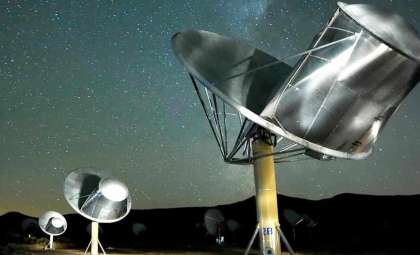
Launched in 1999, SETI@home harnessed the power of millions of volunteer computers worldwide to analyze radio waves captured by the Arecibo Observatory. For many years, incoming signals accumulated faster than researchers could thoroughly examine them.
“Until about 2016, we didn’t really know what we were going to do with these detections that we’d accumulated,” said David Anderson, computer scientist at UC Berkeley and co-founder of the project. “We hadn’t figured out how to do the whole second part of the analysis.”
Add Cosmo Herald as a Preferred Source

The 2025 studies close this gap, explaining how billions of candidate signals were methodically assessed to identify those potentially originating from extraterrestrial intelligence. Anderson described these as "brief bursts of energy at distinct frequencies coming from specific sky coordinates." The team engineered new computational tools to filter out interference from satellites, radar, and other terrestrial sources.
Despite such advancements, the vast volume of data means it remains impossible to examine every detected signal manually. As noted by Berkeley astronomer Eric Korpela, "A complete analysis of every signal exceeds human capacity since it still demands careful, individual attention."
Breakthroughs and Methodological Advances in the 2025 Publications
The first paper focuses on the cutting-edge methods of data capture and filtering that set SETI@home apart, while the second article delves into data interpretation, revealing how advanced algorithms isolated about 100 leading candidate signals. Both stress transparency, releasing comprehensive datasets and source code so the scientific community can verify and extend the research independently.
As Anderson pointed out,
“If we don’t find ET, what we can say is that we have established a new sensitivity level. If there were a signal above a certain power, we would have found it.”
The research represents the most sensitive narrowband sweep of vast sky regions ever accomplished.
The Emotional Journey of Cosmic Exploration
The researchers admit a mix of pride and slight disappointment. "Our search was the most sensitive to date, giving us the best shot at a discovery," Korpela remarked. "So yes, it’s a bit frustrating that no definitive signal emerged."
Nonetheless, the team remains grounded in scientific reality. Anderson acknowledges that early data processing decisions, constrained by computing limitations in the 1990s, may have inadvertently omitted some information.
“We have to do a better job of measuring what we’re excluding,” he said. “Are we throwing out the baby with the bath water? I don’t think we know for most SETI searches… In a world where I had the money, I would reanalyze it the right way. And we did make some mistakes. These were conscious choices because of how fast computers were in 1999.”
Persisting in the Face of Cosmic Noise
The dataset still holds some mysteries. The team's filtering process may not have identified every meaningful signal. Anderson noted,
“There’s still the potential that ET is in that data and we missed it just by a hair.”
This uncertainty inspires ongoing dedication and creativity, reminding us that the quest for extraterrestrial intelligence constantly navigates between rigorous data analysis and hopeful anticipation.
Looking ahead, the work of Korpela and Anderson paves the way for future SETI efforts, incorporating machine learning and expanding telescope capabilities. SETI@home's legacy endures as a bridge linking human curiosity with the possibilities of the universe.
- Categories:
- Extraterrestrial life














0 comments
Sign in to Comment