
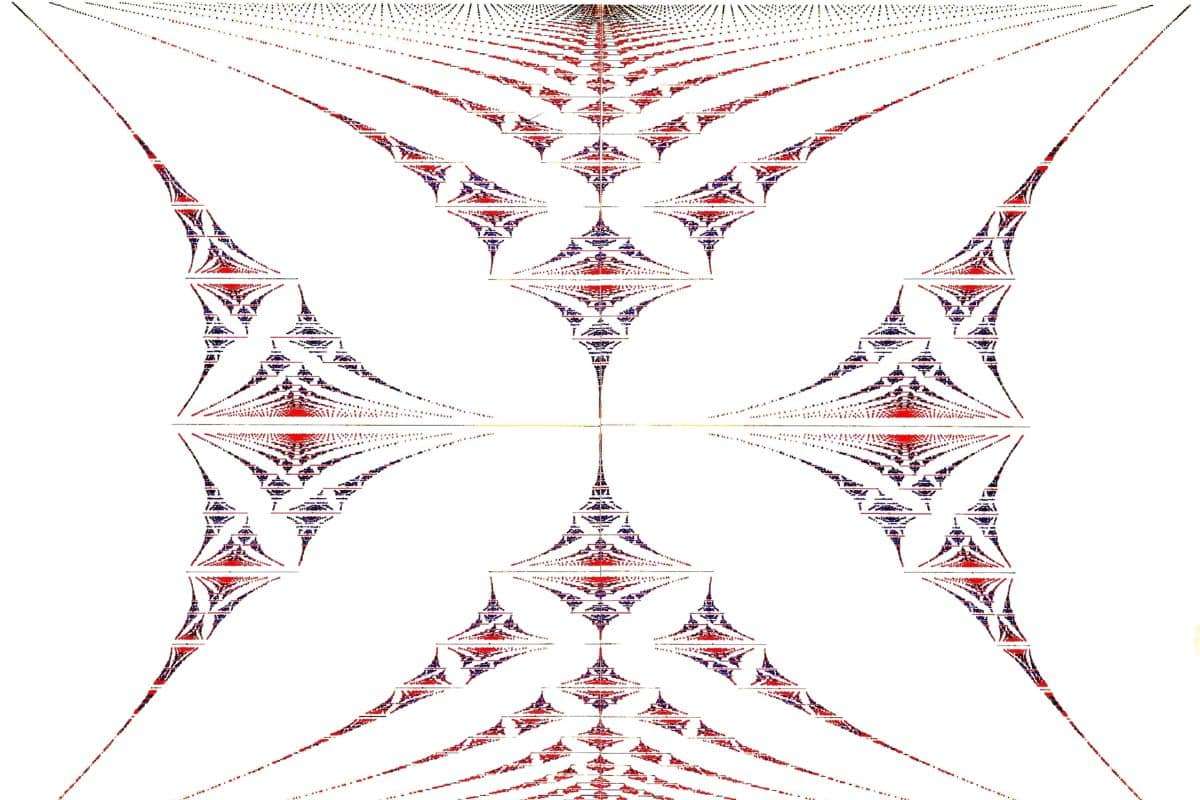
Researchers at Princeton University have made a groundbreaking observation of Hofstadter’s butterfly — a complex fractal structure in electron energy states originally predicted in 1976 but never previously seen in a physical material.
This discovery emerged from experiments on graphene superconductivity, providing an unprecedented glimpse into the self-similar energy landscape governed by quantum mechanics and advancing our understanding of fundamental physics.
Half a Century-Old Prediction Comes Into View
The team behind the Nature publication wasn’t actively seeking Hofstadter’s butterfly at the outset. Their primary focus was probing electron behavior within twisted bilayer graphene, a carbon structure known for its superconducting properties under precise conditions.

A minor, unintended misalignment during sample fabrication serendipitously created an optimal setup, enabling the visualization of the elusive fractal pattern. When exposed to a magnetic field, the electrons manifested a complex, recurring energy configuration — directly reflecting the patterns Douglas Hofstadter theorized nearly 50 years ago.
Revealing Quantum Fractals Through Graphene
To detect this subtle quantum phenomenon, scientists employed a scanning tunneling microscope (STM), which can measure electron energies at atomic precision. This allowed them to map the moiré superlattice created by two graphene sheets stacked at a slight angle.
The resulting data showed groups of electron energy bands forming repetitive, fractal-like arrangements. These closely matched the Hofstadter model, producing the iconic butterfly-shaped pattern long theorized in quantum physics.
Quantum Fractals: Nature’s Recursive Design
While fractals are visible throughout nature—from tree branches to mountain ranges—their presence in quantum systems is quite rare.
The Hofstadter spectrum exemplifies a distinct quantum fractal. Its direct observation not only validates theoretical predictions but also highlights how tailor-made materials can be utilized to experimentally study complex quantum phenomena.
Exploring Electron Interactions and New Quantum States
Beyond confirming Hofstadter’s initial concept, the findings exposed more nuanced electron dynamics. The electron energy distributions aligned more accurately with updated models considering electron-electron interactions, factors not included in the original 1976 theory.
This enhanced understanding underpins the collective behavior of electrons in moiré materials and suggests emergent physics like topological quantum phases, which are increasingly relevant in advanced materials research.
An Unexpected Quantum Discovery
The collaborative project involved Princeton theorists and experimentalists, including Ali Yazdani, Biao Lian, and their graduate students.
Co-lead author Kevin Nuckolls attributes their success to meticulous methodology paired with fortunate circumstances. He noted, “Hofstadter’s butterfly represents a rare quantum problem that is exactly solvable, without approximations.”
“Since Hofstadter’s original work, there have been many experiments and wonderful papers on the subject but, before our work, no one had ever actually visualized this beautiful energy spectrum.”
- Categories:
- Science











0 comments
Sign in to Comment