
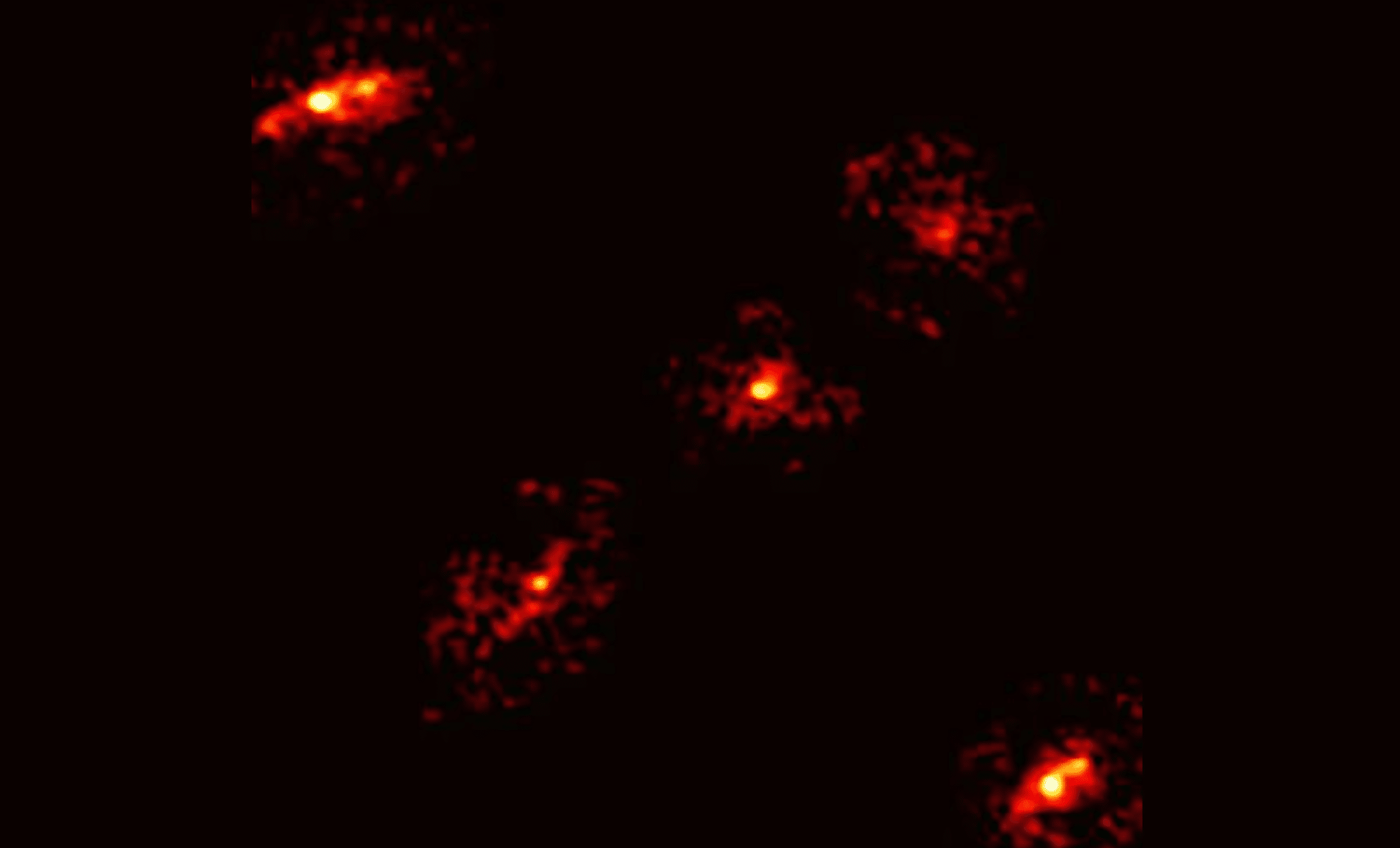
International researchers have identified a unique Einstein Cross displaying five luminous points instead of the typical four. Featured in a recent publication in The Astrophysical Journal, this rare cosmic alignment opens new avenues to explore the mysterious dark matter enveloping galaxies.
An Extraordinary Astronomical Event
The investigation began after Rutgers astrophysicist Charles Keeton received a surprising picture from his colleague. “Ever encountered an Einstein Cross with a central image?” queried Andrew Baker, highlighting an unusual astrophysical pattern. The image featured a fifth glowing point at the center—an unexpected occurrence grabbing immediate attention. “I said, well, that’s not supposed to happen,” recalled Keeton, Vice Provost for Experiential Learning at Rutgers University–New Brunswick. “You only get a fifth image at the center if there’s something irregular about the mass bending the light.”
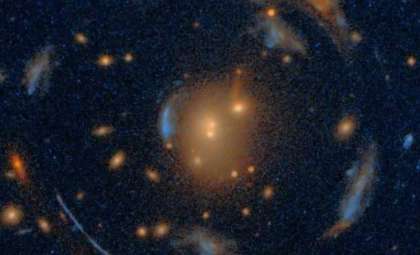
This phenomenon arises when a foreground galaxy’s gravity bends light from a more distant galaxy, typically forming four visible images. The discovery of a fifth point hinted at the presence of an unseen, massive component. Through thorough computer simulations and analysis, the team ascribed this to a dark matter halo.

Probing the Unknown with Cutting-Edge Telescopes
The initial detection occurred in France utilizing the Northern Extended Millimeter Array (NOEMA). “We were like, ‘What on earth?'” said Pierre Cox, a French astronomer and Research Director at CNRS, recalling his discovery of the anomaly. “It resembled a cross with a central image. I’d never seen anything like it before.”
To validate the observation, the scientists used the Atacama Large Millimeter/submillimeter Array (ALMA) in Chile. They observed the faraway, dust-enshrouded galaxy HerS-3 splitting into five distinct light images. At first, instrumental errors were suspected, but repeated studies confirmed the reality of the fifth image. This highly accurate data enabled researchers to investigate dark matter’s gravitational influences in ways seldom achievable through luminous matter.
Unveiling the Concealed Dark Matter
After verifying the anomaly, Keeton teamed up with Rutgers graduate Lana Eid to conduct extensive computational modeling. “We explored every plausible scenario using only the visible galaxies, and none matched,” explained Keeton, a professor in Rutgers’ Department of Physics and Astronomy. “The only solution to reconcile the observations was adding a dark matter halo. Modeling reveals the unseen.”
The simulations showed that this invisible halo accounted for the central fifth image and enhanced the magnification of the background galaxy. Such lensing offers astronomers a rare window to examine the distant galaxy’s inner features and composition with unprecedented clarity. These models also yield testable predictions, including gas outflows from HerS-3, guiding future observations to advance our understanding of mass distribution in the universe.
- Categories:
- News








0 comments
Sign in to Comment