
Could the strange light flashes seen during the 1950s be connected to nuclear detonations from the Cold War era? A recent investigation proposes this unlikely link, revealing that these mysterious luminous bursts appeared significantly more frequently within the 24-hour window following atmospheric nuclear tests.
The study, led by Stephen Bruehl from Vanderbilt University alongside Beatriz Villarroel of Stockholm University, analyzed thousands of vintage sky photographs from the Palomar Observatory Sky Survey (POSS-I). Published in Scientific Reports, their findings present one of the earliest data-driven correlations between nuclear weapon testing and unexplained aerial phenomena (UAPs).
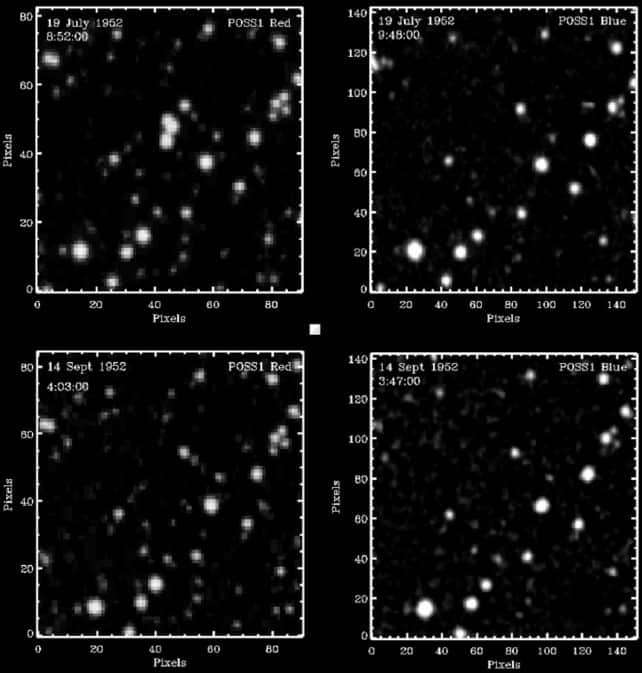
From 1949 to 1958, the POSS-I project documented the northern celestial sphere using glass plates. At the time, astronomers observed brief light flashes termed transients, which appeared in one image and then disappeared for good. These were often dismissed as photographic errors. However, the new analysis reveals a striking pattern: these transients occurred notably more often immediately following atmospheric nuclear detonations conducted by the US, Soviet Union, and UK.

Spike in Light Events Detected the Day After Nuclear Tests
The most dramatic increase was seen within 24 hours after a nuclear explosion, with a 68% higher incidence of transient light occurrences. Such a clear temporal relationship challenges the idea that these were mere imaging defects.
Importantly, the exact timing of these nuclear tests was top secret at the time, and those capturing the photographs were unaware of the detonations’ precise moments. This rules out observer bias or prior knowledge influencing the observations.
Subtle Yet Noticeable Link With UFO Sightings
The team extended their investigation to historical UAP (UFO) reports from the UFOCAT database, looking for related timing trends.
Interestingly, on days when multiple UAP incidents were recorded, there was an approximately 8.5% increase in the likelihood of transients appearing in the archival sky images. Moreover, a modest rise in UAP reports coincided with periods of nuclear testing.
ScienceAlert highlights that the research stops short of explaining what caused these phenomena or confirming a direct connection between UAPs and the transients. Still, it marks the first scientifically substantiated link between these events documented in a peer-reviewed journal.
The True Nature of the Flashes Remains Unknown
Published on October 20, 2025, the paper also dismisses easy explanations. Radioactive fallout seems unlikely since visible effects would manifest over a longer timeframe, not within a day. Similarly, random camera or film glitches would not align so closely with classified nuclear testing dates.
The researchers refrained from speculating on the exact cause of the flashes, focusing instead on confirming the reproducible pattern of their appearance.
“Regardless of what transients are ultimately determined to be,” they write, “our results add to growing evidence supporting the interpretation of transients as real observations rather than as emulsion defects.”
In short, telescopes captured something unusual in the aftermath of these nuclear detonations. Pinpointing what this ‘something’ was remains an open question.
The fact that these eerie sky lights were recorded during an era without digital imaging or satellites suggests that Cold War nuclear tests might have briefly illuminated the night sky in mysterious ways we are just starting to unravel.
- Categories:
- Space







0 comments
Sign in to Comment