
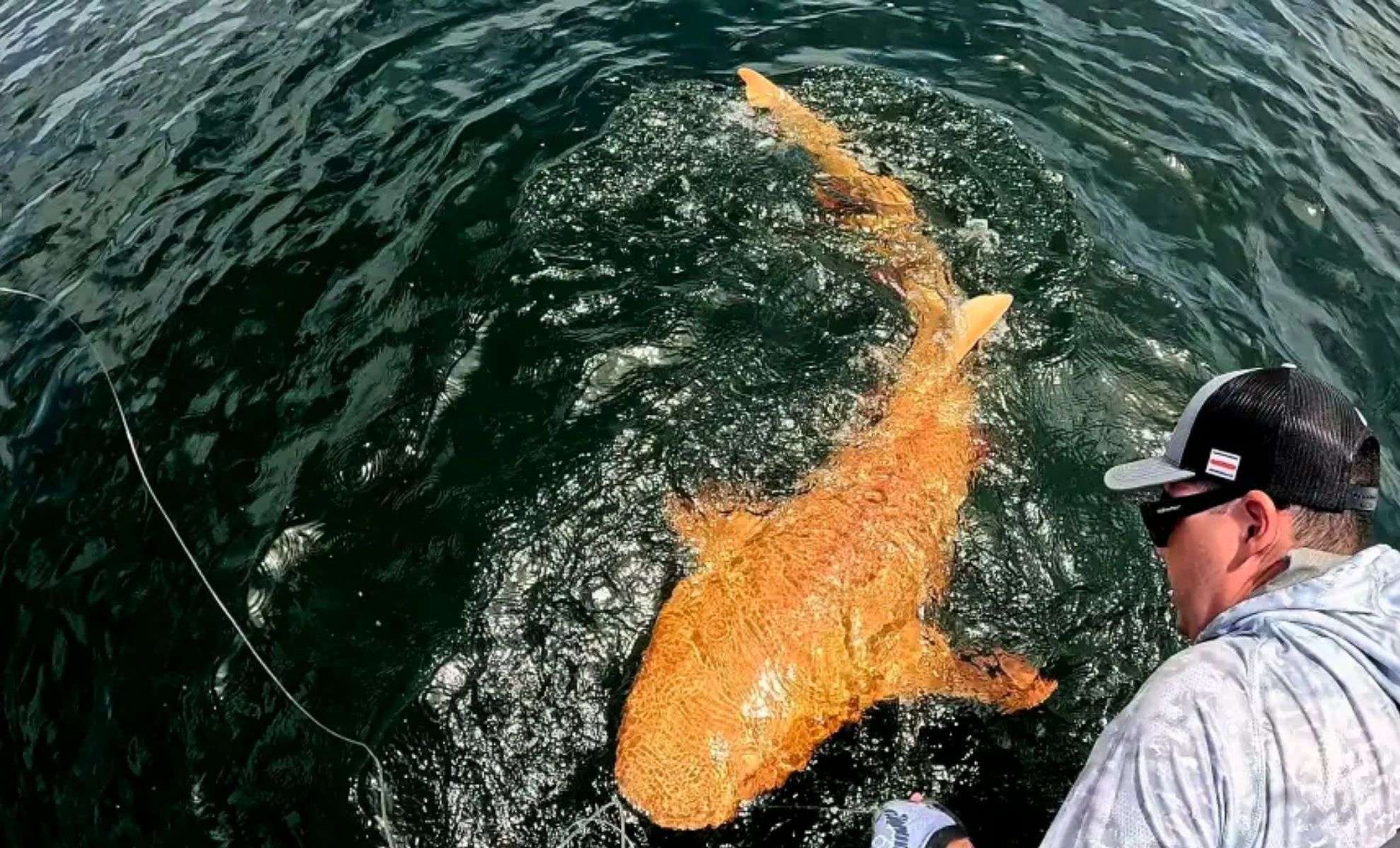
Scientists encountered a nurse shark near Costa Rica exhibiting an extraordinary coloration: its entire body displayed a vivid yellow-orange shade. This marks the first documented instance of xanthochromism—an uncommon pigment anomaly—in this species and the inaugural report of such a trait in any cartilaginous fish within the Caribbean region.
Unusual Hue Revealed Below the Ocean's Surface
The specimen (Ginglymostoma cirratum) was spotted during a recreational fishing expedition in the vicinity of Tortuguero National Park last year, where it was temporarily caught at a depth of 37 meters before being safely released. Measuring approximately 2 meters (6.5 feet) long, its bright yellow-orange skin was immediately noticeable. The initial sighting was shared on Facebook and later formally detailed in the journal Marine Biodiversity.
Researchers attributed the rare coloration to xanthochromism, also called xanthism. This condition results from an excessive expression of yellow or orange pigments and has been observed in various animals including birds and reptiles, but until now, it had never been identified in nurse sharks or any cartilaginous fish inhabiting Costa Rica’s Caribbean or Pacific waters.

An Extraordinary Genetic Trait Affecting More Than Just Color
What makes this shark unique is that its eyes were also unusual. Rather than the typical dark irises, they appeared white with “no visible irises,” suggesting that the shark exhibited more than simple xanthism. Scientists propose it displayed albino-xanthochromism, a rare combination of albinism and xanthism—uncommon in marine creatures.
The genetic basis of xanthochromism isn't fully clarified, but it likely arises from a recessive mutation that suppresses darker pigment production while promoting yellow-orange tones. Similar to melanism and leucism, xanthism may increase an organism’s visibility in its environment, potentially reducing its chances of survival.
Thriving Despite Its Distinctive Appearance
Remarkably, the vividly colored nurse shark appeared healthy and mature. The research team notes its size indicates that “this rare pigmentation did not impede its survival.” Nurse sharks typically prey on small fish, mollusks, and crustaceans, and this individual seems to have reached adulthood unhindered.
However, the conspicuous coloring might pose challenges. In many species, unusual pigmentation can increase detectability by predators and prey alike, potentially impacting natural camouflage. Whether this rare pigmentation influences the shark’s ability to hunt or avoid threats remains uncertain.
Unraveling the Mysteries Below
While genetic causes are primarily credited for the shark’s pigmentation, researchers caution that other factors might contribute. “Elements such as inbreeding, environmental stressors, rising temperatures, and hormonal changes could also impact coloration,” the study notes.
They recommend further research into the genetic diversity of nurse sharks and detailed monitoring of environmental conditions in the northern Caribbean to better understand this rare pigmentation phenomenon.
- Categories:
- News









0 comments
Sign in to Comment