
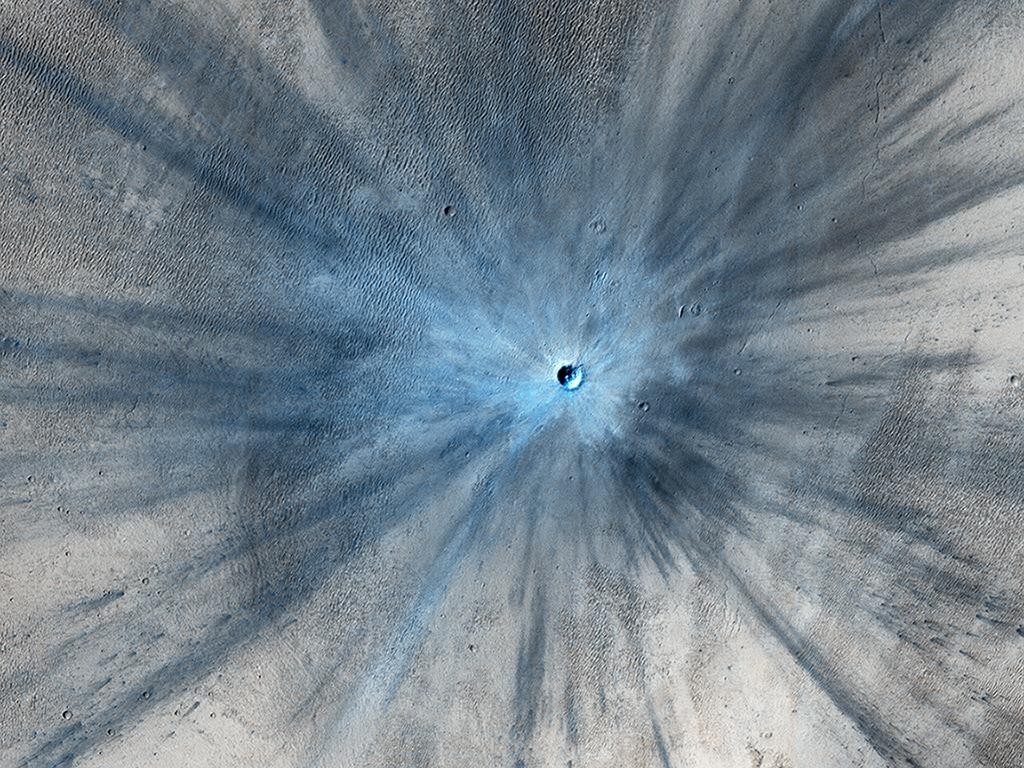
NASA’s Mars Reconnaissance Orbiter recently captured breathtaking images of a new impact crater on the Martian surface. Using the orbiter's HiRISE camera, the team revealed a 30-meter-wide crater surrounded by a blast zone with debris scattered nearly 15 kilometers away.
Estimated to have formed between 2010 and 2012, this recent impact offers fresh insights into the frequency of collisions on Mars and how these violent events continue to reshape the planet's dusty terrain. The bright blue hue of the crater, contrasting sharply with Mars's usual red surface, makes this one of the most visually striking impact sites observed to date.
HiRISE Captures the Dramatic Martian Impact Zone
HiRISE (High Resolution Imaging Science Experiment) is one of six instruments aboard NASA’s Mars Reconnaissance Orbiter, which has been continuously surveying Mars since 2006. This particular discovery began when scientists noticed surface changes with the Context Camera, prompting HiRISE to zoom in and capture the full details of the impact event.

NASA reports that the striking blast pattern uncovered subsurface materials, removing the iconic red dust and giving the crater its distinctive bluish tint.
Located at 3.7° north latitude and 53.4° east longitude, this crater is now under close examination, providing clues about the scale and frequency of recent impacts on Mars.
Pinpointing the Impact’s Date and Origin Through Imaging
By comparing images from the Context Camera between July 2010 and May 2012, researchers identified that this crater formed within that timeframe. Marked as ESP_034285_1835, NASA's HiRISE captured detailed images on November 19, 2013, confirming the crater’s sudden appearance.
The site sits in an unusually dusty region, where the meteorite strike blasted away the red surface dust to expose darker material beneath. This exposure creates a strong color contrast, making the crater stand out vividly in enhanced photos.
“Debris tossed outward during the formation of the crater is called ejecta. In examining ejecta’s distribution, scientists can learn more about the impact event. The explosion that excavated this crater threw ejecta as far as 9.3 miles (15 kilometers).”
A Rare and Clear Window Into Martian Surface Evolution
While new craters frequently form on Mars, few are as visually impressive as this example. The size of the impact zone and the crisp image quality make it a vital reference for future Martian geological research. NASA notes that impacts generating craters larger than 3.9 meters happen over 200 times annually worldwide on Mars, but only a small number are detected with enough precision for detailed follow-up.
Here, the availability of before-and-after imagery greatly enhances the study of this event, enabling researchers to better determine its exact timing and consequences. The combined use of the Context Camera and HiRISE images equips planetary scientists with enhanced tools to monitor Martian surface changes and map ejecta patterns with unprecedented accuracy. According to NASA’s Photojournal, this impact is among the clearest recent examples demonstrating how Mars’ surface continues to be shaped by external forces.
- Categories:
- Astronomy




0 comments
Sign in to Comment