
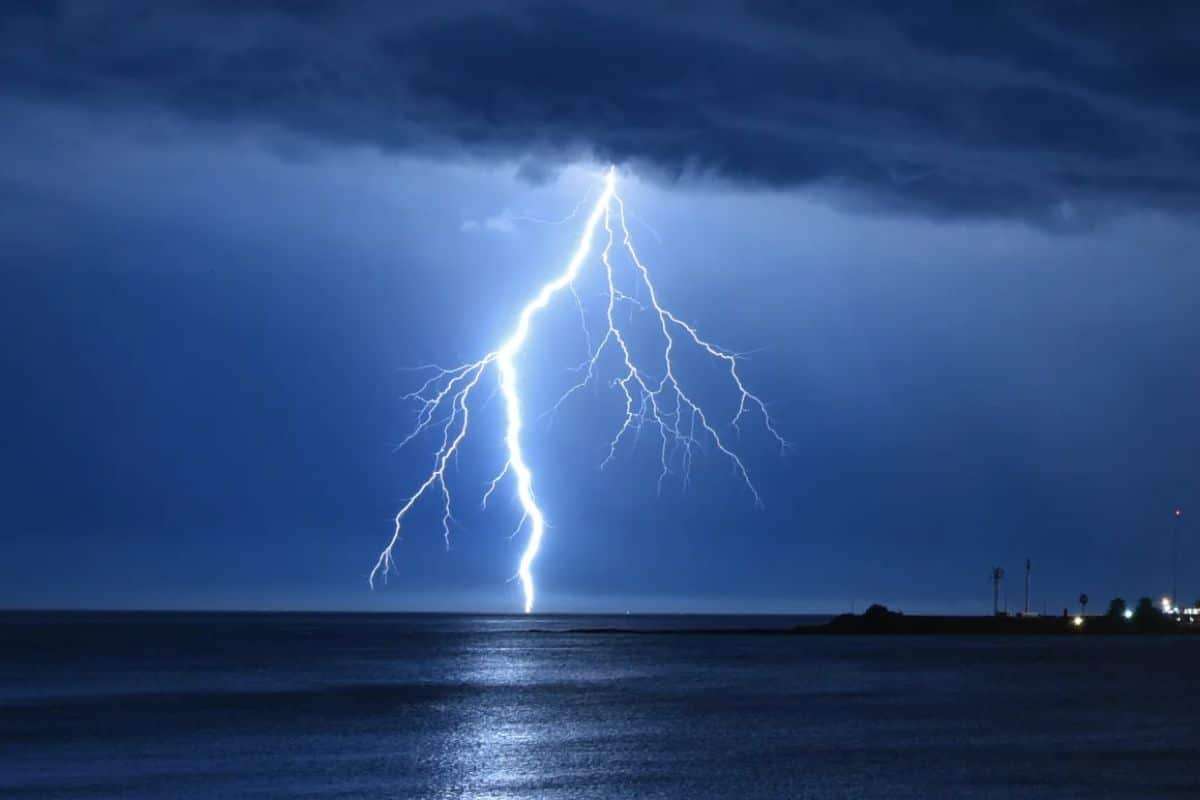
Recent research uncovers that minute electrical discharges, known as microlightning, occurring inside microscopic water droplets may have played a crucial role in creating the first amino acids on our planet.
This discovery offers a fresh perspective on a classical scientific experiment, illuminating new pathways toward unraveling life’s beginnings.
Revisiting A Classic Experiment with New Insights
The foundation of this idea dates back to 1953, when Stanley Miller and Harold Urey pioneered an experiment simulating Earth’s early atmosphere. By mixing gases such as ammonia, methane, hydrogen, and water vapor inside a sealed container and applying electric sparks, they generated amino acids—the essential building blocks of proteins.
Published recently in Science Advances, the new study led by Dr. Richard Zare from Stanford University, shifts focus from large lightning bolts to the electrical activity between charged water droplets as tiny as a micron.
“The larger droplets carry a positive charge, while the smaller ones hold a negative charge,” Zare told CNN. “When droplets with opposite charges approach, electrons can leap from the negative to the positive droplet.”

Microlightning in Action: Sparks at the Microscale
By generating the Miller-Urey gas environment and introducing a fine mist of water droplets, researchers observed faint flashes blazing between these droplets using high-speed photography. These miniature sparks initiated chemical reactions that produced amino acids such as glycine and uracil, a vital nucleotide in RNA.
While the underlying chemical and physical principles were understood, the scale and evidence of light-emitting tiny droplets are novel. “For the first time, we’ve witnessed that small droplets from water generate visible sparks,” Zare explained. “These sparks drive a variety of chemical changes.”
Why Microlightning Is a Game-Changer Compared to Traditional Lightning
Microlightning’s significance stems from its abundance. Large lightning strikes are infrequent, particularly on early Earth, which might have limited their capacity to produce sufficient amino acids for life’s emergence. “Even on a tumultuous early Earth, lightning may have been too sparse to yield adequate quantities of amino acids,” Zare stated in an interview with CNN. In contrast, mist was widespread—found in oceans, volcanic vapors, and clouds—offering a constant source of electrical activity.
“Microdischarges between charged microdroplets replicate all organic molecules observed in the Miller-Urey experiment,” Zare remarked. “This suggests a novel method for the prebiotic formation of life’s molecular precursors.”
Scientific Community Perspectives
Dr. Amy J. Williams, an astrobiologist and geobiologist at the University of Florida, highlighted the critical role of such energetic phenomena. “Lightning, including microlightning, delivers enough energy to break molecular bonds and enable the synthesis of molecules vital for life's origin,” she noted.
She further emphasized the significant energy needed to liberate nitrogen atoms to bond with carbon in amino acid formation. This study demonstrates that microlightning supplies sufficient energy to make these reactions feasible in early Earth conditions.
- Categories:
- News





0 comments
Sign in to Comment