
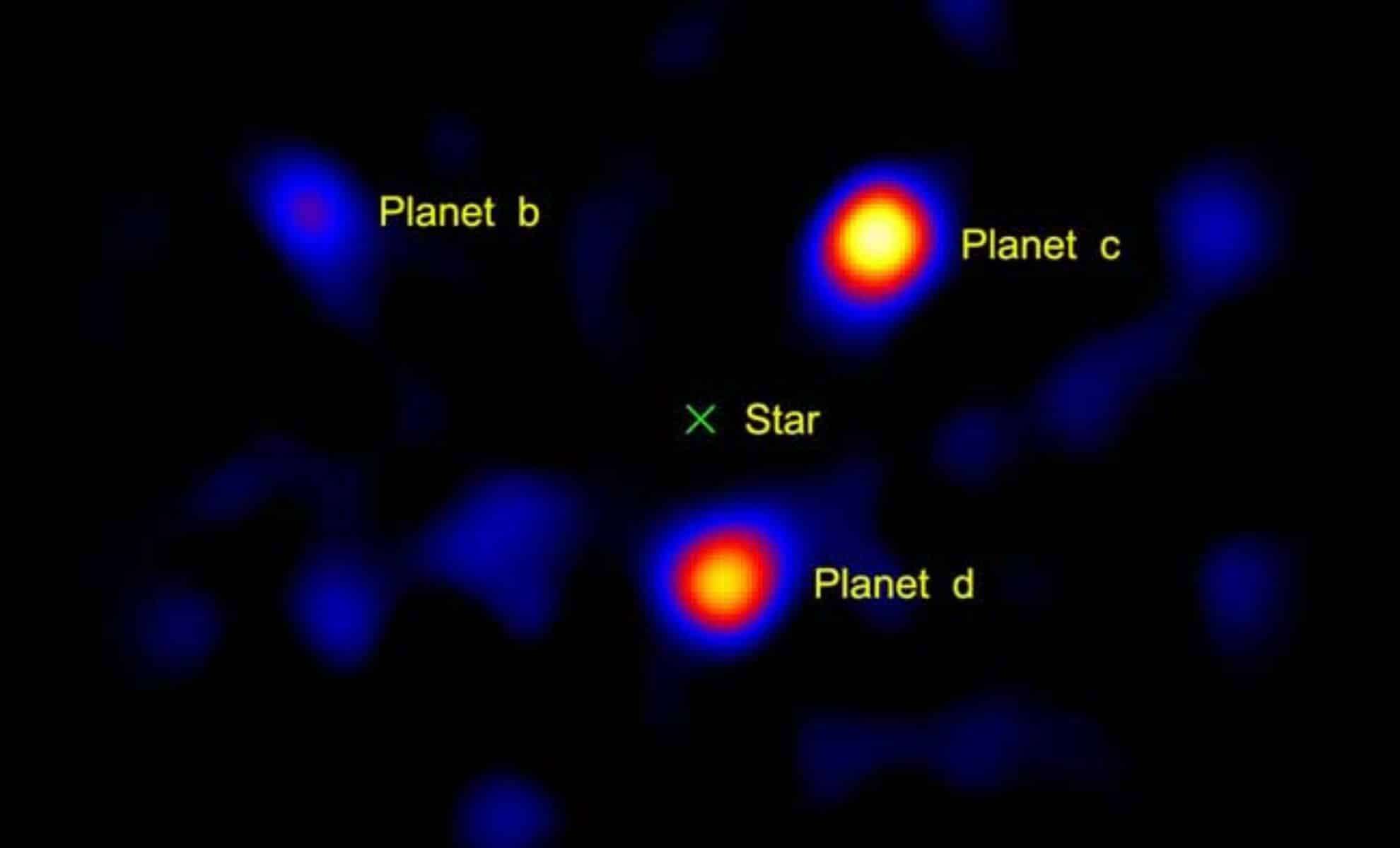
A stunning time-lapse video condenses over a decade’s worth of space observations into mere seconds, revealing the mesmerizing movements of exoplanets in a far-off star system. Crafted by astrophysicist Jason Wang from Northwestern University, the animation highlights four colossal planets circling the youthful star HR 8799.
Advancing the Visualization of Exoplanetary Orbits
Featured by Space.com, this video is assembled from 12 years of data collected by the W. M. Keck Observatory in Hawaii. Following planets beyond our solar system requires cutting-edge methods. The quartet of planets around HR 8799 each dwarf Jupiter in size, but their harsh distance—roughly 133 light-years away in the Pegasus constellation—makes them tricky targets.
By leveraging sophisticated adaptive optics along with a coronagraph to reduce the star’s overwhelming glare, astronomers revealed the faint reflected light from these distant giants. These techniques were essential for producing a visual representation of their orbits that is accessible and compelling.

This latest video expands on an earlier version covering seven years, enriching the planetary trajectories with five additional years of observation. The smoother orbital paths provide fresh insight into the planets’ graceful, slow-motion rotations around their host star.
The Unique Characteristics of HR 8799
HR 8799 stands out among stars. Weighing 1.5 times the mass of our Sun and shining at five times its brightness, it is notable for being relatively young. At approximately 30 million years old, it’s a newborn compared to our 4.5-billion-year-old star.
Its youthful heat makes detecting its gas giants easier. Planets around HR 8799 still emit heat from their formation, glowing visibly in infrared. This made HR 8799 the first star system to have its exoplanets directly imaged back in 2008.
The system boasts at least four massive planets, each larger than Jupiter, with orbital periods varying from about 45 years for the innermost to nearly 500 years for the outermost world.
The Importance of the Timelapse Visualization
While not providing new scientific results, this video is a vital tool for science outreach. Jason Wang explains: “There’s nothing to be gained scientifically from watching the orbiting systems in a timelapse video, but it helps others appreciate what we’re studying.”
“It can be difficult to explain the nuances of science with words. But showing science in action helps others understand its importance,” he added.
Presenting phenomena that unfold over centuries in a short, visual format bridges the divide between complex astrophysical data and everyday understanding. It turns sophisticated orbital dynamics into an engaging display that resonates both emotionally and intellectually. For scientists and educators alike, it serves as a powerful medium for communicating their work.
Decades of Patience in Exoplanet Exploration
Examining planetary systems such as HR 8799 is a meticulous endeavor. Researchers depend on data spanning many years to accurately determine planet properties and their gravitational interactions.
Unlike brief missions or flybys, comprehending planetary orbits demands long-term dedication, often extending across multiple generations of scientists. Here, 12 years of observations have been distilled into a 4-second animation, epitomizing the steady persistence required to monitor celestial bodies moving on unimaginable scales.
This long-term approach reminds us that space science thrives not only on thrilling discoveries but also on the quiet, ongoing effort of data collection—night after night, pixel by pixel.
- Categories:
- Space






0 comments
Sign in to Comment