

Jupiter’s legendary Great Red Spot, the solar system's largest storm, has been steadily diminishing over the last hundred years. New research sheds light on the underlying causes of this notable reduction in size.
An Introduction to the Great Red Spot
The Great Red Spot is an enormous anticyclonic storm situated in Jupiter’s southern hemisphere. Stretching over 10,000 miles wide, it storms with wind speeds surpassing 200 miles per hour. This remarkable atmospheric feature has intrigued scientists for hundreds of years, yet its formation and the source of its distinctive red tint remain topics of debate. Studies reveal that while its width has largely stayed steady, its longitudinal extent has waned considerably, shrinking from 40 degrees in the nineteenth century to about 14 degrees today.

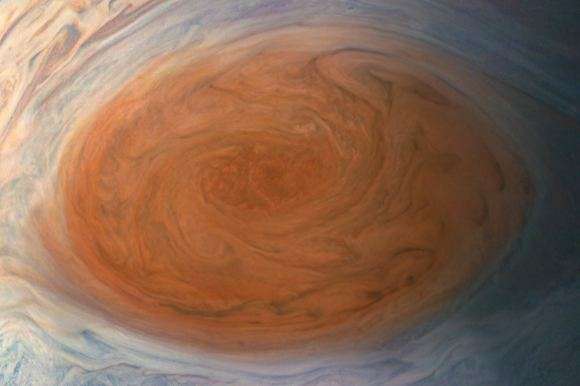
Caleb Keaveney, a doctoral candidate at Yale University, reflects on the storm’s enduring appeal: “For over two centuries, the Great Red Spot has captivated observers just as much as it captivates me.” Despite the wealth of data, astronomers still deliberate its exact origins, structure, and vivid coloration.
Impact of Smaller Storms on the Great Red Spot
Recent work led by Caleb Keaveney points to the influence of smaller, ephemeral storms in controlling the size of the Great Red Spot. Published in Icarus, the team employed detailed 3D computer simulations to study these complex interactions.
“Our numerical models show that feeding the Great Red Spot with a series of smaller storms—an occurrence common on Jupiter—can affect its size,” explained Keaveney. The simulations highlight that these minor storms bolster the giant vortex, promoting its expansion. Conversely, a decline in these storm interactions appears to be associated with the current shrinkage. Comparing simulations with and without such storm interactions, the researchers found strong support that these smaller vortices play a vital role in sustaining the Great Red Spot’s dynamics.
Analogies to Earth’s Weather Phenomena: Heat Domes and Atmospheric Blocks
The study draws a parallel between the Great Red Spot and persistent high-pressure systems on Earth known as “heat domes” or “blocks.” These terrestrial systems can generate extreme weather events such as heatwaves and droughts and are sustained through interactions with smaller atmospheric disturbances. Keaveney remarked, “Seeing how nearby weather systems maintain and intensify heat domes inspired our theory that analogous interactions keep Jupiter’s Great Red Spot alive.”
Heat domes typically form in Earth's mid-latitudes and are linked to westerly jet stream currents. These findings propose that the Great Red Spot shares similar atmospheric mechanisms, where smaller weather systems influence the longevity and power of larger storm structures.
The Great Red Spot’s Diminishing Fuel Supply
The research also explores the notion that the Great Red Spot may be "running low on supplies" due to a dwindling number of smaller storms fueling it. Simulations demonstrate that a scarcity of these minor vortices could cause the storm to contract over approximately 2.6 Earth years. Keaveney explains, “This suggests that the abundance—or absence—of smaller storms governs the Great Red Spot’s size. Numerous small storms encourage growth, while fewer lead to shrinkage.”
This concept aligns well with observed trends showing that a decline in smaller Jovian storms corresponds with the Great Red Spot’s gradual decrease in size. The findings offer a plausible explanation for its long-term fluctuations, linking the storm’s dimensions directly to the presence of smaller vortices in Jupiter’s atmosphere.
Variability in Color and Form
Beyond size changes, the Great Red Spot has also shown variations in its color palette. Predominantly reddish-orange, the storm has sometimes faded to a pinkish shade. These shifts are thought to result from complex chemical reactions triggered by solar radiation interacting with compounds like ammonium hydrosulfide and acetylene. Keaveney’s paper proposes that these chemical changes are connected with the Great Red Spot’s interactions with Jupiter’s Southern Equatorial Belt (SEB).
The SEB experiences cyclical changes in coloration and brightness, which influence the Great Red Spot’s appearance. “On occasion, the spot has nearly vanished due to intricate interactions with the Southern Equatorial Belt,” Keaveney noted. These dynamics add complexity to the ongoing efforts to comprehend the Great Red Spot’s behavior and evolving look.
Ongoing Monitoring and Prospects for Future Studies
The reduction in the Great Red Spot size has been closely observed through data collected by spacecraft such as Voyager, Galileo, Cassini, and Juno, combined with ground-based observations. These efforts have enriched our understanding of the storm’s environment and its interplay with other Jovian atmospheric features. Instruments aboard these missions have measured winds, temperature profiles, and chemical makeup, constructing a detailed portrait of this colossal tempest.
Scientists intend to keep refining models to deepen insights into the Great Red Spot’s origin and long-term evolution. As Keaveney concluded, “Further modeling should help to sharpen our understanding and may unveil clues about the initial development of the Great Red Spot.” Continued research will not only enhance knowledge of Jupiter’s atmospheric dynamics but may also shed light on similar weather processes on other planets, including Earth.
- Categories:
- Astronomy ,
- News ,
- Science ,
- Space






0 comments
Sign in to Comment