
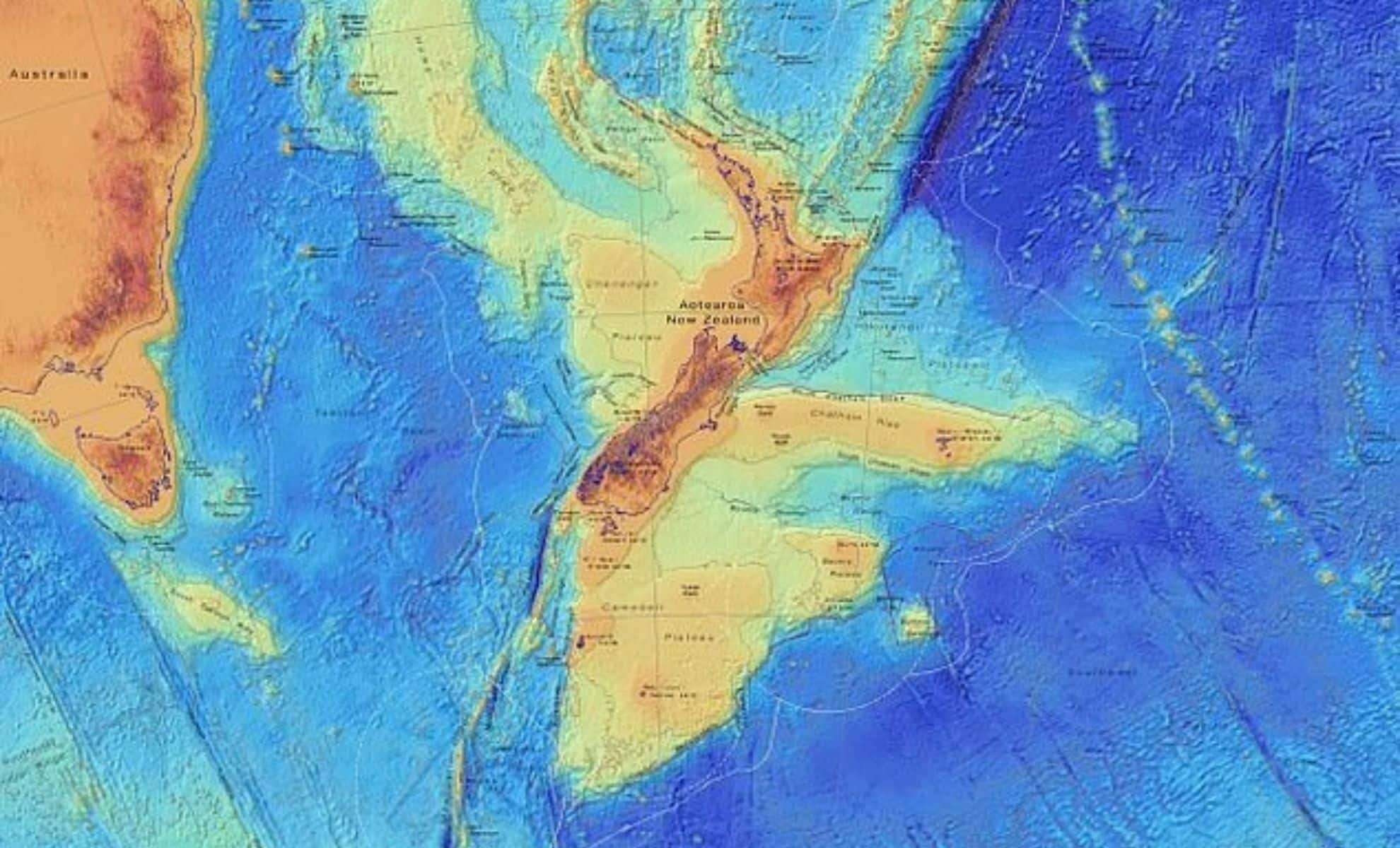
After centuries of curiosity and investigation, researchers have now verified the existence of Zealandia, a vast continent largely submerged beneath the ocean and hidden from view for nearly 400 years. Covering roughly 1,890,000 square miles, this mostly underwater landmass lies beneath approximately two kilometers of seawater. Known as Te Riu-a-Māui in Māori, Zealandia was originally proposed in 1642 by Dutch navigator Abel Tasman, but its full recognition was delayed until recent geological breakthroughs and technological advancements.
This revelation not only reshapes our geographic framework but also prompts fresh inquiries into continental evolution and the dynamic forces influencing our planet’s surface.
Tracing Zealandia’s Origins: From Ancient Supercontinent to Ocean Depths
Zealandia’s history dates back about 500 million years, when it was part of the supercontinent Gondwana, which included regions that are now Antarctica, Australia, South America, and Africa. Around 100 million years ago, tectonic activity initiated Gondwana's fragmentation, leading to Zealandia separating from eastern Australia. Unlike typical continental fragments, Zealandia underwent significant sinking; today, roughly 94% of its original landmass remains underwater, with only areas like New Zealand and New Caledonia still visible above the sea.

The exact causes of Zealandia’s submergence are still under study, but scientists believe tectonic extension and crustal thinning played substantial roles. These processes have concealed Zealandia beneath thick layers of marine sediment, complicating efforts to detect it.
Decades of Searching for the Hidden Continent
The theory of Zealandia gained considerable momentum in 2017 when scientists from GNS Science, New Zealand’s geology research institute, employed advanced seabed mapping and drilling methods to delineate the continent’s underwater boundaries. Despite mounting evidence, the wider scientific community initially hesitated to classify Zealandia as a continent due to its distinctive characteristics.
One major difficulty in exploring Zealandia is its extreme depth, with most of the terrain submerged beyond 2 kilometers under the ocean surface. Robert Sutherland, a geophysics expert at Victoria University of Wellington, noted, "Exploring a continent buried 2 kilometers underwater, with sediment layers 500 meters below the seabed, is a formidable challenge that demands extensive time, financial resources, and specialized equipment."
Nevertheless, comprehensive geological evidence—such as Zealandia’s unique crustal composition—has confirmed its status as a bona fide continent.
A Massive Continent Hidden in the Ocean
The unveiling of Zealandia serves as a powerful reminder that major discoveries can sometimes lie hidden in plain sight. Although it spans nearly two-thirds the size of Australia, Zealandia’s mostly submerged state caused it to be overlooked for centuries. Andy Tulloch, a senior scientist at GNS Science, emphasized, “It shows how something so vast and obvious can evade detection for so long.” The continent’s thicker crust relative to surrounding ocean floor was among the first hints of its continental identity.
Its concealment under two kilometers of water and sediment required sophisticated technology and considerable investment to study. Despite these hurdles, researchers have pieced together enough data to confirm Zealandia as Earth’s eighth continent. Tulloch added, “This discovery highlights how much remains unknown beneath our planet’s surface, with potential findings still lying just out of reach.”
Scientific Significance of Zealandia’s Discovery
Classifying Zealandia as a continent marks a pivotal advancement in geology, offering valuable new insights about continental breakup and subduction processes. Investigations into Zealandia’s development promise to enhance our understanding of how continents disintegrate and sink over geological time scales. The study of this sunken landmass could also reveal parallels to other submerged formations worldwide.
Zealandia’s geological connection to the ancient supercontinent Gondwana makes it an essential puzzle piece for reconstructing tectonic plate histories. Its crust contains minerals and rock types that provide clues about its detachment from eastern Australia and Antarctica. Furthermore, Zealandia’s extended period underwater presents an opportunity to learn about sea level changes and their impacts on landmasses, offering valuable perspectives for climate studies. By mastering Zealandia’s geological record, scientists can refine models of Earth’s evolution and anticipate future surface changes.
Beyond geology, Zealandia holds promise for marine biology. Functioning as a submerged continent for millions of years, it has supported unique ecosystems adapting to the shifting environment. Further research may uncover previously unknown species and track how marine organisms evolved alongside continental movement.
A Frontier for Modern Exploration
The rediscovery of Zealandia ushers in a new chapter in Earth sciences, demonstrating the synergy between cutting-edge technology and persistent inquiry. Confirming Zealandia as the planet’s eighth continent underscores the necessity of international collaboration and investment in sophisticated exploration tools like high-resolution seabed mapping and deep ocean drilling.
This breakthrough also prompts broader questions about the still-unmapped expanses of the seafloor, which covers over 70% of Earth’s surface. Despite recent advancements, large portions remain unexplored and may harbor further geological and biological secrets. Zealandia’s revelation serves as inspiration to continue probing these unexplored domains.
As research into Zealandia progresses, it’s becoming clear that this submerged continent is a crucial natural archive, preserving records of geological transformations, climate shifts, and biodiversity changes. Zealandia stands as a tribute to human curiosity and innovation, and it fuels hopes that many astonishing discoveries are still waiting beneath our planet’s waters.
- Categories:
- News




0 comments
Sign in to Comment