
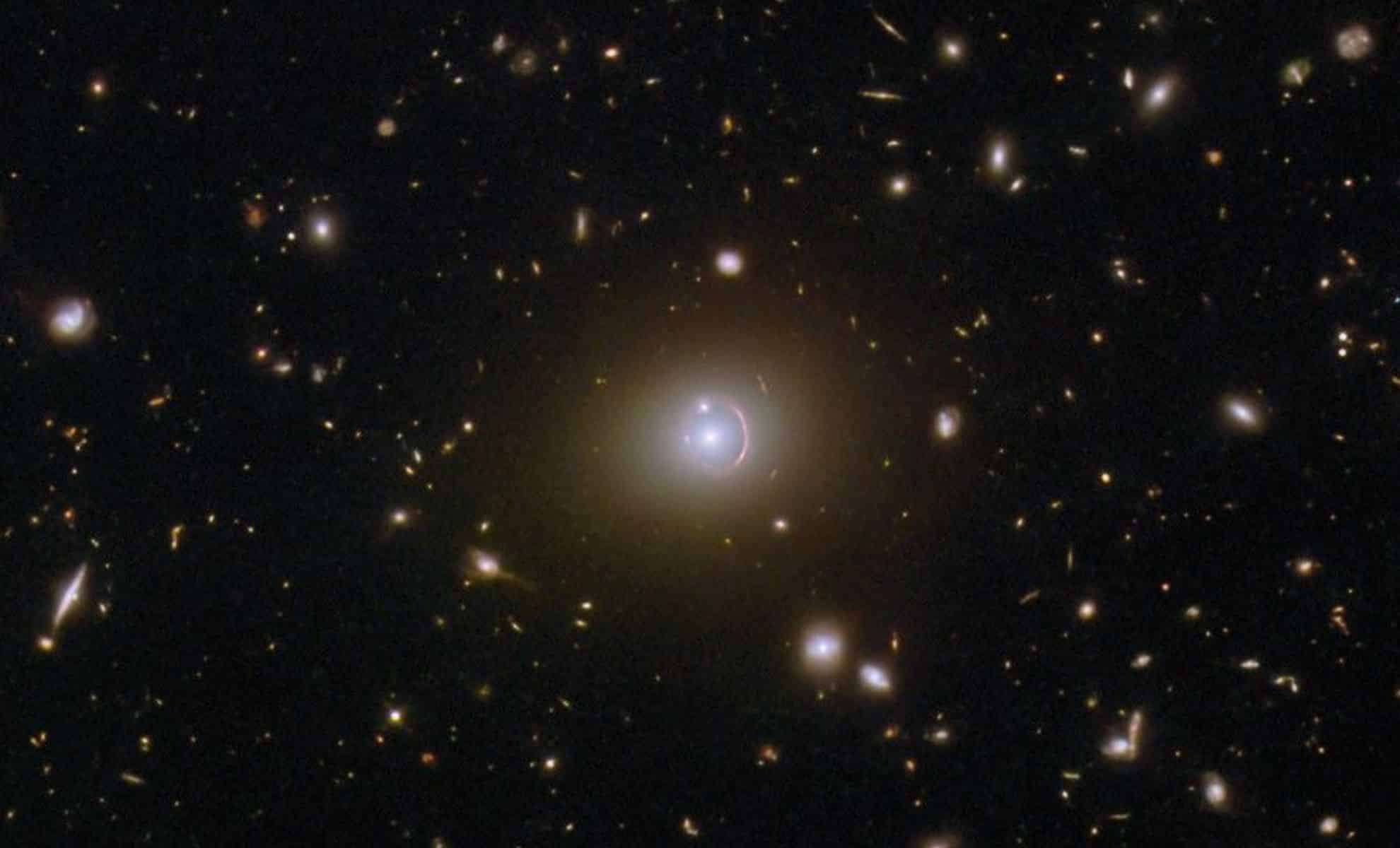
An elusive galaxy hidden from view for billions of years has been unveiled in a remarkable display captured by the Hubble Space Telescope. As detailed by Mashable and supported by official NASA reports from the Hubble mission update, this discovery highlights a near-perfect Einstein ring, produced through gravitational lensing. This cosmic magnification effect reveals a distant galaxy from the early universe and offers insight into the intricate structures of deep space. The galaxy, referred to as HerS 020941.1+001557, is observed as it was roughly 11 billion years ago.
Gravity Bends Light, Illuminating Einstein’s Relativity
What appears as a bright halo or arc in the Hubble snapshot is actually a striking demonstration of Einstein’s General Theory of Relativity at work. The key mechanism, gravitational lensing, happens when a massive body distorts the fabric of space-time around it. Similar to how a heavy object dents a stretched sheet, this mass causes passing light to curve. In this case, a closer galaxy — SDSS J020941.27+001558.4 — functions as a massive natural lens, amplifying the light from the much older, more distant galaxy beyond it.
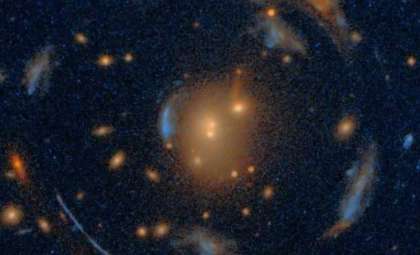
Alignment between the distant galaxy, the lensing galaxy, and Earth's vantage point bends the emitted light into a ring-shaped glow known as an Einstein ring. Such precise cosmic alignment is infrequent, making this symmetrical lens an extraordinary celestial spectacle. The captured image displays a vivid red arc encircling a central galaxy, beautifully illustrating cosmic physics in action.

The Role of Citizen Scientists in Unveiling the Cosmic Ring
This captivating Einstein ring was identified not only by professional astronomers but also thanks to SPACE WARPS, a citizen science initiative that invites the public to scrutinize astronomical pictures for gravitational lenses. Participants—including amateurs, enthusiasts, and space fans—significantly contributed to discovering this stunning lens, underlining the impact of collaborative efforts in today’s astronomical breakthroughs.
Given the overwhelming data generated by deep-space observations, citizen involvement is vital for sorting through vast image repositories. SPACE WARPS has uncovered numerous new gravitational lenses, with this particular ring standing out as one of the most visually striking and scientifically important finds. It exemplifies how space research now thrives as a community-driven pursuit fueled by widespread curiosity.
Peering Back 11 Billion Years Into Cosmic History
Since the galaxy’s light traveled 11 billion years before reaching us, this observation offers a unique window into a universe less than 3 billion years old. Such glimpses enable scientists to analyze the early phases of galactic formation and growth. Studying these ancient structures provides evidence about how primordial galaxies developed, merged, and laid the foundations for stars, planets, and eventually life.
These ancient snapshots are crucial for refining models of cosmic expansion and structural formation throughout the universe. Thanks to gravitational lensing’s magnifying effect, astronomers can examine distant galaxies in extraordinary detail—equivalent to a cosmic zoom lens focused on the universe’s farthest reaches.
A Complex Scene Featuring Multiple Interacting Galaxies
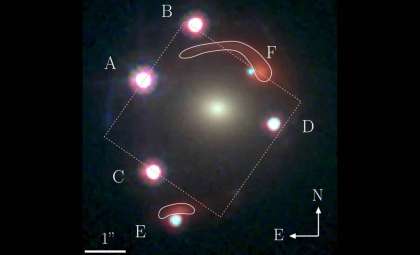
The image reveals more than just a lens and lensed galaxy duo. Researchers also identified a third galaxy—SDSS J020941.23+001600.7—within the frame, partially overlapping the red arc. This additional galaxy contributes to the gravitational lensing complexity, offering a glimpse of a vibrant and interconnected galactic neighborhood where light warps through multiple massive bodies.
Such intricate alignments allow astrophysicists to investigate key topics like dark matter, spacetime distortion, and intergalactic mediums. Since lensing can unveil matter invisible through other means, this Einstein ring not only captivates visually but also serves as a powerful scientific instrument unlocking cosmic mysteries.
The Evolution of Understanding Gravitational Lensing
Initially, the effects of gravitational lensing were misunderstood. During the 1980s, astronomers mistook similar arcs for enormous cosmic structures—the largest in existence. For instance, the arc near galaxy cluster Abell 370 was once thought to be an immense object until it was correctly interpreted as a lensing illusion. These optical phenomena, first theorized by Einstein decades prior, ultimately confirmed his revolutionary theoretical predictions.
With advancements in imaging and simulations, astronomers now swiftly distinguish actual celestial formations from lensing effects. However, the process involved significant learning and refinement. The reappearance of HerS 020941.1+001557 through gravitational lensing continues this journey of discovery—enhancing our understanding and expanding the cosmic puzzle.
- Categories:
- News


0 comments
Sign in to Comment