
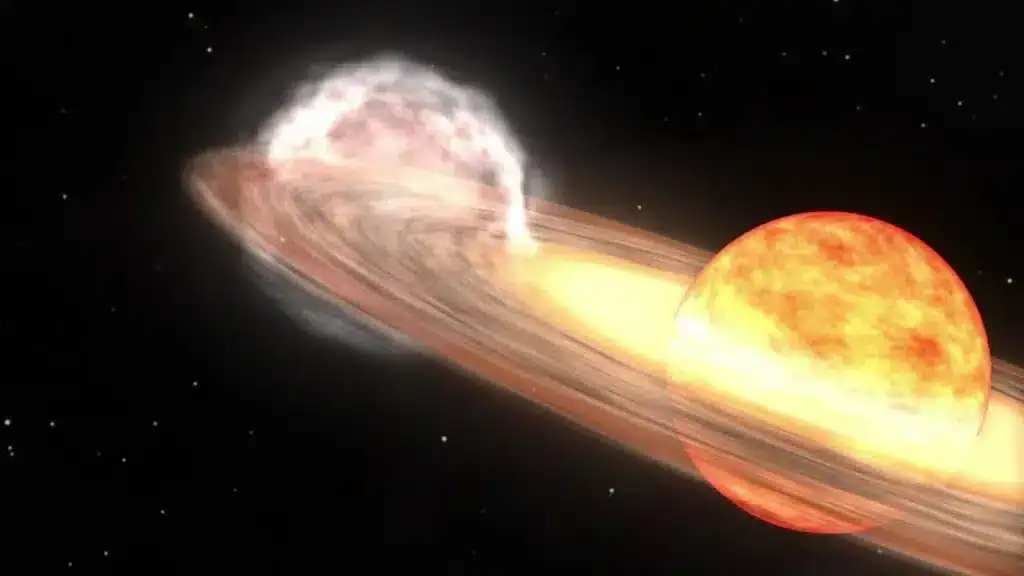
Global astronomy enthusiasts are preparing for an extraordinary celestial spectacle set to light up the constellation Corona Borealis.
The spotlight is on the binary star system T Coronae Borealis, often called the “Blaze Star,” which is expected to produce a nova eruption detectable from Earth without telescopic aid.
Situated roughly 3,000 light-years away, this anticipated outburst offers a rare viewing opportunity that excites both professional researchers and amateur skywatchers alike.

Dr. Rebekah Hounsell, a specialist in nova phenomena at NASA’s Goddard Space Flight Center, comments, “This event is truly rare and will inspire a new generation of astronomers, allowing them to directly observe, inquire, and gather their own astronomical data.”
Understanding the Nova Mechanism of T CrB
T Coronae Borealis is known as a recurrent nova, consisting of a compact white dwarf closely paired with a red giant star. The white dwarf’s intense gravity siphons hydrogen from its swollen companion.
The accreted hydrogen on the white dwarf’s surface builds up pressure and temperature until a thermonuclear explosion is triggered. Dr. Hounsell explains, “As hydrogen gathers on the white dwarf, it eventually ignites in a thermonuclear blast that ejects the accumulated material.”
This explosive event produces a brilliant flash visible from Earth and occurs roughly every 80 years. Unlike supernovae, which obliterate stars, a nova eruption leaves the white dwarf intact, enabling this cyclical phenomenon to persist for thousands of years. This repetitive process underscores the dynamic and evolving nature of stars.
Past Eruptions and Growing Excitement
The earliest recorded nova from T CrB dates back to 1217, chronicled by Burchard, the abbot of Ursberg. The previous eruption happened in 1946, and current observations suggest a similar precursor phase.
Mark Hollands, a research fellow at the University of Warwick, explains, “Before the 1946 explosion, T CrB exhibited a distinct brightness drop, signaling the upcoming nova.”
This year, astronomers have noted analogous dimming trends, suggesting that the nova could occur by September 2024. The predictable interval of these outbursts makes T CrB a captivating target to deepen our comprehension of stellar activity cycles.
How to Spot the Nova in the Night Sky
The nova will appear within the Northern Crown constellation (Corona Borealis), characterized by its distinctive horseshoe arrangement west of Hercules.
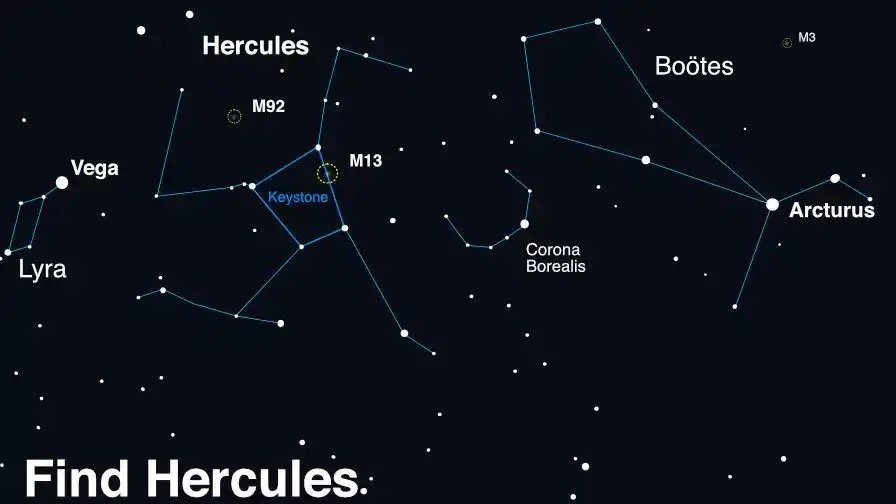
Viewers can locate Corona Borealis by tracing a line between the stars Arcturus and Vega. Dr. Elizabeth Hays, head of NASA Goddard’s Astroparticle Physics Laboratory, advises, “The nova’s brightness surge will be brief, visible to the unaided eye for fewer than seven days, but it promises to be unforgettable.”
Astronomy enthusiasts should familiarize themselves with the night sky beforehand to fully appreciate the event. Apps designed for stargazing can assist in pinpointing the constellation. Dr. Hays adds, “Witnessing this nova will dramatically alter the familiar star pattern, creating a striking and sudden change.”
Coordinated Scientific Efforts and Observations
NASA has organized extensive cooperation among numerous space- and ground-based observatories in preparation for monitoring this event. The Fermi Gamma-ray Space Telescope, the James Webb Space Telescope, alongside IXPE, NuSTAR, NICER, and ground arrays like the Very Large Array in New Mexico, will collectively capture data across multiple wavelengths. Dr. Hounsell emphasizes, “It is vital to document the nova’s entire timeline—from the initial rise to its peak and gradual fading of visible energy.”
Citizen scientists, especially amateur astronomers, play a vital role in early detection and ongoing tracking. Their observations prompt targeted scrutiny by professional teams, ensuring no detail is missed. This partnership highlights the open and collaborative spirit of modern astrophysical research, where multiple data sources contribute to a richer understanding of stellar phenomena.
Innovative Technology Enhances Study
New observational instruments unavailable for previous eruptions will provide fresh perspectives. Advanced gamma-ray imagers and X-ray polarimeters aboard missions like IXPE will yield unprecedented information about the nova’s properties. Dr. Hays notes, “Integrating these data sets will deepen our insight into binary star lifecycles and the complex, yet powerful, stellar activities that drive nova events.”
By analyzing emissions spanning gamma rays to radio waves, scientists can construct a detailed view of the nova explosion’s structure and behavior. This multi-wavelength approach is key to decoding the underlying physics of recurrent novae and expanding knowledge about similar systems throughout the cosmos.
- Categories:
- Astronomy ,
- News ,
- Space











0 comments
Sign in to Comment