
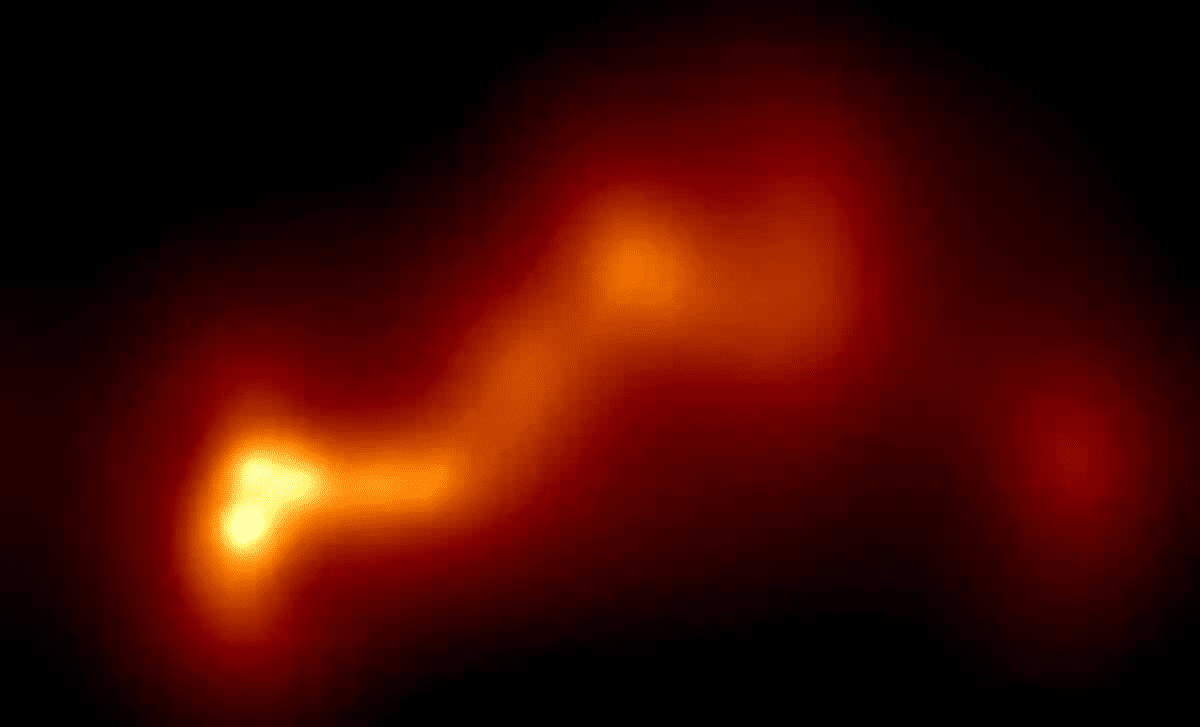
A recent publication in Astronomy & Astrophysics reveals a monumental achievement where astronomers documented the interaction between shock waves and pressure waves in the jet emitted by a supermassive black hole pair. Enabled by the Event Horizon Telescope (EHT), this observation marks the first direct evidence of such a phenomenon, enhancing our grasp of the intricate physics behind black hole jets. Situated roughly 4 billion light-years distant, the binary black hole system OJ 287 exhibited striking transformations within its relativistic jet, highlighting the turbulent forces operating in these extreme cosmic settings.
The Event Horizon Telescope: Pioneering Global Technology
The Event Horizon Telescope (EHT) comprises a worldwide array of radio telescopes functioning jointly to simulate a single Earth-sized instrument. This unprecedented collaboration enables capturing the finest details and data about distant and minute cosmic phenomena such as black holes. The EHT’s extraordinary resolving power, capable of detecting an object the size of a ping pong ball on the Moon, allowed scientists to observe subtle variations within the jet of the OJ 287 system. Such precision is integral to realizing these pioneering observations, showcasing the strength of international teamwork in astronomical research.
Using sophisticated interferometry, the EHT integrates signals from observatories spanning from the South Pole across Europe, South America, and the Pacific Ocean. This blending produces a virtual telescope far beyond the scope of any individual facility. Consequently, researchers can investigate the regions near supermassive black holes in exceptional detail, uncovering the complexities of cosmic jets and their magnetic environments.

OJ 287: A Binary Black Hole with a Unique Cosmic Ballet
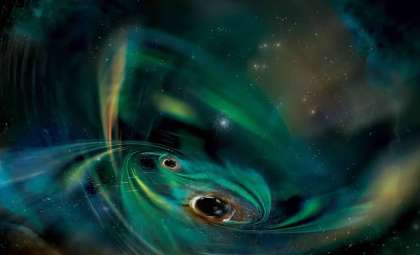
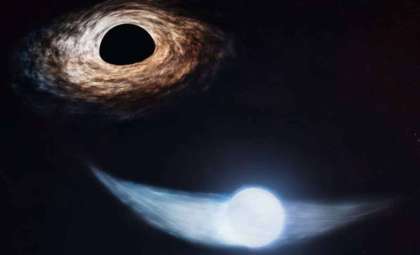
The focus of this study is OJ 287, a system of two black holes approximately 4 billion light-years away, positioned in the Cancer constellation. The larger black hole boasts over 18 billion solar masses and spans an area nearly nine times Pluto’s orbital radius, while its smaller partner contains about 150 million solar masses, with a breadth six times the Earth’s orbit. These massive objects orbit each other eccentrically, with the smaller black hole circling every 11 to 12 years. This unique orbital dance produces unusual effects, especially impacting the relativistic jet the system emits.
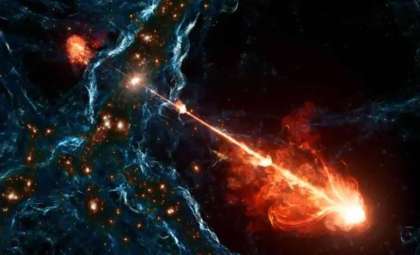
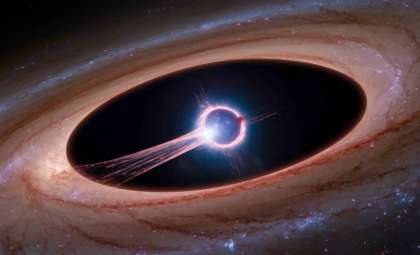
OJ 287’s highly active nature made it a compelling candidate for investigation, as detailed in Astronomy & Astrophysics. The powerful interaction between these black holes generates vast energy that fuels the particle jet streaming outward at near-light speed. As the jet traverses interstellar space, its structure morphs continuously, offering scientists a chance to study the jet’s complex internal dynamics. Notably, observations from April 5 to 10, 2017, captured these swift developments in real time.
Shock Fronts and Kelvin-Helmholtz Instabilities Within the Jet
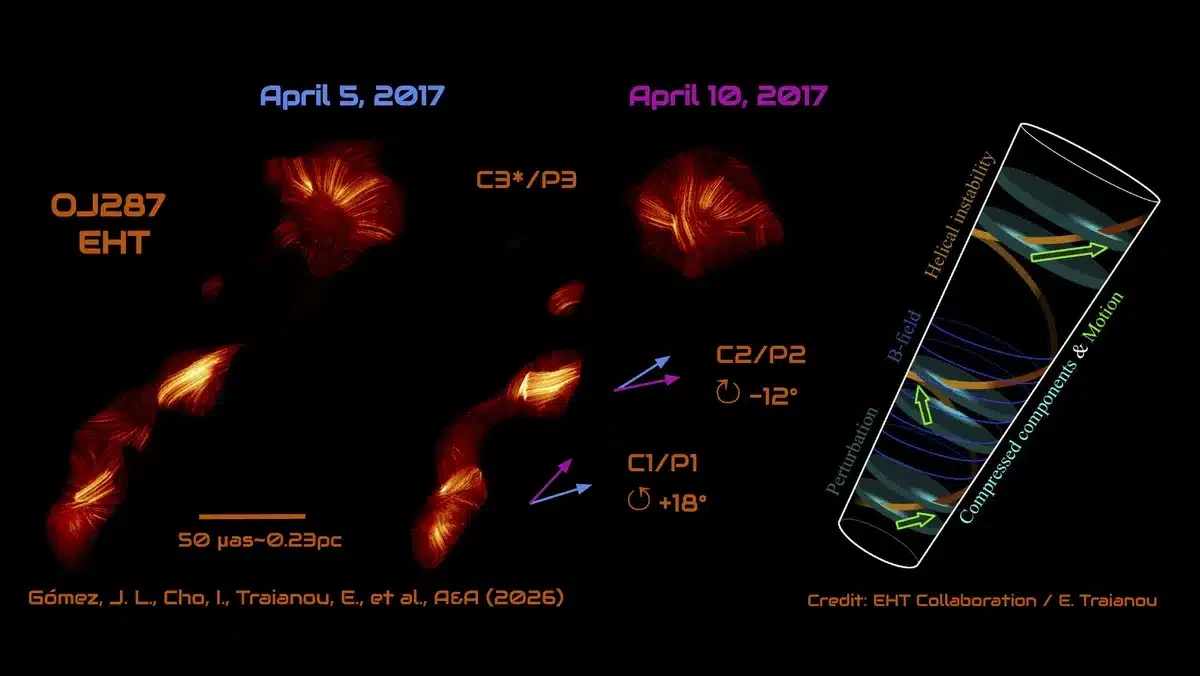
The main discovery highlighted by this research is the identification of shock fronts traveling through the relativistic jet of OJ 287. These shocks move at varied speeds and engage with surrounding slower jet material, triggering Kelvin-Helmholtz instabilities. Typically observed in fluid dynamics, these instabilities arise due to velocity differences creating swirling vortices. For the first time, such fluid-like behavior has been witnessed under the extreme physical conditions near a black hole.
“We observed substantial changes over five days,” said Dr. Efthalia Traianou, one of the paper’s lead authors and AGN Working Group Coordinator for the EHT collaboration. “This is the first time we’ve directly observed this shock-instability interaction in a black hole jet.”
This direct evidence of shock and instability interplay constitutes a major advancement in comprehending the rapidly evolving inner structures of black hole jets and the sophisticated forces governing them.
The data also underscore the jet’s remarkable structural shifts as it propagates through space. Interactions between distinct jet elements create distinctive magnetic field distortions, shedding light on the extraordinary physics present within this cosmic system.
Mapping Magnetic Fields Where the Jet Originates and Narrows
A vital aspect of the investigation was the detailed mapping of magnetic field configurations in regions where the jet is formed and compressed. “These findings enable us to follow the magnetic field’s layout in the jet’s launching and collimation zones,” noted Dr. Ilje Cho, co-lead author and scientist at the Korea Astronomy and Space Science Institute. Being able to characterize these magnetic structures over distances 10 to 100 times larger than the typical black hole radius provides invaluable clues about jet generation and development.
This major scientific revelation opens new possibilities for examining the forces that control jet emergence near black holes, a process long elusive to detailed observation. Understanding the magnetic geometry and the mechanisms at work will help scientists clarify how these potent jets impact their host galaxies and the cosmic surroundings.
- Categories:
- Astronomy





0 comments
Sign in to Comment