
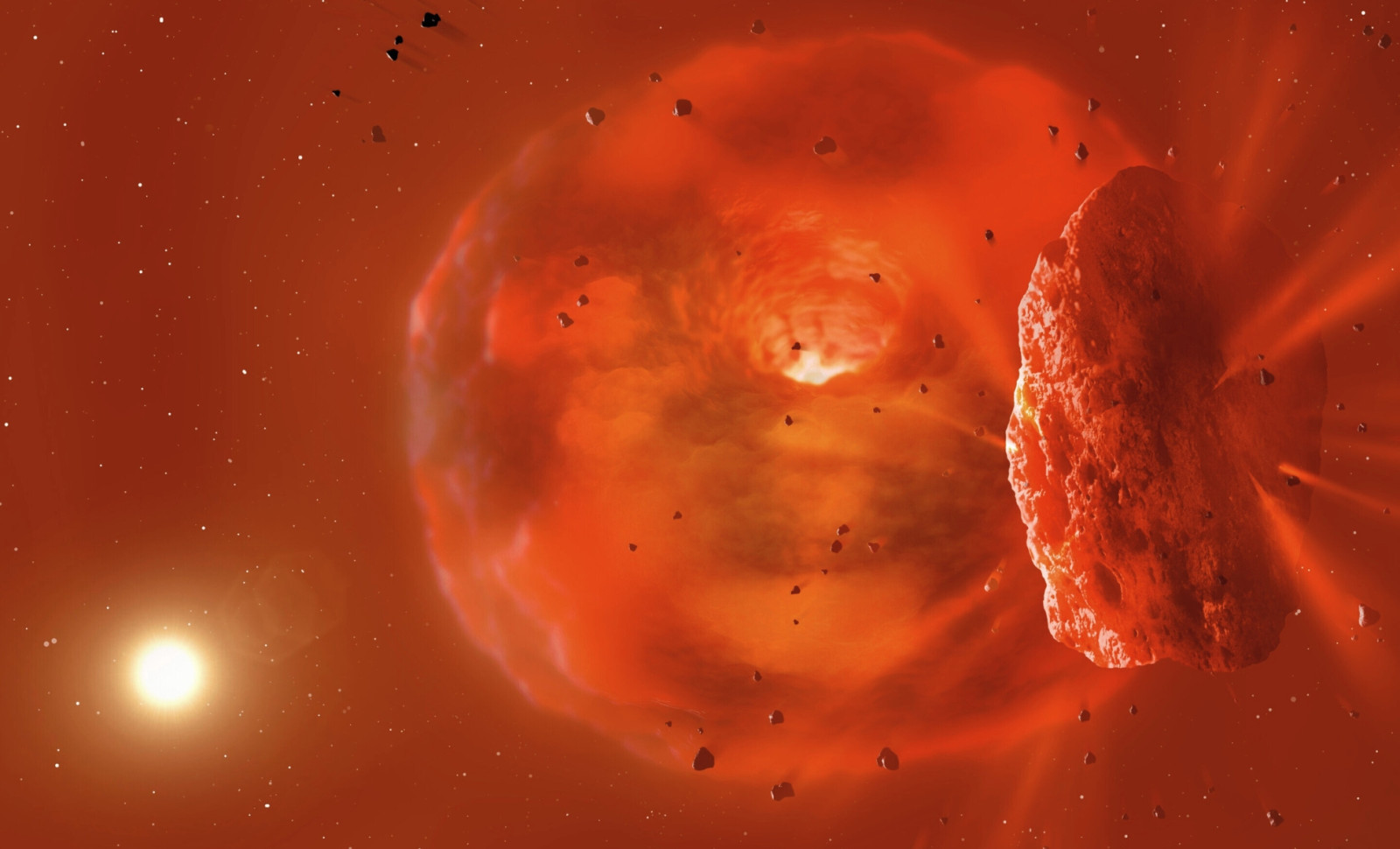
Gaia20ehk once seemed like an unremarkable star positioned about 11,000 light-years away in the Puppis constellation, displaying the steady glow expected of a typical main-sequence star. That perception changed in 2016 when its brightness began to dip in three distinct drops along its light curve. Several years later, its flickering behavior grew erratic and intense, setting it apart from the otherwise consistent signals in survey data.
This unusual activity caught the eye of Anastasios Tzanidakis, a PhD student at the University of Washington, who came across the star while analyzing historical astronomical data. “Initially, the star’s brightness was stable, but starting in 2016, those three drops appeared. Then, around 2021, the light pattern became wildly unpredictable,” he explained.
These observations have led to a compelling hypothesis: the star's flickering might result from a hot, uneven cloud of debris formed after a catastrophic collision between two planetary bodies. This interpretation, advanced by Tzanidakis and his colleague James Davenport in a recent paper published in The Astrophysical Journal Letters, identifies Gaia20ehk—also known as Gaia-GIC-1—as a probable case of a “planetesimal collision afterglow.”

Infrared Insights Unlock the Mystery
Data from visible light revealed only signs of something passing in front of the star. The breakthrough arose when researchers compared these observations with infrared measurements. Contrary to the dimming in visible light, the system's infrared brightness increased, indicating the obscuring material emitted its own heat.
“The infrared brightness surged just as the visible light faded and flickered,” Tzanidakis noted. “This implies the intervening material is intensely hot, radiating strongly in the infrared spectrum.”
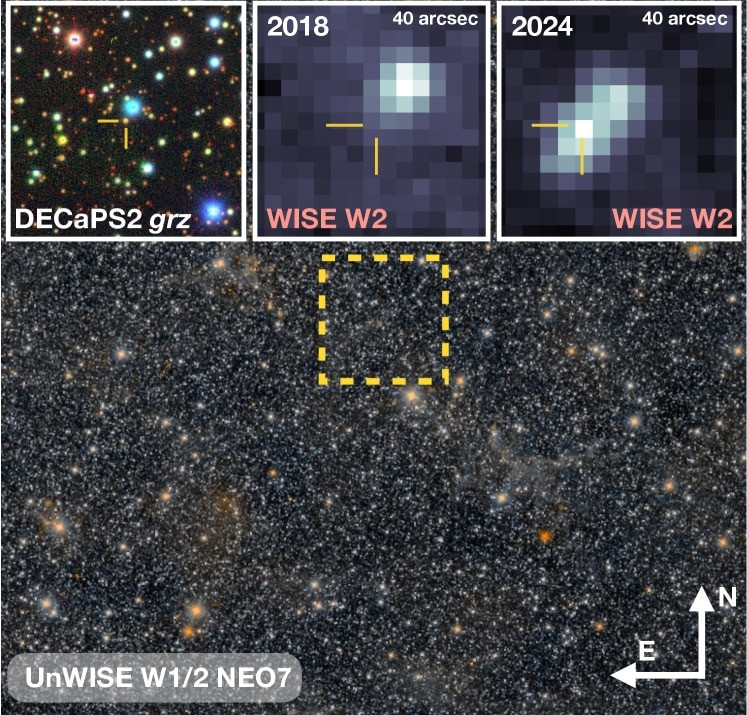
This contrast between visible and infrared light is a key cornerstone of the study. The authors propose that newly formed circumstellar dust absorbs and scatters optical light while emitting thermally in infrared wavelengths. Their findings indicate dust temperatures near 900 Kelvin and a minimum emitting area of 0.13 square astronomical units. The system’s infrared luminosity has persisted for around four years, with updated SPHEREx observations confirming the ongoing excess emission.
Debris Orbiting Close to the Star
Timing data provide additional clues. Before the infrared spike appeared, Gaia’s optical data showed a steady 380.5-day periodicity. Estimating the star’s mass at 1.3 times that of the Sun, the team deduced the orbiting debris resides roughly 1.1 astronomical units away—akin to Earth’s distance from the Sun.
This location is significant because it lies within the zone where terrestrial planets often form and collide. Researchers estimate the minimum dust mass involved is about 4 × 10^20 kilograms, on the scale of a small icy moon like Enceladus. Importantly, this only accounts for visible dust; the original colliding bodies would have been much larger.
The initial three brightness dips might represent early interactions between the two bodies, possibly grazing encounters as they drew closer. “Those initial dips could be planets spiraling together, with minor impacts producing little infrared glow, followed by a massive collision that fueled the infrared flare-up,” Tzanidakis suggested.
The authors phrase their findings cautiously, describing Gaia-GIC-1 as appearing like a “transiting planetary collision afterglow” with newly formed debris likely from two planetesimals. They also acknowledge complexities in the debris geometry, which might include eccentric or elongated dust structures instead of a simple circular ring.
Significance Beyond a Single Star
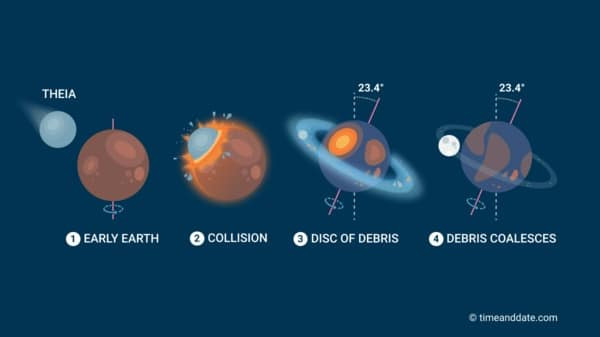
One reason the discovery excites astronomers is its resemblance to the violent formative processes believed to have shaped our own solar system. The widely accepted Giant Impact Hypothesis proposes that Earth’s Moon formed after a Mars-sized body collided with the young Earth, generating debris that coalesced into the Moon. While Gaia20ehk is not a direct analogue, it offers a rare glimpse into the kind of giant impacts that help assemble rocky planets.
Gaia20ehk itself is likely a youthful F-type star, possibly an F5 spectral type based on pre-event energy distribution studies. Nearby open clusters FSR 1347 and FSR 1352, estimated to be between 6 and 16 million years old, share similar distances and extinction characteristics, although the star’s precise age remains uncertain from current photometric data.
Despite this uncertainty, the broader implications remain clear. Planetary systems often experience turmoil early in their development, and collisions are crucial to the final assembly of rocky worlds. What sets Gaia20ehk apart is that astronomers appear to have captured the aftermath still unfolding, with irregular dimming continuing as the debris moves around the star.
Prospects for Future Discoveries
Gaia20ehk’s unique behavior may be just the beginning. The study suggests ongoing infrared monitoring, especially with instruments like JWST, could help distinguish cooling impact afterglows from typical circumstellar matter and monitor debris evolution.
Larger sky surveys are poised to increase such detections. Davenport told UW News that the Vera C. Rubin Observatory’s Legacy Survey of Space and Time might identify around 100 similar impact events within the next decade. “How often do collisions like the one that formed Earth and Moon happen? This is a fundamental question for astrobiology,” he said. “Catching more of these collisions will bring us closer to answering it.”
For now, Gaia20ehk remains a partly obscured and flickering star, shining brightly in infrared yet defying simple explanations. After years of appearing as background noise, it now reveals itself as a fascinating planetary system caught in the chaotic process of building—and destroying—worlds.
- Categories:
- Space


0 comments
Sign in to Comment