
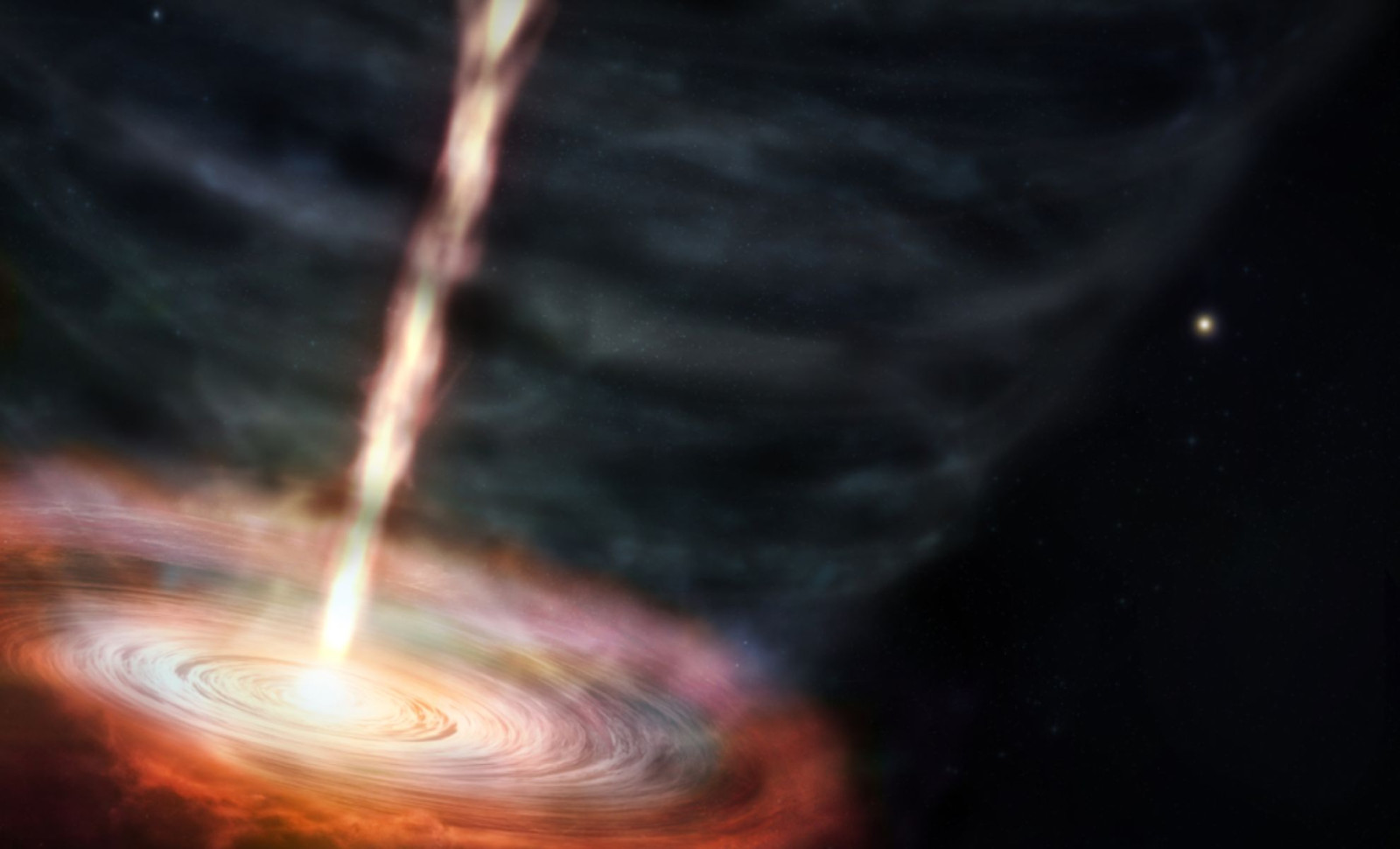
Astronomers have detected the most intense and remote microwave laser, or maser, ever recorded, emanating from a pair of merging galaxies roughly 8 billion light-years distant. This exceptionally strong signal, captured at 1667 megahertz, immediately stood out to scientists as unprecedented in strength.
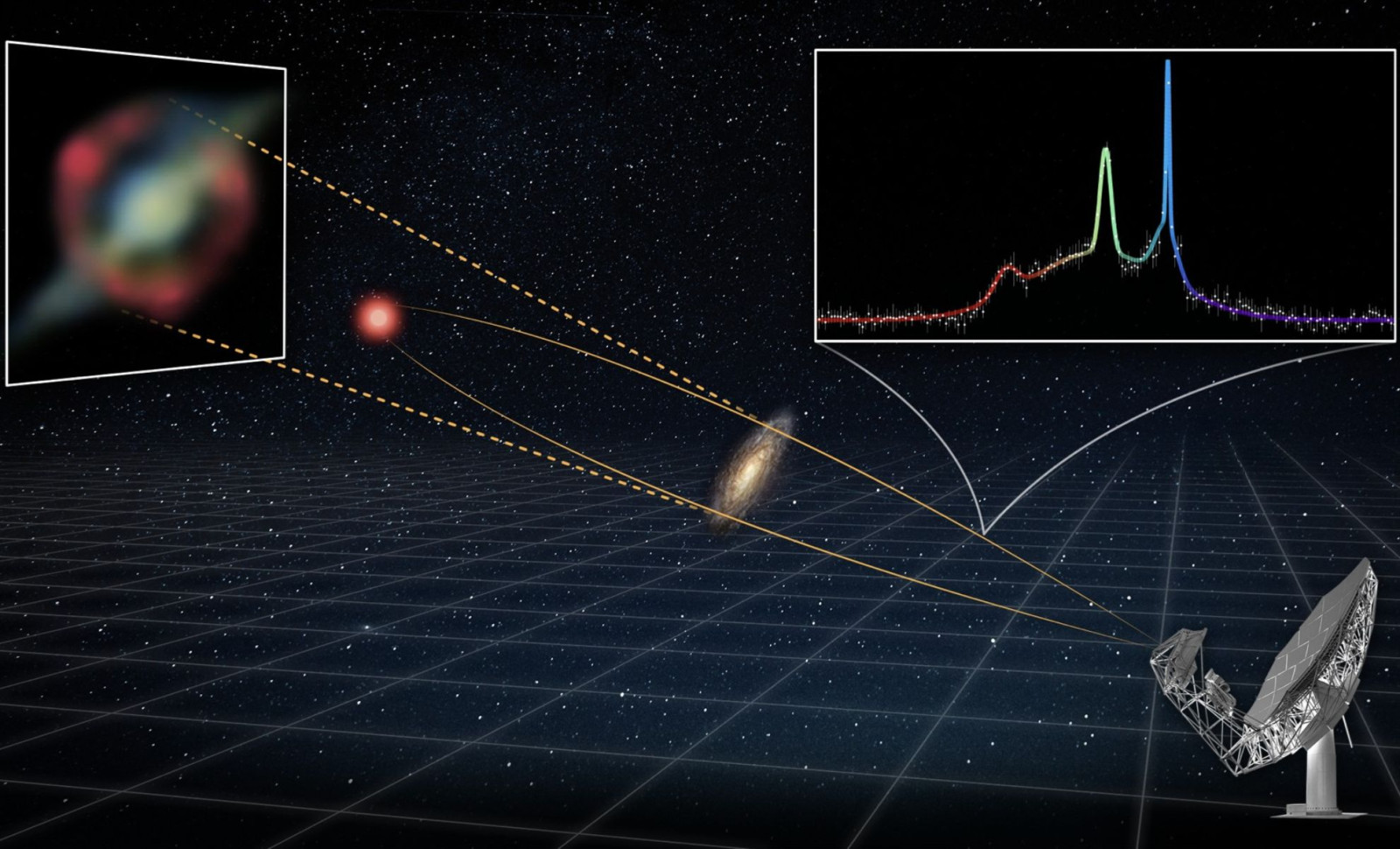
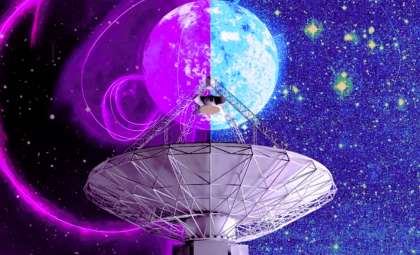
The focus of this finding is the galaxy system H1429-0028, whose light is magnified and distorted through gravitational lensing by a galaxy in the foreground. Observations were conducted with South Africa’s MeerKAT radio telescope array, initially aimed at locating galaxies abundant in molecular hydrogen.
Masers function as microwave analogs to lasers, which emit organized visible light. Masers generate tightly concentrated microwaves. Certain environments in space, especially in the turbulent conditions of galaxy mergers, can naturally produce effects similar to those in human-made lasers.

Unexpected Maser Signal at 1667 Megahertz
The research group, headed by Roger Deane from the University of Pretoria, was not targeting masers initially. According to their paper on arXiv, they used MeerKAT’s 64-dish setup to explore galaxies rich in molecular hydrogen emitting at specific radio frequencies.
While examining H1429-0028, the team casually checked the 1667 megahertz band.
“We had a quick look at the 1667 megahertz [frequency], just to see whether it was even detectable, and there was this booming, huge [signal],” Deane said. “It was immediately the record. It was serendipitous.”
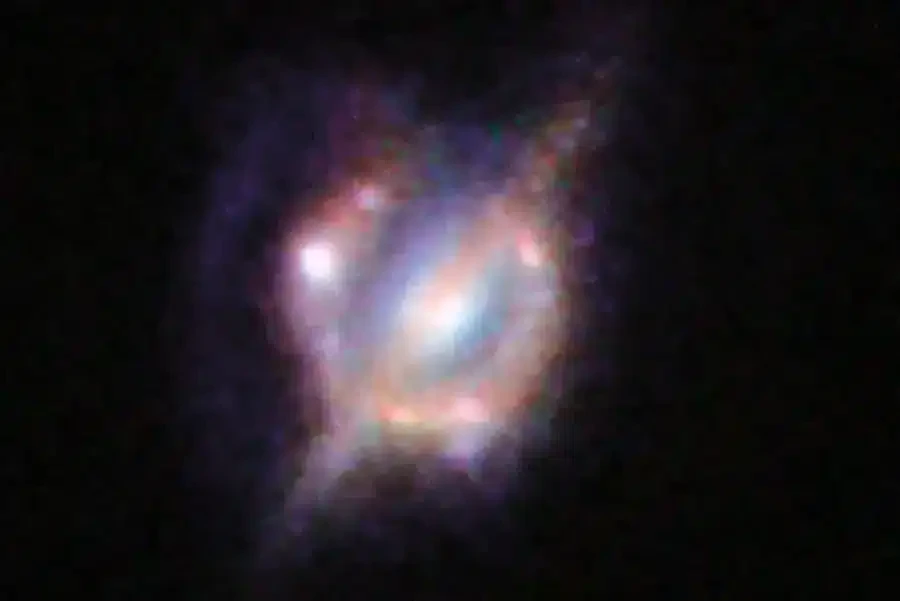
The detected emission set a new benchmark as the brightest and most remote maser ever recorded. The gravitational lensing effect enhances the background galaxy’s light, clearly visible in combined images from the Hubble telescope and the Keck II observatory, which show the foreground galaxy as a slanting streak and the lensed galaxy as a warped ring.
Origin of Intense Masers in Colliding Galaxies
Producing masers requires very distinct conditions. When galaxies merge, compressing their gas clouds, they ignite bursts of star formation. Radiation from these new stars passes through clouds of dust, exciting hydroxyl ions, molecules containing hydrogen and oxygen, into elevated energy states.
According to the study’s researchers, these energized ions, when hit by radio waves—such as those near a supermassive black hole—rapidly emit coherent microwave radiation, generating a sharply focused beam at a single frequency.
Deane commented that this newly found maser could be classified as a gigamaser, a category more powerful than megamasers found in nearer galaxies. The maser’s luminosity is approximately 100,000 times that of a typical star, concentrated in a tiny slice of the electromagnetic range.
Using Masers to Study Distant Galaxy Mergers
Located almost 8 billion light-years away, H1429-0028 emits signals that commenced their journey when the universe was much younger. Observing such distant masers helps scientists understand the process of galaxy mergers and their evolution across cosmic history.
Matt Jarvis from the University of Oxford highlighted the rare physical conditions required for these signals.
“[Masers] need very precise conditions,” he said. “You need this radio continuum emission and you need this infrared emission, which you only really get from dust heated around forming stars. In order to get these very specific physical conditions to get the maser in the first place, you need merging galaxies.”
Jarvis noted that upcoming observations with the Square Kilometre Array, a more sensitive radio telescope expected to succeed MeerKAT in South Africa, will enable detection of a larger number of these masers at even farther distances.
- Categories:
- Space



0 comments
Sign in to Comment