
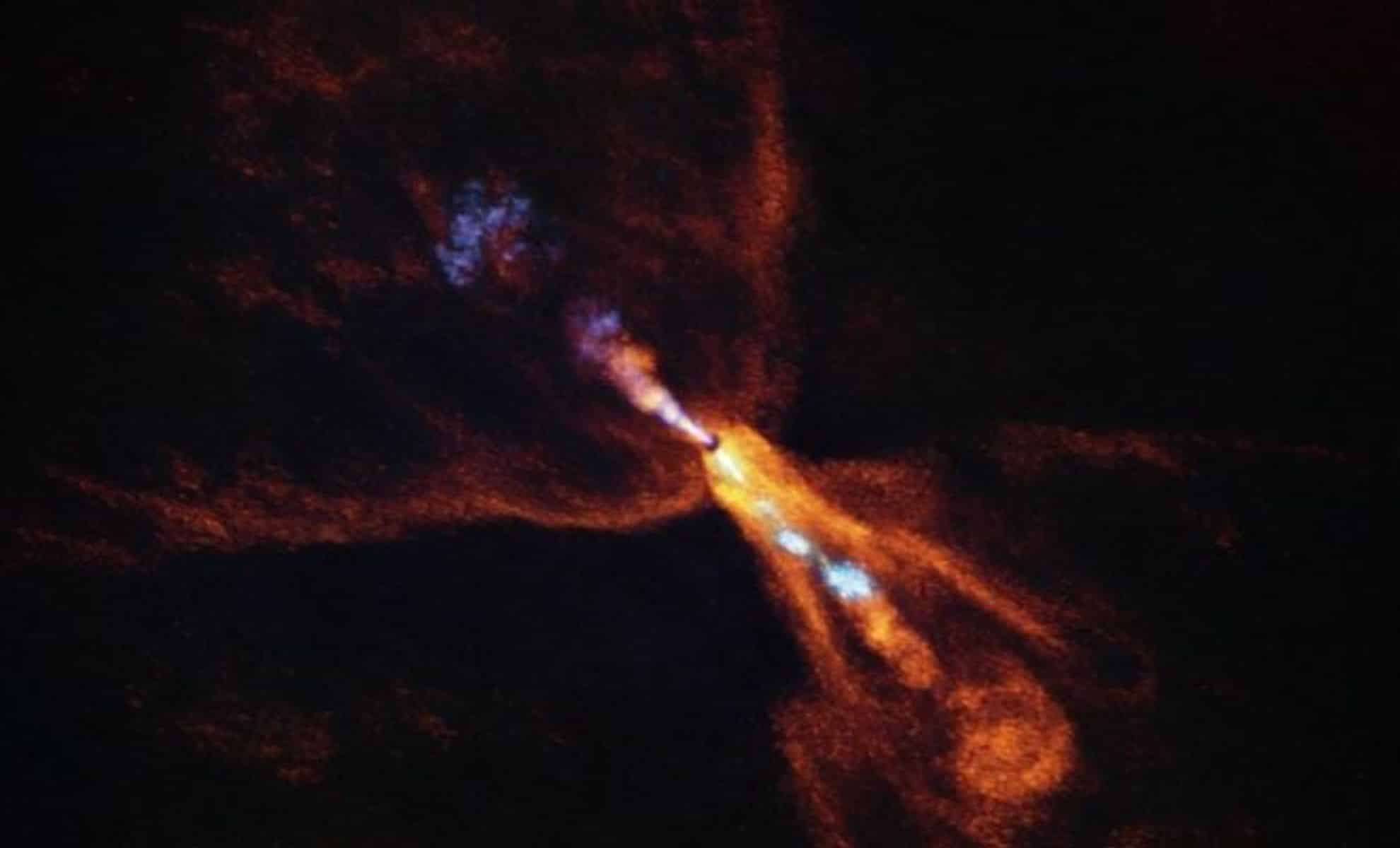
Scientists have long aimed to unravel the mysteries of how planetary systems come into existence. A groundbreaking achievement has recently been made with the observation of planet formation in its earliest phase around a star situated 1,300 light-years from Earth. Utilizing advanced instruments such as the James Webb Space Telescope (JWST) and the Atacama Large Millimeter/submillimeter Array (ALMA), researchers have obtained an extraordinary look at the birth of a solar system beyond our own. This landmark finding could be crucial in deciphering the origins of distant exoplanetary systems and enhancing our knowledge about the formation of the Solar System we inhabit. A key publication in Nature explores this phenomenon further, offering insights into how planet formation varies across diverse stellar surroundings.
Earliest Signs of Planet Creation Around a Non-Solar Star
Melissa McClure, an astronomer at Leiden University, emphasized the importance of this discovery: “For the first time, we have identified the earliest moment when planet formation is initiated around a star other than our Sun.” This pivotal observation revolves around HOPS-315, a young star resembling the Sun but still in its formative stages, located inside a molecular cloud roughly 1,300 light-years away. HOPS-315 continues to accumulate mass from the surrounding hot gas, making it an ideal subject to study early star and planet development. While the general outlines of planetary system formation have been understood, directly observing its initiation marks a significant advance for astronomy.
This milestone matters because it marks the initial stage at which the gas and dust within HOPS-315’s protoplanetary disk start clustering to create planetesimals, or the foundational components of planets. As the star spins and surrounding materials cool and condense, these planetesimals will collide and merge, eventually forming larger planetary bodies. Witnessing this embryonic phase offers invaluable data on how planets form in differing stellar environments.

Decoding the Role of Silicon Compounds in Planet Formation
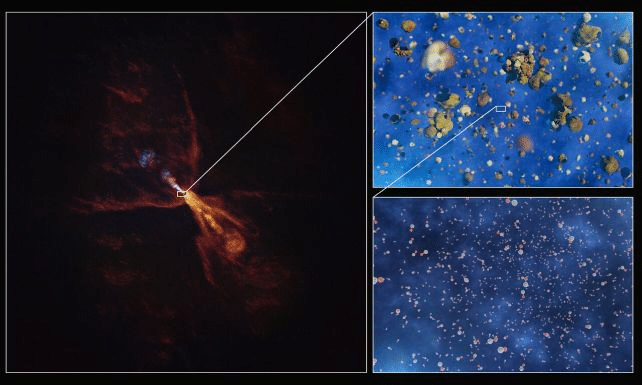
A critical breakthrough involved detecting warm silicon monoxide gas and silicate minerals within the protoplanetary disk. Astrophysicist Edwin Bergin of the University of Michigan highlighted the uniqueness of this finding, stating, “This process has never been seen before in a protoplanetary disc – or anywhere outside our Solar System.” Such silicon-based materials are essential in the construction of rocky planets and serve as the first direct proof that planet-building activities are underway during this nascent stage.
Thanks to JWST's infrared observational capabilities, researchers could pinpoint these warm minerals, confirming that silicon monoxide gas—a precursor to solid silicates—is present. This discovery signals that the formation of solid structures, the precursors to planets, is active around HOPS-315. The implications for understanding how terrestrial planets like Earth might arise around other stars are profound.
Insights into Our Solar System’s Early Days from HOPS-315
HOPS-315 is particularly fascinating due to the resemblance between its developmental stage and what scientists believe our Solar System experienced billions of years ago. Merel van ‘t Hoff, a physicist and astronomer at Purdue University, noted, “We’re seeing a system that looks like what our Solar System looked like when it was just beginning to form.” The protoplanetary disk surrounding this young star closely mirrors the early conditions thought to have existed around the Sun approximately 4.5 billion years ago, making it an exceptional case study for the beginnings of our cosmic neighborhood.
Despite being only about 60% the mass of the Sun and still in the early stages of formation, HOPS-315 shares many characteristics with the infant Sun. This similarity makes it an invaluable natural laboratory for investigating how planetary systems like ours might come into being. Continued examinations of HOPS-315 and comparable stars are expected to deepen our understanding of the dynamics shaping the formation of planets and the environmental factors conducive to life-supporting worlds.
JWST and ALMA: Powerful Tools Opening New Windows into Star and Planet Formation
The revelation of HOPS-315’s early planet formation owes much to the capabilities of JWST and ALMA, two of the most sophisticated telescopes available today. ALMA's radio wavelength observations and JWST's infrared imaging allow astronomers to penetrate thick clouds of dust and gas, unveiling the processes hidden within stellar nurseries.
By leveraging these instruments, McClure’s team detected specific light signals indicative of warm silicon monoxide and silicate particles encircling HOPS-315. Such detailed observations mark only the beginning, as ongoing use of JWST and ALMA will enable scientists to investigate many other nascent stars and their potential for forming planets. The progression in observational technology continually enhances our view of how stars and worlds come into existence across the universe.
Broader Implications for Planetary System Research
Though HOPS-315 stands as a singular example, the early onset of planet-forming activity observed here carries significant weight for astrophysics. Discovering that planet formation begins so soon after a star’s birth opens new doors for exploring other juvenile star systems throughout our galaxy. Through comparative studies of protoplanetary disks similar to HOPS-315’s, researchers aspire to refine models of planetary development and determine whether these formative processes are common or unique to certain conditions.
As van ‘t Hoff emphasizes, “We’re seeing a system that looks like what our Solar System looked like when it was just beginning to form,” underscoring the broader value of this research for understanding planetary system emergence. This work could ultimately enhance our knowledge of how frequent solar systems resembling ours might be and aid in identifying those with the greatest potential to support life.
- Categories:
- News






0 comments
Sign in to Comment