
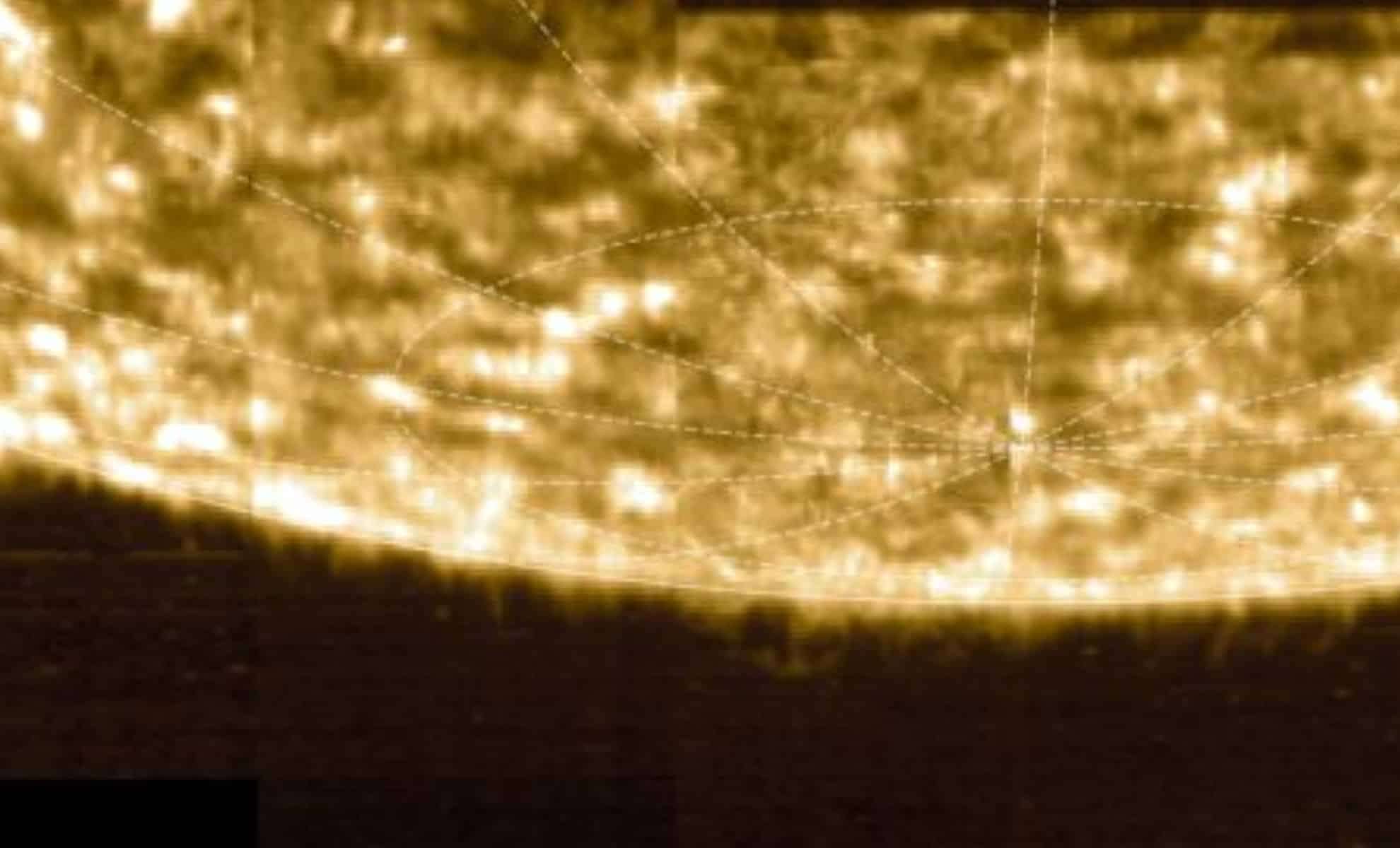
For the very first time, researchers have obtained a direct view of the Sun’s southern polar region, a part of our star previously hidden from observation. This remarkable achievement was made possible by the European Space Agency’s (ESA) Solar Orbiter, which adjusted its trajectory to tilt its orbit by 17 degrees in February 2025. This maneuver allowed the spacecraft to look beneath the solar system’s plane, unveiling a crucial area of the Sun never before captured in detail.
A Revolutionary Outlook on Our Star
Traditionally, most solar observations have focused on the Sun’s equatorial regions due to Earth’s vantage point and the orbits of space instruments. As a result, the poles remained largely out of reach. ESA’s science director, astrophysicist Carole Mundell, explained the significance, stating, “Today we reveal humankind’s first-ever views of the Sun’s pole.”
The Sun’s poles significantly influence solar phenomena, including the well-known 11-year solar cycle, during which magnetic poles reverse places. Studying these regions was challenging until now due to limited observational data.

The timing of Solar Orbiter’s mission perfectly coincides with the Sun’s transition from its solar maximum phase, when this magnetic flip occurs, to solar minimum. These new perspectives promise to deepen our understanding of this critical cycle.
Cutting-Edge Technology Unveils the Unknown
The Solar Orbiter carries a suite of sophisticated instruments that collaborated to capture this unprecedented data. The Polarimetric and Helioseismic Imager (PHI) studied the Sun’s magnetic field by analyzing polarized light, revealing a complex patchwork of magnetic polarities at the south pole. Astrophysicist Sami Solanki from the Max Planck Institute for Solar System Research describes these polar areas as “literally terra incognita,” emphasizing their unexplored nature until this mission.
Meanwhile, the Extreme-Ultraviolet Imager (EUI) took detailed images of the solar atmosphere at specific wavelengths, highlighting intricate structures unseen before. The Spectral Imaging of the Coronal Environment (SPICE) instrument gathered data on the corona’s temperature and composition, tracking carbon ion movements in the transition region.
SPICE’s Doppler velocity maps reveal vital details about particle flows that contribute to the solar wind, a continuous stream of charged particles influencing our entire solar system.
Decoding the Sun’s Magnetic Field Reversal
One of Solar Orbiter’s most intriguing discoveries is the chaotic interplay of magnetic polarities at the Sun’s south pole. The magnetic field showed mixed north and south regions during the survey. As the Sun proceeds toward solar minimum, one dominant polarity will emerge, stabilizing the magnetic field before the next cycle begins. This process, known as the solar polarity reversal, has long puzzled scientists, and the new evidence may illuminate its mechanisms.
These findings mark the dawn of a transformative period in solar research. Solar Orbiter is slated to maintain its 17-degree orbital tilt through 2026, with plans to incrementally increase this tilt to 33 degrees by 2029.
This expanding vantage point will enable clearer and more detailed views of the Sun’s poles, offering critical insights into the star’s magnetic dynamics, solar wind, and overall activity like never before.
- Categories:
- News







0 comments
Sign in to Comment