
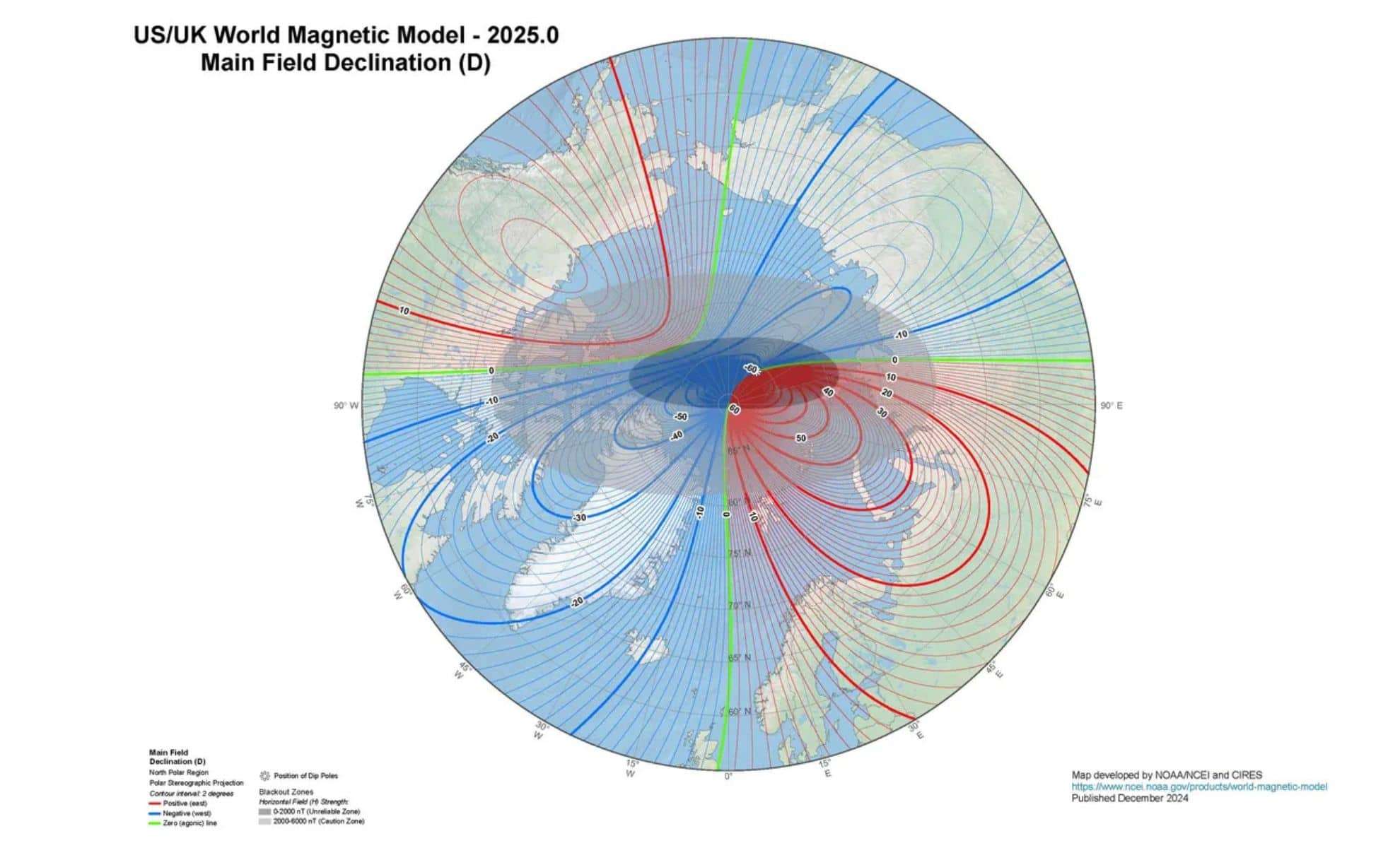
The magnetic north pole, a key reference point of Earth’s magnetic field, is continuously migrating from the Canadian Arctic toward the Siberian region. This ongoing shift is driven by the complex movements within Earth’s liquid outer core. Updated data from the World Magnetic Model (WMM) highlight important alterations that will impact navigation technology around the globe.
What Drives the Magnetic North Pole’s Movement?
The magnetic north pole is constantly changing position due to turbulent flows of molten iron and nickel in Earth’s outer core. These flows generate electrical currents, which in turn produce a varying magnetic field via the geodynamo mechanism. Unlike the fixed geographic North Pole, the magnetic north drifts unpredictable distances each year.
According to Dr. William Brown, a geomagnetic modeler at the British Geological Survey (BGS), “The current pattern of magnetic north movement is unprecedented. For centuries it moved slowly around Canada, but in the last two decades, it picked up speed toward Siberia, accelerating annually until about five years ago when it slowed from around 50 to 35 kilometers per year.”

This shift provides valuable insights into the inner workings of our planet’s core, revealing processes still under investigation by scientists.
Consequences for Modern Navigation Systems
Keeping track of the magnetic north pole’s location is vital for navigation technologies worldwide. The World Magnetic Model (WMM), collaboratively maintained by the National Centers for Environmental Information (NCEI) and BGS, offers updated magnetic field data crucial for devices such as:
- GPS navigation
- Magnetometer-enabled smartphones
- Avionics and aircraft guidance systems
- Marine and defense navigational equipment
The most recent WMM release on December 17, 2023 delivers key enhancements:
- Improved spatial resolution of roughly 186 miles at the equator, a marked advance from the prior resolution exceeding 2,000 miles.
- Model projections extending through 2029, ensuring navigation tools remain dependable for the coming five years.
Brown notes, “Navigation accuracy stays consistent with daily expectations. Frequent model updates keep magnetic variations within manageable limits so users rarely notice discrepancies.”
Historical Trends in Magnetic North Pole Movement
The path of the magnetic north pole has varied over time. Since the 1830s, it has traversed more than 2,250 kilometers (1,400 miles) from Canada toward Siberia, with movement speeds fluctuating markedly in recent decades:
- 1830–1990: Slowly drifting at less than 15 kilometers (9.3 miles) per year.
- 1990–2005: Sharp acceleration to 50–60 kilometers (31–37 miles) annually.
- 2019: An off-cycle update was necessary due to unusually rapid shifts.
- 2020s: Noticeable deceleration down to around 35 kilometers (22 miles) per year.
Table of Magnetic North Pole Movement Rates Over Time:
Such variations underline the unpredictable nature of Earth’s inner core dynamics, which continue to challenge scientific modeling efforts.
Looking Ahead: The Path of the Magnetic North Pole
Researchers refresh the WMM every five years, integrating the latest data to predict the pole’s course, velocity, and direction. This ongoing migration provides valuable perspectives on the mechanisms that maintain Earth’s magnetic shield, protecting our planet from solar radiation.
Brown comments, “Model accuracy tends to diminish after about five years. Regular updates incorporate new information, refining forecasts and maintaining precision.”
What Lies on the Horizon?
The magnetic north pole’s erratic voyage continues to drive scientific inquiry and necessitate updates. Most navigation device users may remain unaware of these subtle shifts, but the magnetic field’s evolution has profound technological and environmental significance. Continuous observation ensures navigational accuracy and functionality are sustained.
This migrating pole exemplifies Earth’s constantly evolving interior—a remarkable interaction of subterranean forces shaping the magnetic environment impacting our daily lives.
- Categories:
- News








0 comments
Sign in to Comment