
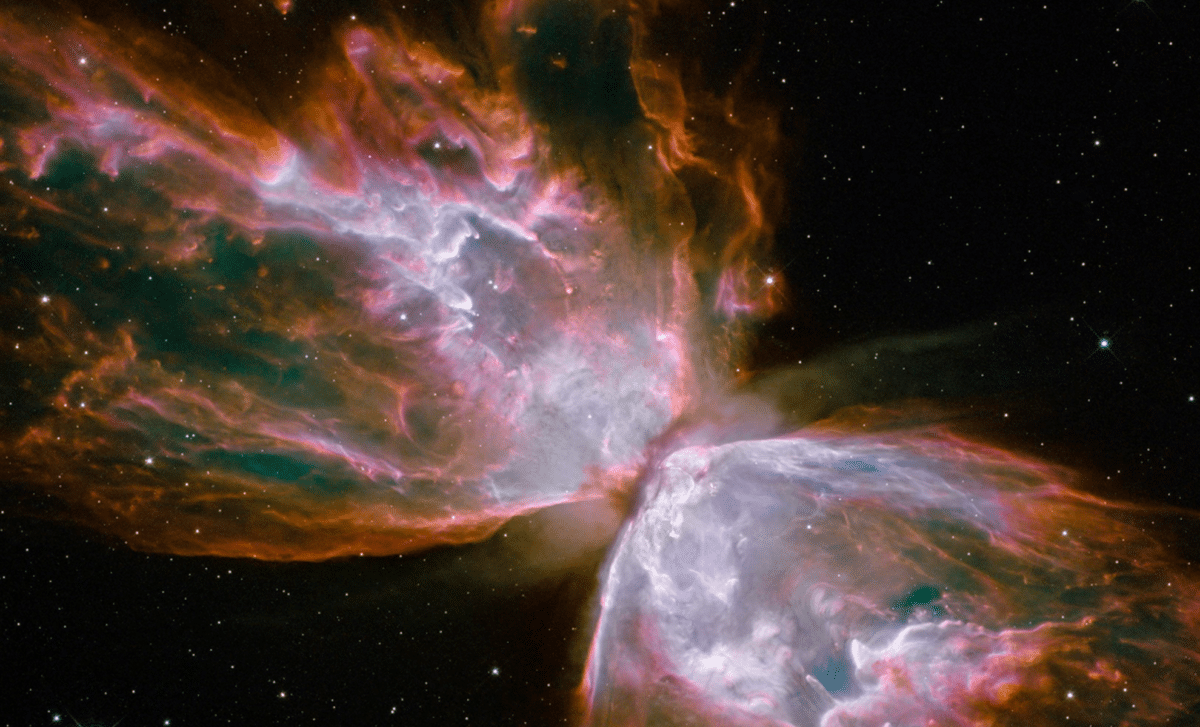
Astronomers have, for the first time, detected carbon dioxide ice (dry ice) within a planetary nebula, unveiling new insights into the intricate chemistry occurring in some of the universe’s most changing and intense regions. This pioneering observation was achieved thanks to the James Webb Space Telescope (JWST), with the findings released on the arXiv preprint platform on February 25, 2026. Led by Charmi Bhatt from the University of Western Ontario, the research team has taken a major step forward in our understanding of the chemical dynamics in dying stars and the interstellar medium.
Exploring Uncharted Territory in Space Science
The identification of dry ice in the planetary nebula NGC 6302 marks a significant shift in how scientists view ice formation under extreme cosmic conditions. Situated approximately 3,400 light-years away in the Scorpius constellation, NGC 6302 has fascinated astronomers due to its intricate formations and varied chemistry. Often referred to as the Butterfly Nebula, its distinct shape and vivid features have made it a prime target for studies into its gaseous and dusty environment.
Planetary nebulae like NGC 6302 are formed in the last phases of a star’s life before it becomes a white dwarf. Comprised mostly of gas and dust expelled from the star, these nebulae create a rich chemical network, revealing information about the universe’s elemental content. Finding carbon dioxide ice here challenges earlier beliefs about the vulnerability of ice molecules in harsh conditions where ultraviolet radiation typically eradicates molecular ices such as CO2.

JWST Sheds Light on Chemical Details
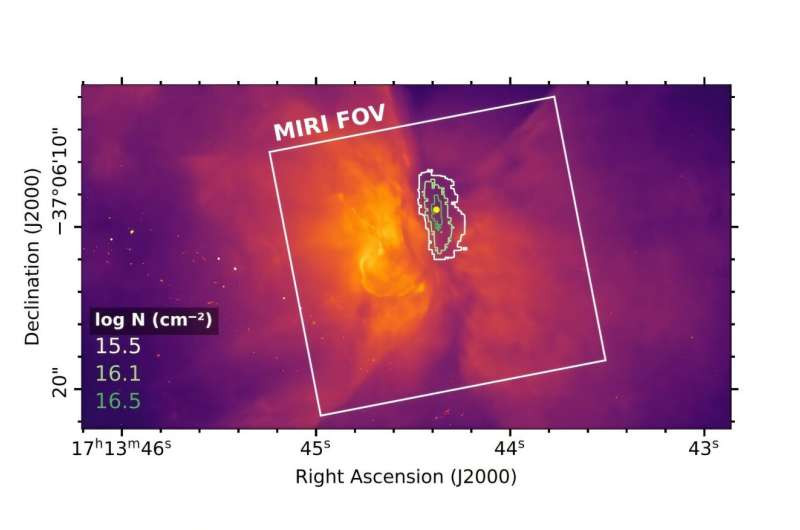
The key data leading to this breakthrough were gathered through JWST’s Mid-Infrared Instrument (MIRI), an advanced device capable of capturing detailed infrared images and spectra. The investigation targeted the central star, the surrounding torus, and the inner zones of NGC 6302’s bipolar lobes, employing MIRI’s medium-resolution spectrometer (MRS) to analyze the nebula’s chemical signatures with exceptional precision.
“This work utilizes JWST MIRI/MRS observations of NGC 6302 covering the central star, torus, and innermost region of the bipolar lobes,” the paper states.
This analysis uncovered distinct absorption features within the 14.8 to 15.2 µm wavelength range, indicative of gas-phase carbon dioxide, confirming the first-ever identification of CO2 ice in a planetary nebula. Additionally, two specific absorption bands from 14.9–15.15 µm and 15.2–15.3 µm were attributed to the unique spectral fingerprints of solid carbon dioxide.
The Significance of This Finding
Spotting CO2 ice in NGC 6302 represents a major advancement for planetary nebula research and offers profound implications for our understanding of cosmic chemistry. Whereas molecular ices like water and carbon dioxide commonly form in cold, dense regions such as molecular clouds and protoplanetary disks, the harsh ultraviolet radiation characteristic of planetary nebulae typically eradicates these fragile ices, making this discovery all the more remarkable.
It suggests that dry ice in NGC 6302 likely formed through mechanisms unlike those in cooler cosmic environments, indicating previously unrecognized physical or chemical conditions capable of sustaining such ices amid intense radiation.
Insights into Chemical Activity in Aging Stars
Discovering solid carbon dioxide expands the growing understanding of the chemical evolution occurring in stars nearing the end of their life cycle. Earlier studies of NGC 6302 had already detected complex molecules like the methyl cation (CH3+), an important molecule in organic chemistry. The nebula’s capacity to harbor such chemically diverse species suggests it serves as a natural laboratory for exploring molecular complexity, possibly even relevant to the origins of life.
Furthermore, the team’s research, accessible via arXiv, reveals that the ratio of gas to ice in NGC 6302 is quite different from ratios observed in young stellar objects (YSOs). This points to distinct ice formation and transformation processes in advanced stellar stages, offering new perspectives on the chemical pathways within evolving star systems.
- Categories:
- Astronomy


0 comments
Sign in to Comment