
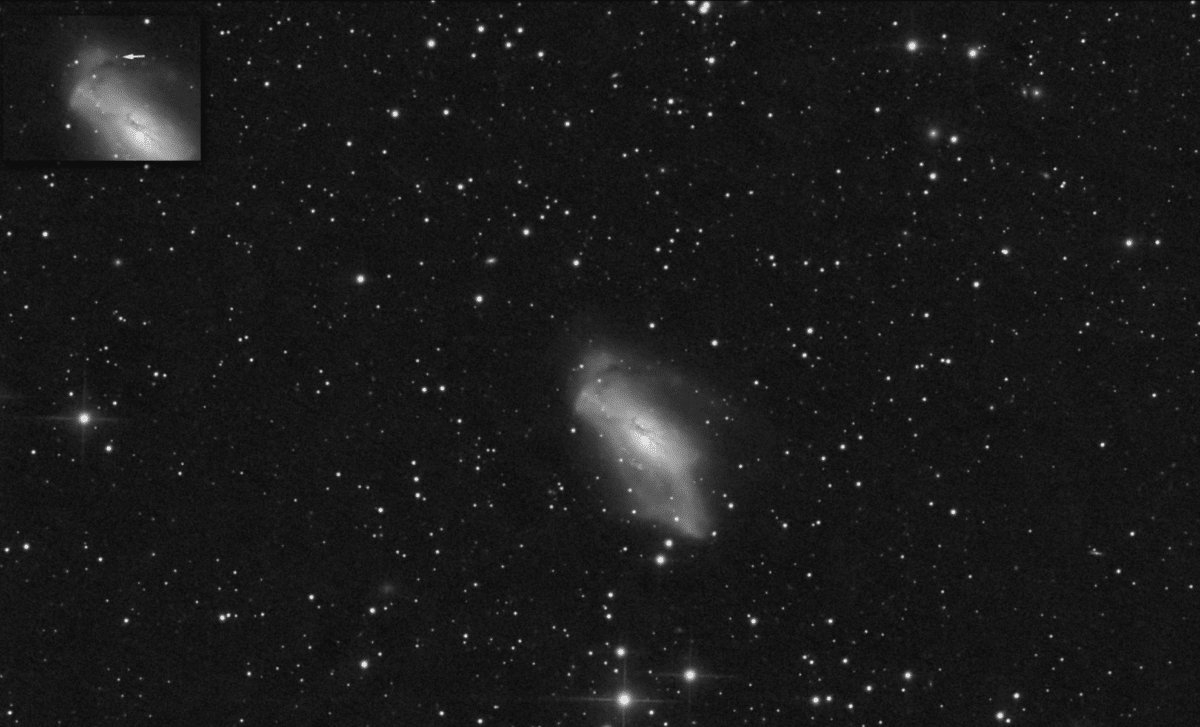
Astronomers have recently identified a faint Type IIP supernova, designated SN 2024abfl, situated within the galaxy NGC 2146. This uncommon discovery is providing new perspectives on the mechanisms behind stellar explosions. Led by Xiaohan Chen from the Chinese Academy of Sciences, the research team employed observations from multiple telescopes, including the Xinglong Station observatory in China, revealing surprising properties of the supernova. Their findings, published on arXiv, enhance our understanding of star life cycles, the evolution of stars, and how supernovae influence galaxy formation.
Deciphering Type IIP Supernovae and Their Astronomical Significance
Supernovae rank among the universe’s most intense and radiant phenomena, captivating astronomers for decades. These explosions are categorized based on hydrogen lines in their spectra: Type I supernovae lack hydrogen signatures, while Type II supernovae present them. Within Type II, the classifications include Type IIL (Linear) and Type IIP (Plateau). Unlike the rapidly dimming SNe IIL, Type IIP supernovae display a sustained plateau phase during which their brightness remains nearly constant for a prolonged time—up to 100 days, making them ideal for studying explosion dynamics. As a low-brightness sample in this classification, SN 2024abfl has offered distinctive clues about these stellar phenomena.
The Observation of SN 2024abfl: Characterizing a Dim Supernova
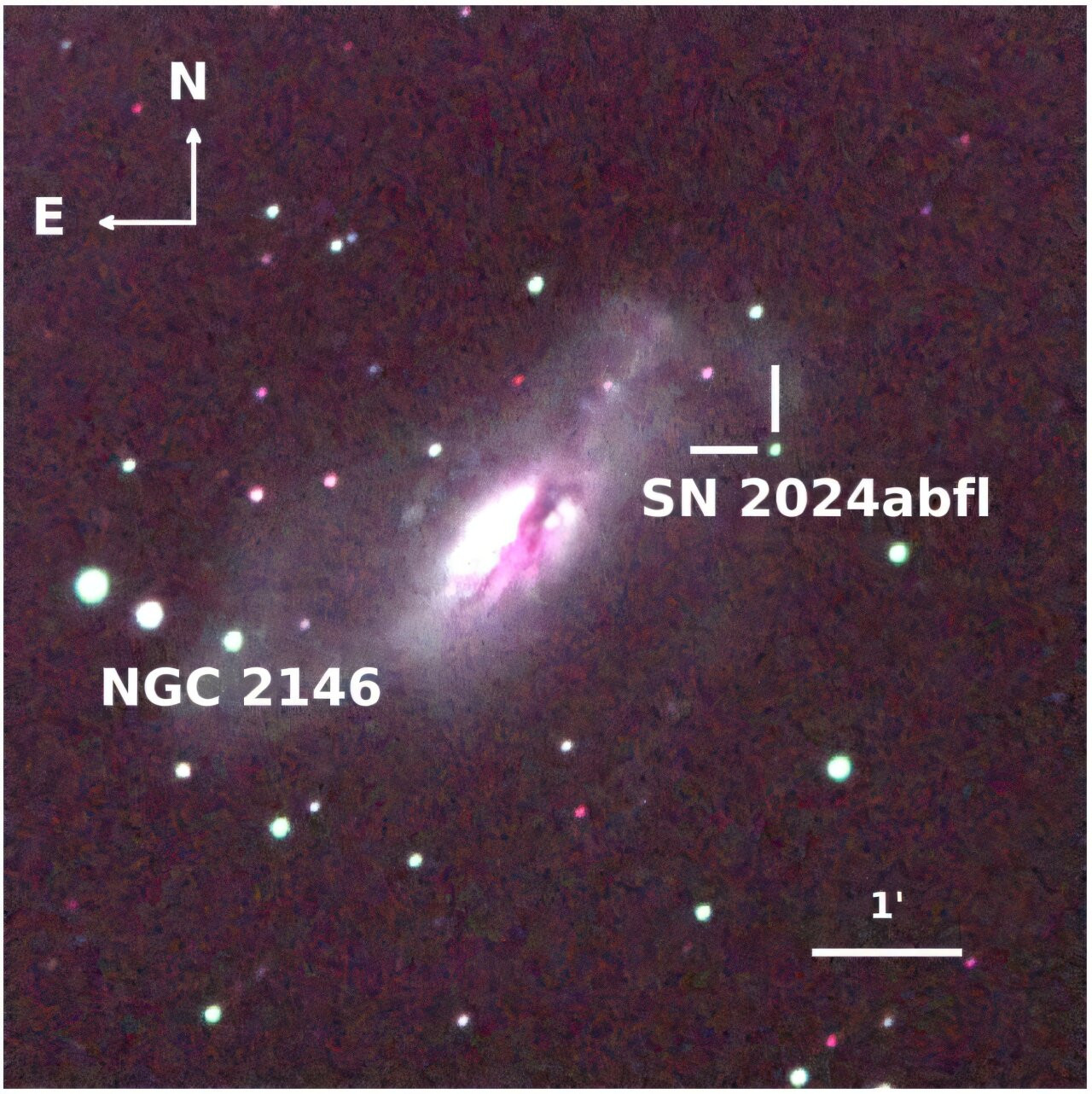
SN 2024abfl was first detected on November 15, 2024, within the nearby galaxy NGC 2146. Its observed magnitude of 17.5 indicated it was notably fainter than standard Type IIP supernovae. Despite the subdued brightness, SN 2024abfl maintained typical features like an extended plateau phase. Still, its absolute magnitude during this phase hovered around −15 mag, substantially dimmer than standard Type IIP supernovae. This classification as a low-luminosity Type IIP event expands our awareness of the diverse brightness and duration these explosions can exhibit.

Tracing Back to the Progenitor: Origins of SN 2024abfl
An essential aspect of the investigation, detailed on arXiv, is the likely identification of the progenitor star. Estimated to weigh between 9 and 12 solar masses, this progenitor was probably a red supergiant, representing a late stage in stellar evolution before eruption. By examining archival images from the Hubble Space Telescope, researchers pinpointed the candidate star. This challenges the prevailing notion that only stars exceeding 15 solar masses give rise to Type IIP supernovae, thereby broadening the scope of possible progenitor stars capable of such events.
Examining the Plateau Phase: SN 2024abfl’s Long-lasting Brightness Stability
The plateau phase, a hallmark of Type IIP supernovae, is a time span when luminosity remains steady, offering astronomers critical insights into the explosion’s nature. For SN 2024abfl, this plateau stretched an exceptional 126.5 days, substantially longer than typical counterparts. Such an extended plateau hints at an abnormally thick stellar envelope, causing a slower rise in brightness and prolonged visibility. This combination of low brightness and extended plateau phase enriches the understanding of Type IIP supernova variability.
Spectral Observations: Unveiling the Dynamics of SN 2024abfl
Analysis of spectral data from SN 2024abfl revealed an evolution paralleling other Type IIP supernovae but with several distinctions. The ejecta velocity was significantly slower than usual. Around 37 days post-explosion, a high-speed hydrogen-alpha absorption feature appeared, signaling a plume of fast-moving matter deep within the ejecta. Subsequently, approximately 24 days after this detection, two emission components with velocities near 2,000 km/s became visible, likely indicating interactions between the exploding material and the surrounding circumstellar environment. These phenomena may explain the unique brightness profile observed.
Energy Output and Nickel-56 Content: Identifying a Low-Powered Supernova
SN 2024abfl’s energy release was notably lower compared to typical supernova explosions. The produced nickel-56 mass was estimated around 0.009 solar masses, a fraction of the amount generated in more luminous cases. The explosion's initial kinetic energy measured approximately 42 quindecillion ergs, underscoring its relatively modest power. This subdued energy likely reflects the lower mass of the progenitor star and illustrates the diverse energetics possible in supernova events.
- Categories:
- Astronomy





0 comments
Sign in to Comment