

A remarkable cosmic event may soon capture the attention of skywatchers worldwide as scientists from the University of Turku predict the star system V Sagittae is nearing a spectacular explosion unseen for hundreds of years. Their November publication in the Monthly Notices of the Royal Astronomical Society reveals compelling evidence pointing to the system’s imminent transformation into a brilliant supernova.
V Sagittae: An Intriguing Binary Star on the Edge of a Drastic Shift
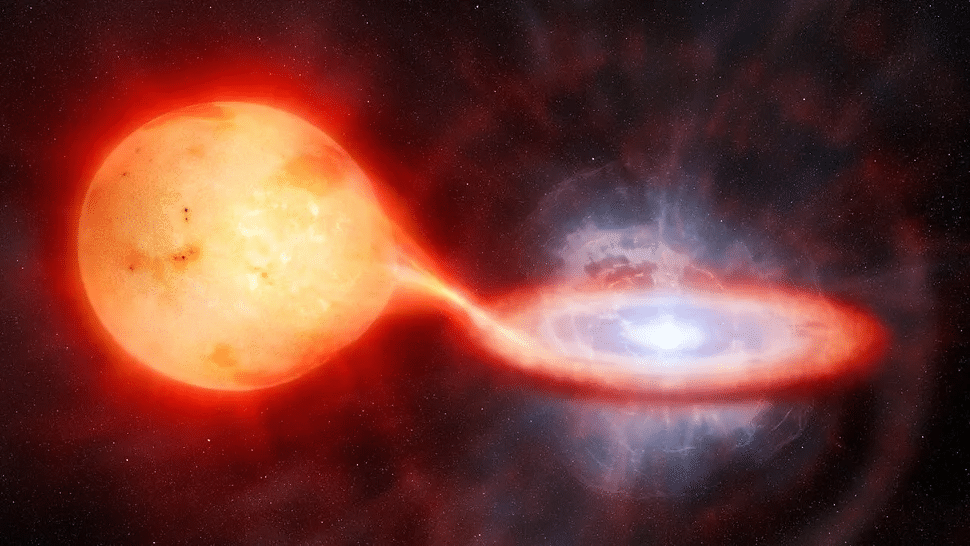
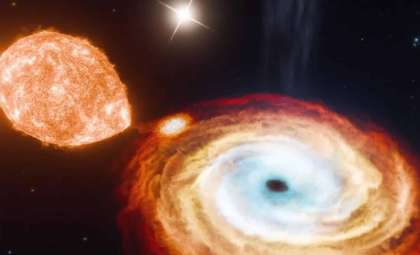
Situated about 10,000 light-years away in the Sagitta constellation, the V Sagittae system has fascinated astronomers due to its peculiar features. It consists of a white dwarf—a compact stellar remnant akin to our Sun’s final stage—and a heftier companion star. Recent data from the Very Large Telescope of the European Southern Observatory (ESO VLT) has provided new insights into this complex duo. The observations reveal a system on the precipice of a dramatic outburst potentially visible even during daylight hours.
Published in November in the Monthly Notices of the Royal Astronomical Society, the study led by an international team of researchers offers insights into the forces at play in this remarkable system. The research suggests that the white dwarf is currently devouring material from its companion star at an unprecedented rate, setting the stage for a dramatic outburst that will light up the sky. “The voracious white dwarf is gorging on material from its companion ‘at a rate never seen before,'” the team noted in a statement, underscoring the magnitude of this cosmic event.
Add Cosmo Herald as a Preferred Source

Approaching a Nova: A Prelude to a Cosmic Blast
The intense feeding of the white dwarf is expected to trigger a nova event. This phenomenon arises when the white dwarf gathers too much matter from its companion, resulting in a powerful thermonuclear eruption. While incredibly bright, novae don’t obliterate the white dwarf; they cause a dramatic surge in luminosity by thousands or even hundreds of thousands of times. Observers may soon witness V Sagittae’s nova explosion with the naked eye.
Pablo Rodríguez-Gil, astrophysics professor at the Canary Islands Institute and co-author of the study, explains:
“The matter accumulating on the white dwarf is likely to produce a nova outburst in the coming years, during which V Sagittae would become visible with the naked eye.”
This forthcoming spectacle promises to mesmerize anyone gazing upwards, providing a rare look at the star system’s stunning evolution.
The Ultimate Act: A Supernova Bright Enough to Illuminate the Day
Yet, the nova is just the beginning for V Sagittae’s dramatic finale. As the two stars spiral closer, their eventual merger will trigger a supernova explosion with a brilliance that could rival or surpass the Sun’s light. Unlike a nova, this supernova event signifies the destruction of the white dwarf and marks the end of the binary system’s life.
Experts anticipate this cosmic detonation will be bright enough to be seen even during daylight hours. Such a rare event offers astronomers and sky enthusiasts a once-in-a-lifetime chance to observe a stellar death unfold in real time, yielding valuable insights into stellar life cycles and binary star evolution.
Complexities Within V Sagittae: Unlocking Stellar Secrets
Months of careful investigation have deepened our understanding of V Sagittae, though many questions remain, particularly about the precise properties of its stellar components. Phil Charles, emeritus professor of astronomy at the University of Southampton and study co-author, comments to LiveScience,
“From our study we show that no one has yet been able to uniquely identify the orbital motion of each component, and hence we don’t yet have a good measure of each star’s mass.”
These challenges highlight the intricate dynamics at work in binary stars, where gravity-driven interactions often produce unpredictable results.
Nonetheless, astronomers remain confident that the accelerating accretion onto the white dwarf, combined with unusual light patterns from the system, points to an imminent, extraordinary explosion. The brightness of V Sagittae is expected to increase steadily as it approaches its defining nova event. Scientists are eager to continue monitoring this fascinating star system to uncover further clues about its ultimate destiny.
- Categories:
- Astronomy




0 comments
Sign in to Comment