
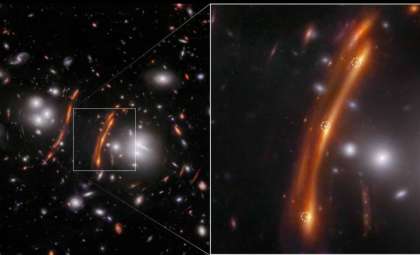
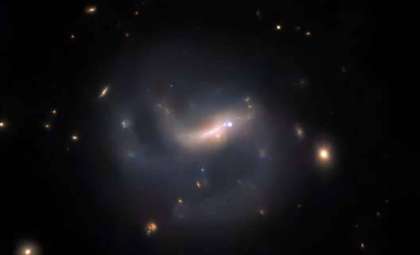
The James Webb Space Telescope’s near-infrared instrument, NIRCam, has captured an extraordinary event within the galaxy cluster PLCK G165.7+67.0, situated 3.6 billion light-years away. Astronomers detected three separate luminous spots all stemming from a single type Ia supernova. This remarkable occurrence arises from gravitational lensing, where the powerful gravitational field of a foreground galaxy bends and amplifies the light from a distant cosmic explosion.
Type Ia supernovae happen when a white dwarf accumulates matter from a companion star, eventually igniting a gigantic thermonuclear blast. These supernovae serve as “standard candles” in astronomy due to their consistent intrinsic brightness, enabling researchers to gauge immense cosmic distances and refine measurements of the universe’s expansion rate.
The supernova observed by JWST, dating back 10.2 billion years, offers a rare glimpse into early cosmic history. By studying the time differences between the three gravitationally lensed images and applying advanced lensing models, scientists have derived an updated estimate for the Hubble constant.

The challenge of the Hubble tension
The newest data from JWST contributes to the deepening mystery known as the Hubble tension, a conflict arising from divergent values of the universe’s expansion rate depending on the measurement technique. This contradiction poses questions about the accuracy of current cosmological theories.
Two main approaches are used to determine the Hubble constant:
- Examining temperature variations in the cosmic microwave background radiation
- Utilizing Cepheid variable stars as distance indicators
Measurements based on the cosmic microwave background indicate an expansion velocity near 67 kilometers per second per megaparsec (km/s/Mpc), consistent with predictions derived from the standard cosmological model. Conversely, observations focusing on Cepheid stars yield a higher value of 73.2 km/s/Mpc.
The new analysis leveraging the gravitational lensing of the JWST-discovered supernova estimates the Hubble constant at 75.4 km/s/Mpc (with uncertainties of +8.1 or -5.5), adding further complexity to the ongoing Hubble tension debate.
Broader consequences for cosmology
The unresolved disparity in measuring the Hubble constant has significant repercussions for our fundamental understanding of cosmic dynamics. The prevailing cosmological framework invokes dark energy as the agent driving a steady acceleration of the universe’s expansion. However, inconsistent results from these measurements challenge this paradigm.
Dr. Brenda Frye, an associate professor of astronomy at the University of Arizona and co-author of the study, highlighted the importance of these findings: “Our team’s results are impactful : The Hubble constant value matches other measurements in the local universe, and is somewhat in tension with values obtained when the universe was young.”
For clarity, here is a comparison of different Hubble constant measurements:
MethodHubble Constant (km/s/Mpc)Cosmic Microwave Background~67Cepheid Variables73.2JWST Lensed Supernova75.4 (+8.1/-5.5)
As astronomers continue investigating this cosmic conundrum, the advanced instruments aboard the James Webb Space Telescope provide unprecedented opportunities to observe additional distant supernovae. These efforts aim to enhance our understanding of the universe’s expansion and address the persistent discrepancies in current models.
The pursuit to decipher the Hubble tension remains active, with research teams worldwide employing varied methodologies. JWST’s novel observations of repeatedly imaged ancient supernovae may be key to unraveling the complexities behind the universe’s accelerating expansion.
- Categories:
- Astronomy




0 comments
Sign in to Comment