
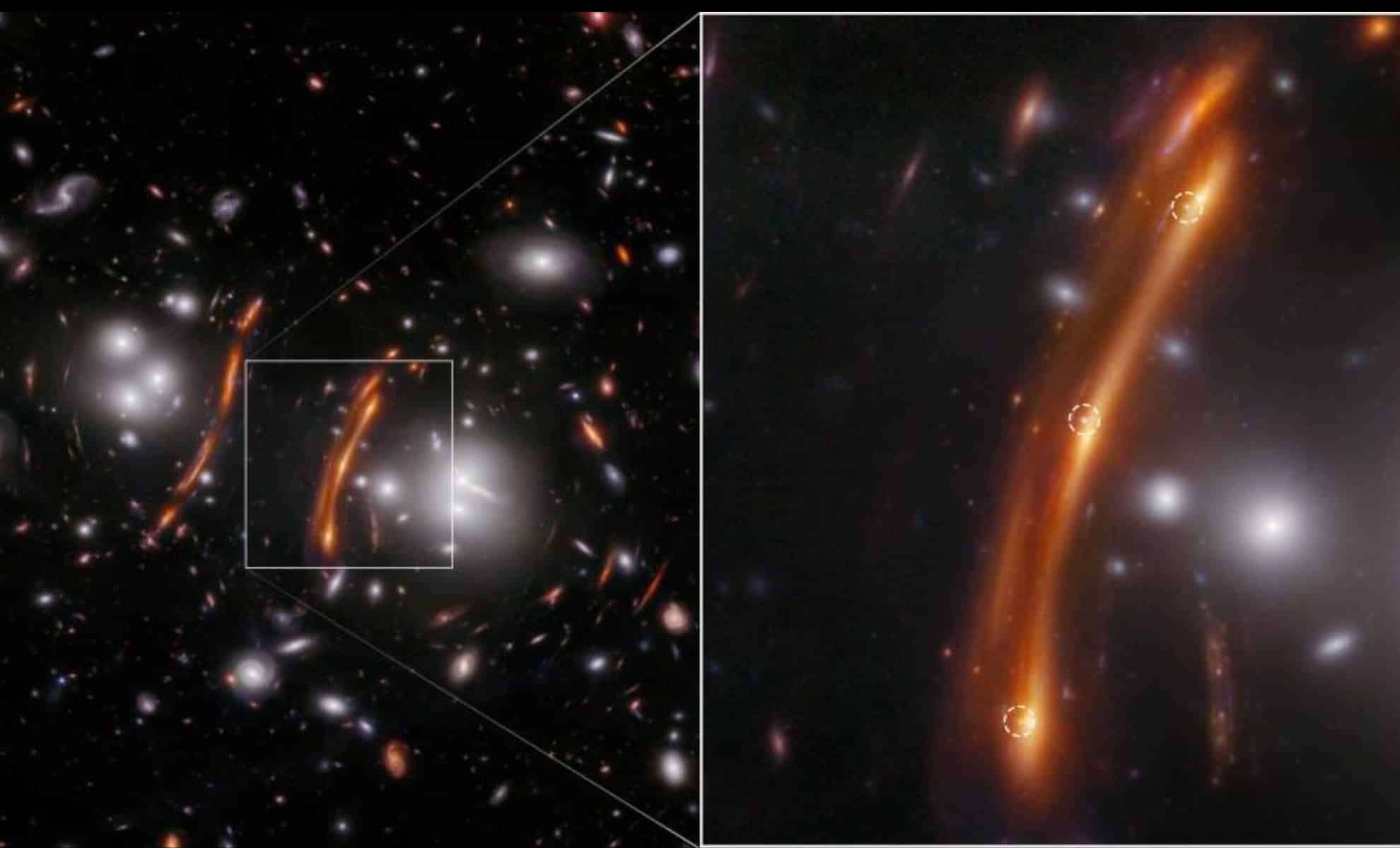
NASA's James Webb Space Telescope (JWST) has unveiled an exceptional gravitationally lensed supernova, making a significant contribution to cosmology.
This extraordinary event, called Supernova H0pe, provides an innovative tool to hone measurements of the Hubble constant, the parameter that quantifies how fast our universe is expanding, and advances our understanding of the persistent Hubble tension dilemma.
The identification of Supernova H0pe not only underscores the sophisticated capabilities of JWST but also opens new investigative pathways for probing cosmic expansion, offering essential data to address one of the field’s most pressing scientific puzzles.

Gravitational Lensing: Revealing the Universe’s Secrets
Located within the PLCK G165.7+67.0 galaxy cluster, JWST observed Supernova H0pe as three separate light sources—an effect caused by gravitational lensing. This natural phenomenon bends and intensifies light from background objects due to the mass of foreground clusters, enabling astronomers to study remote cosmic entities with unprecedented clarity. Brenda Frye from the University of Arizona, the leading astronomer behind the discovery, described the moment the team first noticed the unusual illumination. “It all started with one question by the team: ‘What are those three dots that weren’t there before? Could that be a supernova?’” Whereas earlier Hubble Space Telescope snapshots from 2015 showed no such features, JWST’s observations brought them sharply into focus.
The gravitational lensing effect allowed the team to witness the supernova during multiple stages of its explosion, generating several images of the same event. Frye likened the effect to peering into a tri-fold vanity mirror, remarking: “In the Webb image, this was demonstrated right before our eyes in that the middle image was flipped relative to the other two images, a ‘lensing’ effect predicted by theory.” This phenomenon provided crucial timing information, as light took different paths through space, creating a distinctive sequence of visual events.
Refining the Hubble Constant Using Supernova H0pe
Supernova H0pe stands out because it is a Type Ia supernova, renowned for serving as precise standard candles in measuring astronomical distances. These explosions have consistent intrinsic brightnesses, which make them invaluable to calibrate the cosmic distance scale. Gravitational lensing presented an extraordinary chance to observe the supernova’s light from multiple vantage points, improving the precision of the Hubble constant determination.
The JWST team capitalized on time delays between the images—caused by light traveling different routes—to estimate a new Hubble constant value: 75.4 kilometers per second per megaparsec, with an uncertainty range of +8.1 and -5.5. This result aligns with elevated Hubble constant values derived from studies of nearby galaxies, lending valuable support to one side of the ongoing Hubble tension debate between early and late universe observations.
Frye reflected on the discovery’s significance: “The supernova was named SN H0pe since it gives astronomers hope to better understand the universe’s changing expansion rate.” Utilizing gravitational lensing offers a novel, independent route to measuring a fundamental cosmological constant. Remarkably, this is only the second time such a method has been applied to a Type Ia supernova.
The Puzzle of the Hubble Tension
The persistent Hubble tension presents a key challenge in cosmology, arising from differences in the Hubble constant values measured from the cosmic microwave background—reflecting the early universe—and those from objects in the local universe, including Type Ia supernovae. Measurements based on the early cosmos typically yield lower rates of expansion, while local measurements indicate a faster rate. This discrepancy has sparked intense debate, with some researchers proposing new physics to reconcile these findings.
Data from Supernova H0pe contributes crucial evidence favoring the higher local universe expansion rates. Rogier Windhorst, the principal investigator of the PEARLS (Prime Extragalactic Areas for Reionization and Lensing Science) project, highlighted the impact of the discovery: “This is one of the great Webb discoveries, and is leading to a better understanding of this fundamental parameter of our universe.” Continued observations of lensed supernovae like SN H0pe could provide key breakthroughs in resolving the Hubble tension.
Looking Ahead: Continued Exploration
Uncovering Supernova H0pe marks a significant advance in unraveling the universe’s expansion history and the underlying phenomena influencing it. JWST’s gravitational lensing analysis approach establishes an innovative framework to further bridge differences between measurements from disparate cosmological time scales. Upcoming observations of similarly lensed supernovae and distant cosmic phenomena will refine these critical measurements.
The PEARLS program aims to keep monitoring Supernova H0pe and related gravitationally lensed events in future observing cycles, striving to sharpen the precision of the Hubble constant and deepen insights into the Hubble tension. Frye emphasized their optimism: “Our team’s results are impactful. The Hubble constant value matches other measurements in the local universe and is somewhat in tension with values obtained when the universe was young.”
As JWST delves deeper into the far reaches of space, its ability to reveal gravitational lensing and other cosmic effects promises essential clues about cosmic expansion, dark matter, and cosmic structure origins. Supernova H0pe’s discovery stands as a beacon of hope in tackling the profound mysteries of cosmology.
- Categories:
- Astronomy ,
- News ,
- Space ,
- Nasa






0 comments
Sign in to Comment