
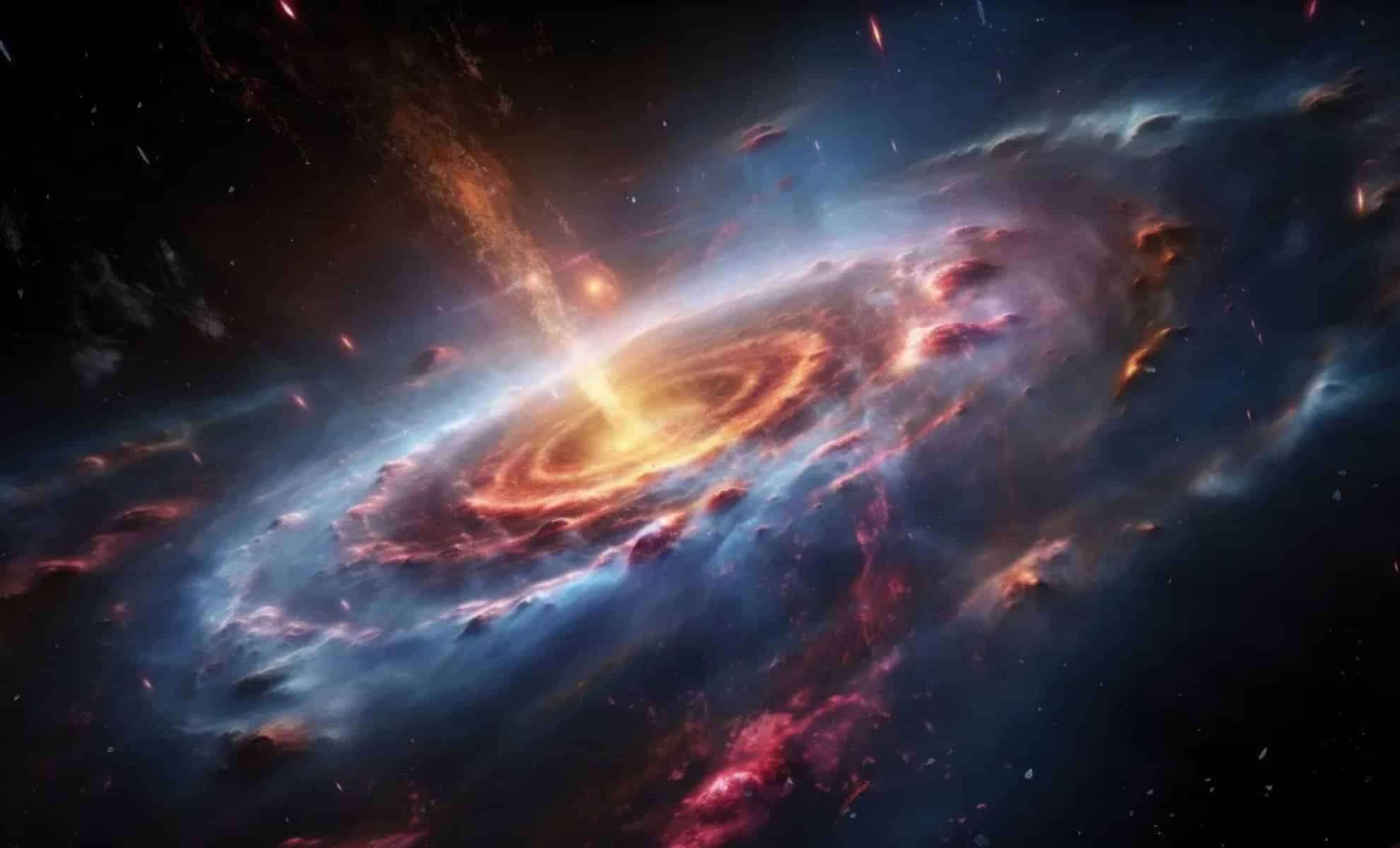
Dark matter continues to puzzle scientists, making up approximately 85% of all matter in the cosmos while remaining invisible to direct observation. Researchers at the University of California, Berkeley suggest that an imminent supernova explosion could be the key to detecting this elusive component. They theorize such an event might emit a surge of axions, hypothetical particles thought to be strong contenders for dark matter.
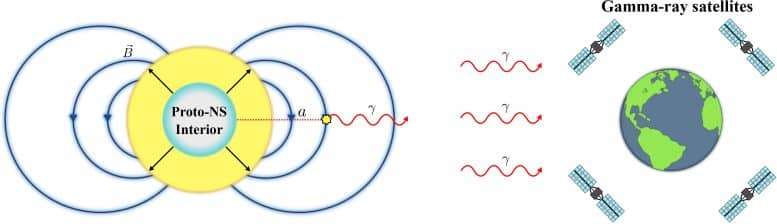
Should axions be real, their interaction with the magnetic fields generated during a supernova could convert them into gamma rays that might be detectable. Capturing this brief signal, however, is a challenge since the resulting gamma-ray flashes would only last around 10 seconds, demanding precise timing and advanced instruments.
Axions’ Potential Link to Dark Matter
Axions are a leading theoretical candidate in the quest to explain dark matter, fitting within the standard particle physics framework while helping resolve outstanding questions. Unlike neutrinos, which interact weakly and gravitationally, axions are proposed to have subtle interactions with all four fundamental forces, including electromagnetism.

As Dr. Benjamin Safdi, an associate physics professor at UC Berkeley, noted, “Observing even one gamma-ray burst could pinpoint the mass of the QCD axion over an extensive theoretical range and invalidate much of the mass window currently explored in experiments.” Such findings would radically deepen our insight into the universe’s invisible mass component.
Supernovae serve as natural experimental settings for this theory. When a massive star collapses into a neutron star, axions might be produced in vast amounts. These particles, escaping the star, could interact with the intense magnetic fields, converting into gamma rays observable from Earth.
An Infrequent but Valuable Event
One major challenge is the rarity of supernovae near enough to reveal axion signatures—typically inside the Milky Way or nearby dwarf galaxies. Such events happen roughly once every few decades. The last close case, 1987A located in the Large Magellanic Cloud, preceded the capability of current gamma-ray instruments to detect axion-related emissions.
Dr. Safdi warned of the high cost of missing future events: “If a supernova occurs tomorrow and we fail to detect axions, it may be another 50 years before the chance arises again.”
The UC Berkeley team advocates for building a dedicated gamma-ray observatory aboard a satellite named GALAXIS (GALactic AXion Instrument for Supernova). This instrument would provide around-the-clock monitoring of the sky, improving the chances of spotting axion-induced gamma-ray bursts when the next nearby supernova happens.
Gamma Rays as Evidence of Axions
Today’s gamma-ray observations primarily rely on the Fermi Gamma-ray Space Telescope, which is capable of detecting axion-related phenomena but has its limitations. With only one operational gamma-ray observatory in orbit, researchers estimate the odds of catching a supernova-driven gamma-ray burst at just 10%.
However, a confirmed detection would revolutionize astrophysics. Dr. Safdi explained, “A Fermi observation would allow precise measurement of axion mass and interaction strength, revealing everything essential about these particles.” Such a breakthrough would not only confirm axions as dark matter candidates but also fine-tune laboratory efforts by narrowing down their properties.
Getting Ready for the Next Event
The pursuit of axions as the dark matter solution illustrates the synergy between astrophysics, particle physics, and cutting-edge technology. Although proximate supernovae are uncommon, their potential scientific payoff is enormous.
According to SpaceDaily, researchers are prioritizing preparedness for the next local supernova by leveraging existing gamma-ray detectors like Fermi alongside proposals such as GALAXIS. This comprehensive strategy will maximize the chances of detecting fleeting gamma-ray signals that could expose the nature of dark matter. Verifying a single gamma-ray burst would confirm axions as dark matter components and transform our comprehension of their cosmic significance.
As astronomers continue refining their models and technologies, the possibility of a major breakthrough draws nearer. Though the next close supernova might occur at any moment or many years hence, current efforts ensure scientists will be poised to seize this rare window of discovery.
- Categories:
- Astronomy ,
- News ,
- Physics




0 comments
Sign in to Comment