
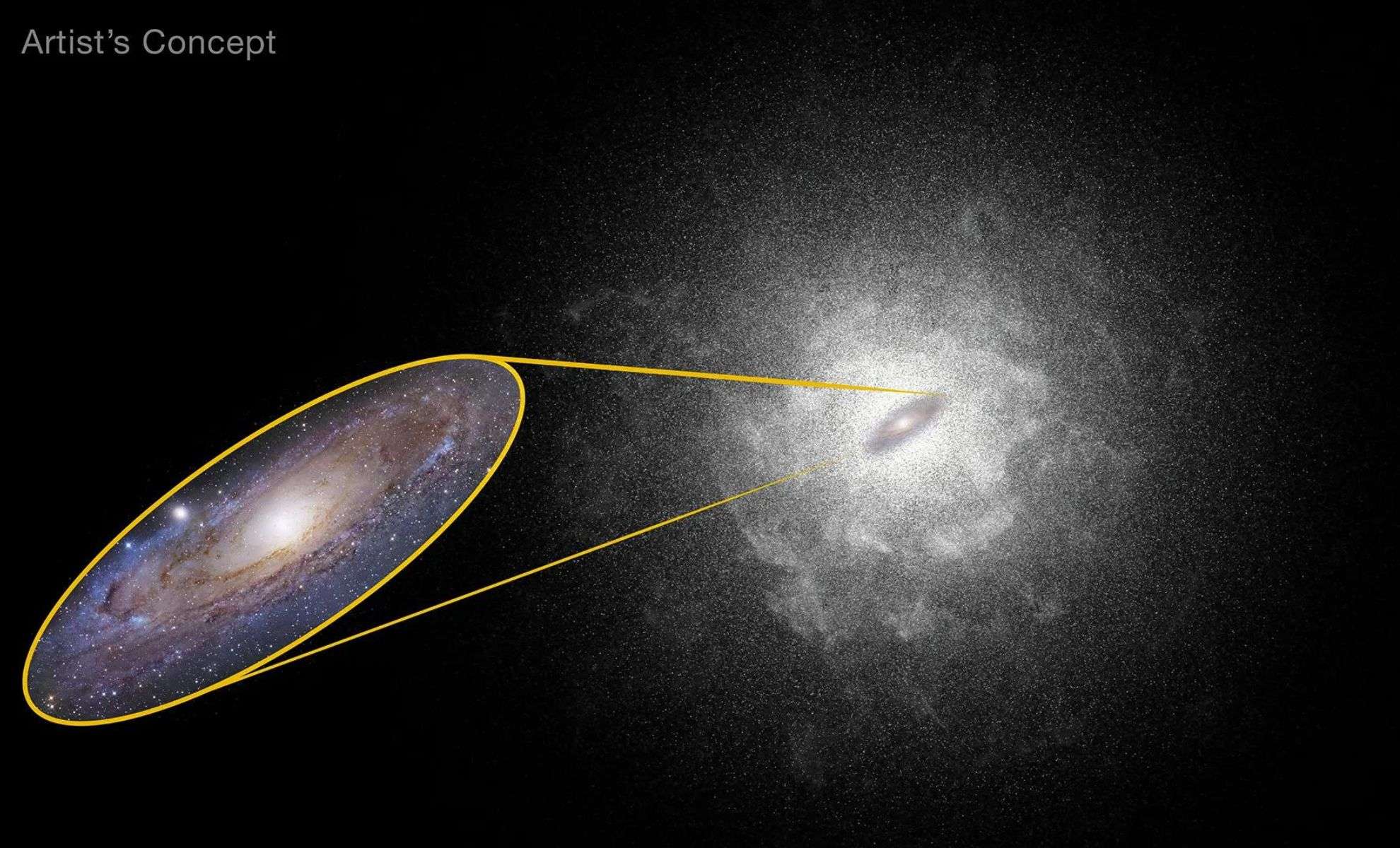
NASA’s Nancy Grace Roman Space Telescope is gearing up to transform our understanding of galaxy formation and the enigmatic dark matter in the cosmos.
Planned for deployment in 2027, the Roman Telescope will probe the Milky Way and neighboring galaxies, equipping astronomers with cutting-edge tools to dissect the origins and evolutionary pathways of these vast cosmic entities.
Its sophisticated instruments are anticipated to uncover fresh evidence about ancient galactic remnants—stellar leftovers that archive a galaxy’s developmental timeline—and bring new clarity to the elusive dark matter that constitutes the bulk of the universe’s mass.

Tracing Ancient Galactic Remnants with Roman
A key mission for the Roman Space Telescope involves studying ancient galactic remnants, collections of old stars that offer essential insights into the birth and growth of galaxies. These remnants include expansive formations such as tidal streams, star trails, and halo stars that extend far outside visible galactic borders. By capturing sharp, detailed images of these structures, the Roman Telescope will allow researchers to piece together the complex history of galactic formation over billions of years.
Robyn Sanderson, deputy principal investigator for the Roman Infrared Nearby Galaxies Survey (RINGS) at the University of Pennsylvania, compared the analysis of these galactic artifacts to archaeological digs. “It’s like going through an excavation and trying to sort out bones and put them back together,” Sanderson commented. The Roman Telescope’s capability for wide, high-resolution sky surveys will enable scientists to assemble these clues and gain a clearer view of how galaxies similar to the Milky Way formed and changed.
Deciphering our galaxy’s past is complicated by our embedded vantage point within it. According to Professor Raja GuhaThakurta from UC Santa Cruz, “We simply don’t have a selfie stick long enough to take those kinds of photos.” The Roman Telescope will provide an extraordinary viewpoint by observing galaxies akin to the Milky Way from an external perspective. By making these comparisons, astronomers can better understand the forces that shaped our home galaxy, offering a more complete cosmic context.
Illuminating the Mystery of Dark Matter
Alongside exploring galactic remnants, the Roman Space Telescope will be instrumental in unlocking the secrets of dark matter, an invisible component that makes up roughly 80% of the universe’s mass but cannot be detected by ordinary light-based methods. Dark matter is believed to exert the gravitational pull needed to hold galaxies together, yet it neither absorbs nor emits light, rendering it unseen by traditional telescopes.
The RINGS survey is a prospective Roman project that targets the halos enveloping galaxies—massive zones dominated by dark matter. These halos reach far beyond the luminous edges of galaxies and can be 15 to 20 times larger than the galaxies themselves. By analyzing the spatial distribution of stars and material in these halos, the Roman Telescope will collect essential data for testing dark matter models and clarifying its role in galaxy development.
Ultra-faint dwarf galaxies provide a special window into dark matter studies due to their scarcity of stars and overwhelming dark matter content. GuhaThakurta noted, “Ultra-faint dwarf galaxies are so dark matter-dominated that they have very little normal matter for star formation. Even when they do form stars, the process will blow away more of the gas needed to create the next generation of stars, so they are deeply inefficient at producing stars.” These galaxies thus serve as nearly pure dark matter laboratories, offering invaluable insight into this mysterious substance.
By delivering high-resolution images of these dim galaxies and their encompassing halos, the Roman Telescope will enable researchers to observe dark matter’s influence on a scale far grander than currently feasible. As Ben Williams, principal investigator for RINGS at the University of Washington, remarked, “With Roman, all of a sudden we’ll have 100 or more of these fully resolved galaxies,” vastly increasing the window for dark matter exploration.
Heralding a New Chapter in Cosmic Discovery
The Nancy Grace Roman Space Telescope marks a major advancement in astronomical research. Often called the Hubble Telescope’s spiritual successor due to its enhanced capabilities, Roman is expected to transform the study of both luminous and invisible galactic components. Featuring a wide field of view and exceptional resolution, it will empower astronomers to analyze not only individual stars and their groups but also the large-scale formations that guide galactic evolution.
When combined with deep, extensive spectroscopic data from Earth-based observatories like the Keck II 10-meter telescope and the DEIMOS spectrograph, Roman’s imaging will support sophisticated methods such as co-added surface brightness fluctuations (SBF) spectroscopy. This technique, co-developed by GuhaThakurta, promises to deepen our grasp of how galaxies—ranging from those similar to the Milky Way to much smaller or larger ones—form and evolve.







0 comments
Sign in to Comment