
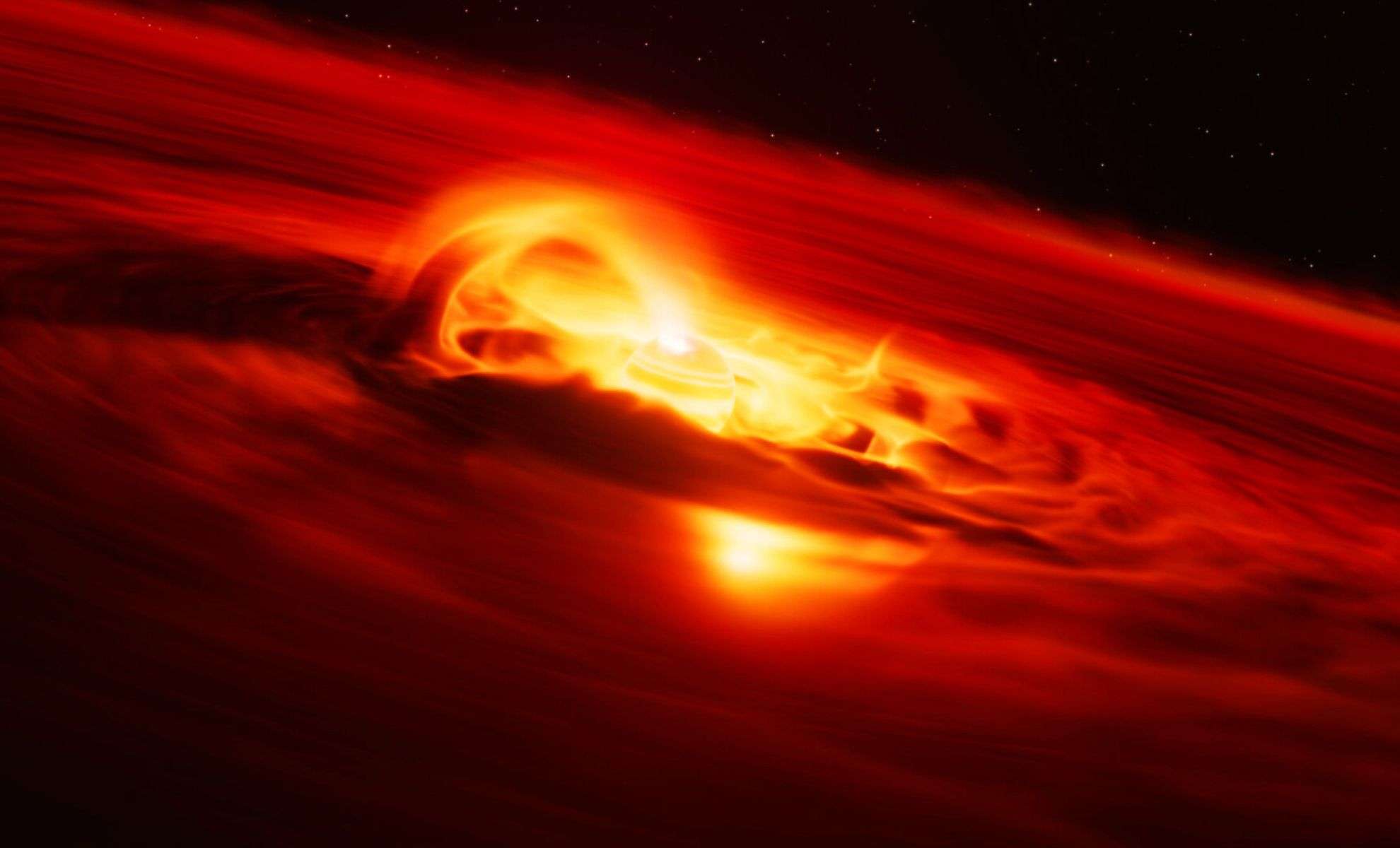
Drifting through the vast interstellar void, a rogue planet is exhibiting an extraordinary growth rate that defies standard astronomical understanding. Using the European Southern Observatory‘s Very Large Telescope (VLT), researchers have documented the object, named Cha 1107-7626, absorbing gas and dust from its environment at an astounding rate of six billion tonnes per second.
The study, featured in The Astrophysical Journal Letters, has taken the scientific community by surprise. Cha 1107-7626 is not tethered to any star, wandering the galaxy independently, yet it displays accretion dynamics and luminous outbursts typically attributed to young stellar objects.
“This is the strongest accretion episode ever recorded for a planetary-mass object,” said Víctor Almendros-Abad, lead author of the study and astronomer at the INAF Observatory of Palermo. “It blurs the very definition of what a planet is.”
Add Cosmo Herald as a Preferred Source

A Solitary World with an Unprecedented Hunger
Identified in 2008 within the Chamaeleon I star-forming complex about 620 light-years from Earth, Cha 1107-7626 was initially hypothesized to be a brown dwarf or a star still in formation. Its mass, estimated between five and ten times that of Jupiter, falls below the accepted mass requirements for stars or brown dwarfs, which require at least 80 and 13 Jupiter masses, respectively, to sustain fusion or deuterium burning.
Despite its size, Cha 1107-7626 is actively undergoing accretion, a hallmark of stellar birth, by drawing in matter from a circumstellar disc. An intense brightening event observed in 2025 by Almendros-Abad's team highlighted this unusual behavior.
An ESO press release notes that the brightness surge resembles the EXor bursts characteristic of young stars—short, intense accretion flares. Historical data indicate the planet experienced a similar episode in 2016, suggesting a repetitive accretion cycle akin to stellar processes.
Planetary Accretion Mirroring Stellar Phenomena
Employing the VLT’s X-shooter spectrograph, scientists observed an eightfold increase in the accretion activity of Cha 1107-7626 between early and mid-2025. At its maximum accretion, this object absorbed more material than any recorded planetary-mass entity.
Spectral data identified the presence of silicate and hydrocarbon compounds within its disc, aligning with materials typically found around young stars. Additionally, the detection of water vapor during the outburst marks the first time such a stellar accretion signature has been observed in a planetary-mass object.
“It’s as if this object didn’t get the memo that it’s supposed to be a planet,” remarked Dr. Belinda Damian, co-author from the University of St Andrews. “It’s acting like a young star in every observable way, just… smaller.”
Reevaluating Origins of Free-Floating Planets
The study reignites discussions about the formation mechanisms of free-floating planetary-mass objects (FFPMOs) such as Cha 1107-7626. Key questions include whether these bodies are failed stars or ejected planets from nascent solar systems.
Co-author Aleks Scholz from St Andrews supports the idea that the planet formed independently, much like a star, rather than being expelled from a planetary system. “This object appears to have formed in isolation, like a star, not been kicked out from a planetary system,” Scholz stated in the ESO report.
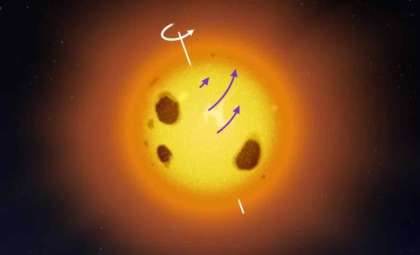
Magnetic fields were also detected influencing the accretion process, drawing further parallels with traditional star formation. The accretion events temporarily changed the disc's chemical composition, underscoring how closely planetary-mass bodies can resemble stars during their formation.
Advancing the Frontier of Astronomical Research
This discovery exemplifies the progress in observational astronomy and the potential for future explorations. Though rogue planets are difficult to spot due to their faintness, upcoming instruments like the Extremely Large Telescope (ELT) promise to enhance detection capabilities during early formation stages.
By integrating high-resolution observations from the VLT, NASA’s James Webb Space Telescope, and previous data gathered by SINFONI, astronomers have effectively captured Cha 1107-7626 in the midst of its growth. This finding highlights that cosmic categories remain fluid, with the distinctions among planets, brown dwarfs, and stars still being refined — one rogue planet at a time.
- Categories:
- Space








0 comments
Sign in to Comment