
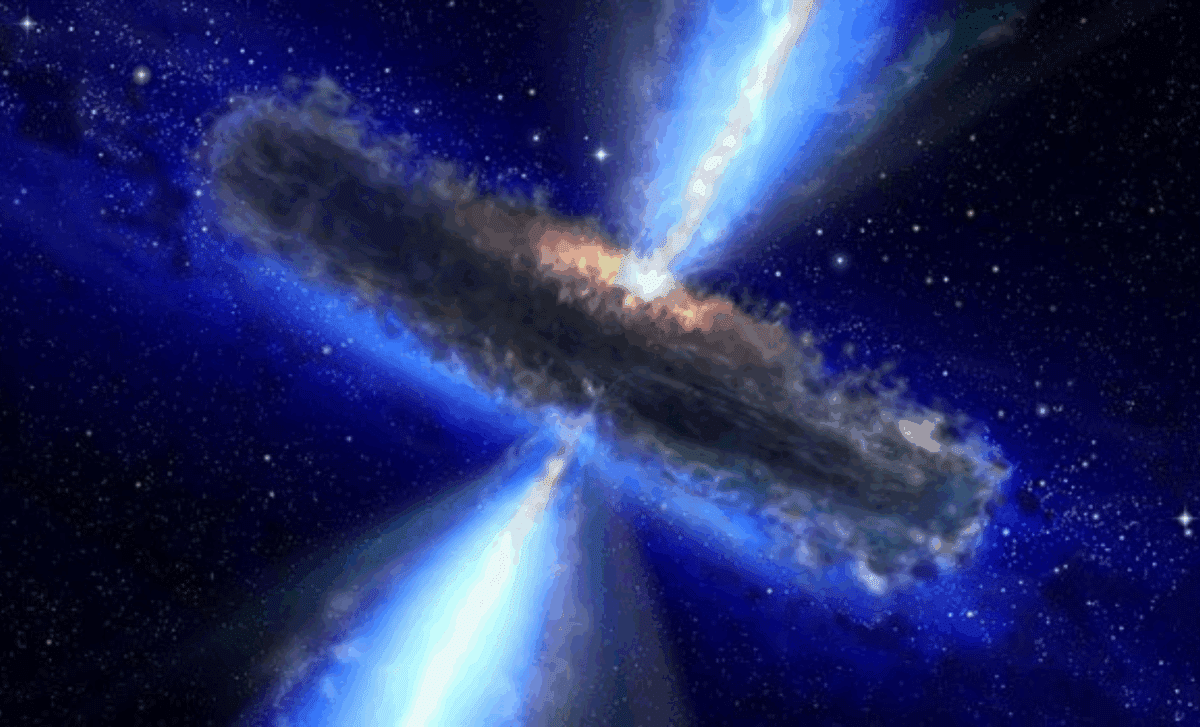
Astronomers have identified the most extensive and farthest water vapor reservoir ever recorded, encircling a quasar situated over 12 billion light-years away. This remarkable discovery extends the timeline of water’s presence in the cosmos, revealing that vast quantities of water existed when the universe was still in its formative years. Utilizing observations from some of the most advanced telescopes globally, scientists tracked this colossal vapor cloud to a celestial body formed during the universe’s early stages, revolutionizing our understanding of galactic chemistry and cosmic development.
An Enormous Water Reservoir in the Distant Universe
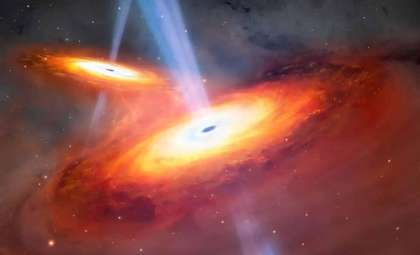
Within a distant quasar—a luminous, energetic center of a youthful galaxy powered by a supermassive black hole—scientists have found an astonishing reservoir of water vapor holding 140 trillion times the water volume contained in all Earth’s oceans. Documented in The Astrophysical Journal Letters and described on NASA’s Jet Propulsion Laboratory website, this evidence confirms that substantial amounts of water were present when the cosmos was less than 1.6 billion years old.
"The region surrounding this quasar is unique due to the enormous quantity of water it produces," explained Matt Bradford, a researcher at NASA’s Jet Propulsion Laboratory and the lead scientist of one of the teams involved. "This finding further demonstrates that water is a widespread component throughout the universe, even during its earliest periods."

The quasar dubbed APM 08279+5255 emits energy equivalent to a thousand trillion Suns. Surrounding its supermassive black hole is an expansive gaseous cloud rich in water vapor, spanning several hundred light-years. This breakthrough was achieved using the Combined Array for Research in Millimeter-wave Astronomy (CARMA) and the Plateau de Bure Interferometer located in the French Alps, both instruments specialized in detecting weak radio and submillimeter signals from deep space.
Reevaluating Cosmic History Through Water’s Early Existence
Finding such an immense water supply at a distant era challenges previous ideas about when complex molecules first formed after the Big Bang. Formerly, it was thought that water and molecules like carbon monoxide could not build up substantially until much later. These results indicate that massive galaxies and supermassive black holes had already reached advanced chemical maturity, enabling the formation and preservation of molecular compounds critical to stars and planets.
This research enhances our comprehension of matter cycling within galaxies. The intense radiation from the quasar heats nearby gas and dust, fostering chemical reactions that generate water molecules, which contribute to star-forming processes. The link between black hole dynamics and molecular material offers a new perspective on how galaxies develop from their earliest configurations to the complex systems we observe today.
Bradford and colleagues note that while these environments may seem infrequent, their actual prevalence could be higher than assumed. The sheer magnitude of this aquatic cosmic cloud implies that water—essential for life—was widespread, not confined to the Milky Way or adjacent galaxies, but dispersed throughout the early universe.
Future Prospects for Investigating Cosmic Water
This landmark discovery alters perspectives on water’s distribution in space and informs the design of upcoming observational missions. Facilities such as ALMA (Atacama Large Millimeter/submillimeter Array) and the JWST (James Webb Space Telescope) can now target similar reservoirs from even earlier epochs. Charting these water-rich zones may pinpoint regions where planetary systems capable of sustaining life can arise.
The detection of such an enormous water vapor supply also highlights the significance of collaborative efforts among multiple observatories. It required the precise measurements from several telescopes operating worldwide to extract faint signals from this quasar, obscured by billions of years of cosmic expansion. Each new observation enriches our knowledge of the early universe and reinforces that the essential components for life are embedded in its very fabric.
- Categories:
- Space

0 comments
Sign in to Comment