

Artificial intelligence is dramatically reshaping the workforce, yet even Bill Gates acknowledges the pace of change is unpredictable. In a recent CNN interview, the Microsoft cofounder cautioned that rapid AI advancement could lead to the disappearance of entire job sectors before people have time to adapt.
“It’s evolving faster than I expected,” Gates revealed, noting how he frequently challenges AI with complex problems and is often surprised by the detailed responses. This concern is echoed by other industry leaders. Anthropic CEO Dario Amodei has forecasted that up to 50% of entry-level white-collar jobs might vanish within the next five years.
Companies like Meta, under Mark Zuckerberg, are already integrating AI engineers. Earlier this year, IBM eliminated 8,000 HR positions due to automation. Despite these shifts, Gates identifies three fields likely to remain resilient.

The Unsettling Speed of AI Development
Gates’ remarks come amid a rapid transformation sweeping across industries. AI has moved beyond experimentation to actively crafting emails, coding, and handling customer interactions at scale. Amazon’s CEO Andy Jassy has predicted that some corporate units, including software teams, will downsize due to AI.
What troubles Gates is not only what AI has accomplished but what lies ahead. He asked, “Has it accelerated so quickly that society can’t keep up?” and increasingly, the answer appears affirmative.
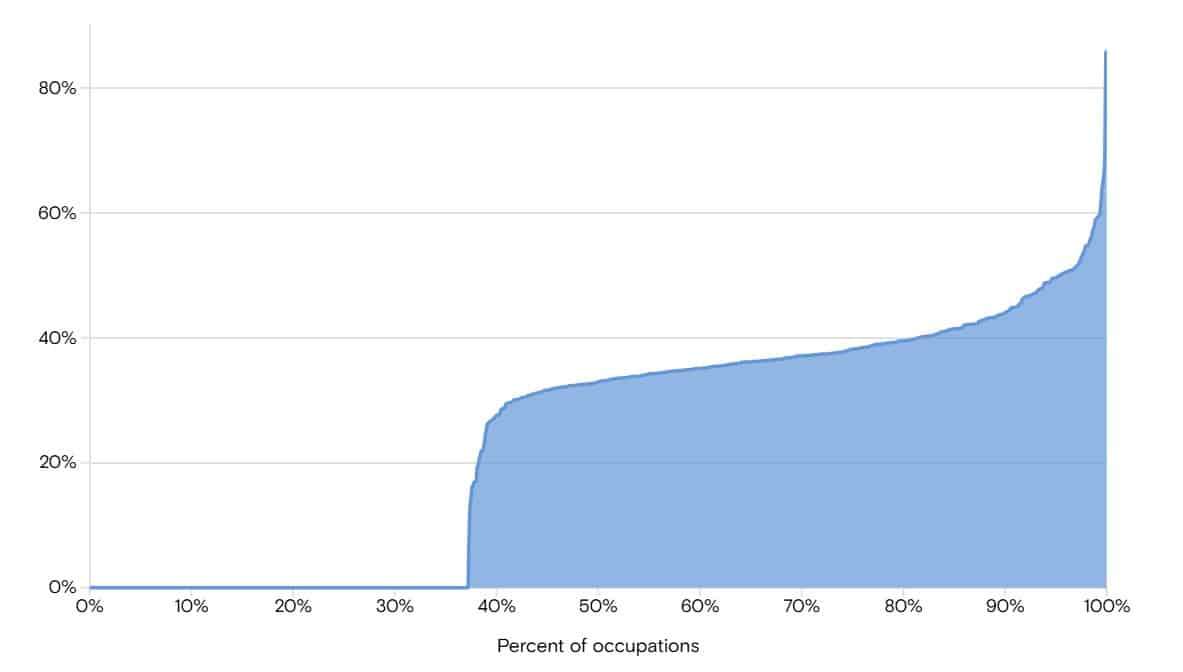
Research from Goldman Sachs indicates that AI has the potential to replace workloads equating to 300 million full-time jobs worldwide. Positions involving repetitive or routine tasks—such as telesales, data input, or administrative roles—are among the first to be impacted.
Experts remain divided about when AI might match human capabilities, with estimates ranging from a couple of years to a decade. The rapid evolution of generative AI platforms such as Claude, GPT-4, and Gemini further fuels this uncertainty, showcasing significant advancements in reasoning and task completion.
Three Professions That Could Remain AI-Resistant
What does this mean for the average worker? Gates identifies three career paths that may hold firm in the near future.
First are software engineers. Even though AI can assist in coding and debugging, it falls short of being fully accountable. Gates emphasizes that human developers are still indispensable for designing critical systems, overseeing algorithms, and fine-tuning AI models. Simply put, AI continues to rely on human expertise for creation and correction.
Second, professionals in the energy industry appear safeguarded. The intricate safety protocols and complex operations of nuclear plants and renewable energy grids make it unlikely for AI to assume full control. Gates poses a provocative question: “Would you leave a national power grid entirely in AI's hands without human oversight?” Currently, few would feel comfortable doing so.
Lastly, biologists are positioned to retain relevance—though with an important note. While AI swiftly analyzes genomes and detects medical patterns, breakthrough research still demands human intuition, creativity, and scientific inquiry. Funding constraints in biology persist, and AI cannot substitute for genuine curiosity and investigative spirit. According to Gates, these uniquely human traits continue to drive progress in the life sciences.

The Future of Work Hours: Could a Shorter Week Become the Norm?
Among Gates’ more striking forecasts is the potential end of the traditional40-hour workweek. AI could enable a move toward three-day workweeks, offering people more time for leisure, family, or alternate careers. As he explained to CNN, "Greater productivity lets us reduce workloads, leading to smaller class sizes, extended vacations, or pursuing other interests."
Yet, the optimistic scenario is counterbalanced by concerns for workers displaced by automation. Entry-level jobs, which often serve as stepping stones to career advancement, are disappearing first. This development creates a bottleneck, making upward mobility far more challenging.
A 2025 report from McKinsey & Company revealed that 42% of Gen Z graduates feel AI has already diminished their employment opportunities. Companies are investing heavily in AI-oriented roles while simultaneously cutting traditional graduate job offerings.
Uncertainty Looms: The Unpredictable Trajectory of AI’s Impact
Despite numerous projections, the ultimate impact of AI remains an open question. Some analysts predict the emergence of general AI—technology with human-like cognition—by decade’s end, while others view such claims as overly optimistic.
Gates acknowledges his own predictions might miss the mark. His primary concern centers on the rapidity of AI’s evolution rather than the fact that it will affect jobs. In a future where key skills from 2023 may become obsolete by 2026, this accelerated timeline could leave even prepared workers struggling to keep pace.
For now, if you don’t work in coding, energy, or biology, it’s wise to plan ahead.











0 comments
Sign in to Comment